AEO vs SEO: What's the Difference in the AI Search Era?
How AEO and SEO differ, And how to build a strategy that covers both traditional and AI-driven search.
Learn the key differences between AEO and SEO, how AI search engines rank content, and how to optimize your strategy for both traditional and AI search.
Search has changed. Not in a small, incremental way — but in a fundamental, structural shift that's rewriting how people find information online.
For over two decades, SEO was the playbook. You picked your keywords, built backlinks, optimized your pages, and earned your spot on page one. That formula worked because Google served a list of links, and users clicked through to find answers.
That's no longer the full picture. Today, platforms like ChatGPT, Google AI Overviews, Perplexity, and Gemini don't just point people toward answers — they provide them directly. Users ask a question and get a synthesized response, often without ever clicking a link. According to recent data, roughly 60% of traditional searches now end without a click. In Google's AI Mode, that number jumps to 93%.
This shift has given rise to Answer Engine Optimization (AEO) — a discipline focused on getting your content cited and referenced inside AI-generated answers. And it raises a critical question for every marketer and business owner: What's the difference between AEO and SEO, and how should you approach both?
This guide breaks down the AEO vs SEO comparison in detail. You'll understand how each works, where they overlap, and how to build a strategy that covers traditional search and AI-driven discovery.
What Is SEO?
Search Engine Optimization (SEO) is the practice of improving your website's visibility in organic search engine results. The goal is straightforward: rank higher on Google (and other search engines) so more people find and visit your site.
SEO has been around since the mid-1990s and has evolved significantly. But at its core, the mechanics remain consistent. Search engines crawl your website, index your pages, and use ranking algorithms to determine where your content appears for relevant queries.
How SEO Works
SEO operates across three main areas:
On-page SEO focuses on your content and HTML elements. This includes keyword placement in titles, headings, and body copy, along with meta descriptions, image alt text, and internal linking structures.
Off-page SEO revolves around external signals, primarily backlinks. When other reputable sites link to your content, search engines interpret that as a vote of confidence, boosting your authority and rankings.
Technical SEO deals with the backend of your website — site speed, mobile responsiveness, crawlability, structured data, and URL architecture.
When done well, SEO drives consistent organic traffic. It's a proven, long-term strategy that still matters — a lot. But it was designed for an ecosystem where users scroll through a list of links and choose which one to click. That ecosystem is shrinking.
What Is Answer Engine Optimization (AEO)?
Answer Engine Optimization (AEO) is the practice of structuring and optimizing your content so that AI-powered platforms can easily extract, understand, and cite it when generating answers to user queries.
Where SEO is about ranking in a list of links, AEO is about becoming the source that AI systems pull from when they generate direct responses. Think of it this way: SEO gets you on the page. AEO gets you inside the answer.
AEO matters because the platforms people use are changing. ChatGPT now serves over 800 million users weekly. Google AI Overviews reach more than a billion people monthly. Perplexity processes millions of queries every day. These platforms don't present ten blue links. They synthesize information from multiple sources into a single, cohesive answer — and they cite the sources they trust most.
AEO requires a shift in how you think about content. Instead of optimizing for keyword rankings and click-through rates, you're optimizing for:
Citability — Can an AI system easily extract a clear, accurate answer from your content?
Authority signals — Does your content demonstrate expertise, include credible sources, and carry trust indicators?
Structural clarity — Is your content organized with clear headings, direct definitions, and question-answer formats that AI systems can parse?
Entity optimization — Does your content clearly define and connect relevant entities (people, brands, concepts) that AI knowledge graphs rely on?
AEO doesn't replace SEO. It builds on top of it. But the intent and the execution are different enough to warrant its own strategy.
How AI Search Engines Work
To understand the AEO vs SEO difference, it helps to know how AI search engines actually generate their responses.
Traditional search engines use crawlers to index web pages, then rank those pages based on hundreds of signals — relevance, authority, user experience, and more. The output is a ranked list of links.
AI answer engines work differently. They use large language models (LLMs) that process natural language queries, search the web or their training data for relevant information, and then synthesize a response. The output isn't a list — it's an answer.
The AI Answer Generation Process
Here's what happens when someone asks an AI platform a question:
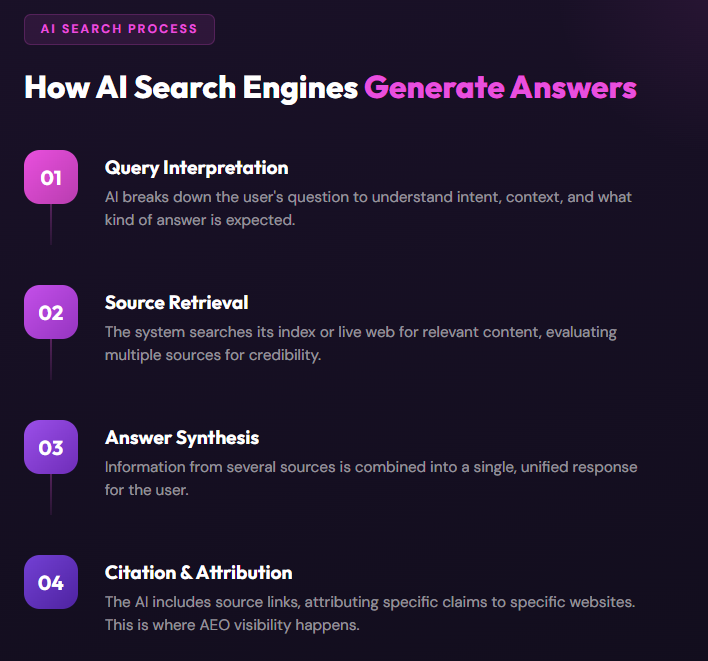
Query interpretation — The AI breaks down the user's question to understand intent, context, and what kind of answer is expected.
Source retrieval — The system searches its index (or the live web) for content that matches the query. It evaluates multiple sources for relevance, accuracy, and credibility.
Synthesis — Rather than pointing to a single page, the AI pulls information from several sources and combines them into a unified answer.
Citation — Many AI platforms now include citations or source links, attributing specific claims to specific websites. This is where AEO visibility happens.
The key difference: traditional search ranks content. AI search selects and cites content. Your page doesn't need to be #1 on Google to be the source an AI pulls from — but it does need to be clear, accurate, authoritative, and structured in a way the AI can understand.
Research from Ahrefs found that ChatGPT frequently cites pages that rank beyond position 20 in traditional search. That means AEO opens visibility opportunities that traditional SEO alone doesn't provide.
AEO vs SEO: Key Differences
Understanding the difference between AEO and SEO comes down to what each strategy optimizes for and how success is measured.
Side-by-Side Comparison
FactorSEOAEOPrimary GoalRank in search engine results pagesGet cited in AI-generated answersContent FormatKeyword-optimized long-form contentStructured, citation-ready content with direct answersUser IntentNavigational, informational, transactionalConversational, question-based queriesKey Ranking SignalsBacklinks, keyword relevance, technical healthAuthority, accuracy, content structure, entity clarityTraffic ModelClick-through from search resultsBrand visibility through AI citations and mentionsSuccess MetricsRankings, organic traffic, CTRAI citations, brand mentions, citation trafficContent StructureHeaders, keywords, meta tagsQuestion-answer format, structured data, clear definitionsPlatform FocusGoogle, Bing, YahooChatGPT, Perplexity, Gemini, Google AI Overviews
The Biggest Shift
The core difference between AEO and SEO is this: SEO focuses on getting your page in front of users. AEO focuses on getting your information into the answer users receive.
With SEO, success means your link appears. With AEO, success means your content is the source the AI trusts enough to reference. That's a fundamentally different game, and it requires different tactics.
That said, the two aren't opposed. Strong SEO still feeds AEO visibility — AI platforms often rely on search indexes to find sources. Content that ranks well and is well-structured has an advantage in both worlds.
Why AEO Is Becoming Essential in the AI Search Era
The shift toward AI-powered answers isn't a trend that might happen. It's happening now, and the data makes that clear.
Gartner projects that traditional search engine volume will drop 25% by 2026 as users shift to AI chatbots and virtual assistants. Google's own AI Overviews now appear in roughly 25% of all searches. And when AI Overviews are present, click-through rates drop significantly — by about 58% for the top-ranking page, according to Ahrefs' February 2026 analysis.
Meanwhile, AI referral traffic is growing fast. Data from 2025 shows AI platforms generated over a billion referral visits in a single month, representing a 357% year-over-year increase. And that traffic converts better — AI search visitors convert at roughly 5x the rate of traditional organic search visitors.
What This Means for Businesses
If your content isn't structured for AI citation, you're not just missing a new channel — you're losing ground on a channel that's quickly becoming the first touchpoint in the buyer journey.
Consider this scenario: A SaaS buyer asks ChatGPT, "What's the best project management tool for remote teams?" The AI synthesizes an answer from multiple sources, names specific tools, and cites the sources it pulled from. If your brand isn't in that answer, you don't exist in that moment — regardless of where you rank on Google.
AEO isn't replacing SEO. But it's becoming an essential companion strategy. The businesses that invest in AEO now are building compounding advantages — because AI systems learn which sources to rely on over time.
Key Ranking Factors for SEO vs AEO
The signals that determine visibility are different for SEO and AEO — though there's meaningful overlap.
SEO Ranking Factors
Traditional search engines rely on well-documented ranking factors:
Backlinks remain a primary authority signal. Quality and relevance of linking domains matter more than raw quantity.
Keyword relevance — content must match the searcher's query in both topic and intent.
Technical health — fast load times, mobile optimization, secure connections, and clean site architecture.
User engagement — metrics like bounce rate, dwell time, and click-through rate influence rankings.
Content depth — comprehensive coverage of a topic signals expertise and relevance.
AEO Ranking Factors
AI answer engines evaluate content differently. While there's no published algorithm, research and testing reveal several consistent patterns:
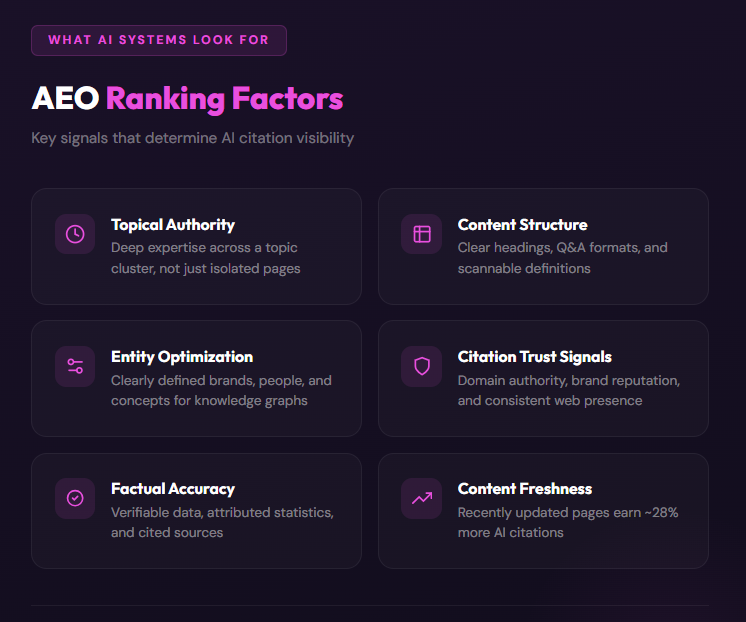
Topical authority — AI platforms favor content from sources that demonstrate deep expertise across a topic cluster, not just isolated pages.
Content structure — Clear headings, question-answer formats, bullet points, and definitions make it easier for AI to extract relevant information.
Entity optimization — AI systems rely on knowledge graphs. Content that clearly defines entities (brands, people, concepts) and their relationships gets referenced more often.
Factual accuracy with sources — Content that includes verifiable data, statistics with attribution, and cited sources builds credibility with AI systems.
Citation trust signals — Domain authority, brand reputation across the web, and consistent information across platforms all influence whether an AI trusts your content enough to cite it.
Freshness — Pages updated within the last two months earn roughly 28% more AI citations than older content, according to industry research.
The takeaway: SEO rewards optimization. AEO rewards clarity, trust, and authority. Both need strong content — but AEO puts a premium on how that content is structured and whether it can serve as a reliable source.
How Businesses Can Optimize for Both SEO and AEO
You don't have to choose between SEO and AEO. The most effective strategy combines both. Here's a practical framework.
Step 1: Audit Your Current Content
Start by assessing your existing content. Which pages rank well in traditional search? Which topics align with the questions your audience asks AI platforms? Tools like Google Search Console, Ahrefs, and emerging AI visibility platforms can help map your current position.
Step 2: Restructure Content for AI Readability
For each high-priority page, make structural improvements:
Add question-based headings (H2s and H3s) that mirror how people phrase queries
Include direct, concise definitions in the first paragraph of each section
Use bullet points and comparison tables for scannable information
Add FAQ sections with clear, 2-3 sentence answers
Step 3: Build Topical Authority
AI systems favor sources that demonstrate expertise across a subject area. Create content clusters — a pillar page supported by related articles that cover subtopics in depth. Internal linking between these pages strengthens both your SEO and AEO signals.
Step 4: Implement Structured Data
Use Schema.org markup to help both search engines and AI systems understand your content. FAQ schema, How-To schema, Article schema, and Organization schema all provide structured signals that improve discoverability.
Step 5: Strengthen Entity Presence
Make sure your brand, key people, and products are consistently represented across the web — on your website, in business listings, on social profiles, and in third-party mentions. AI systems cross-reference entity information from multiple sources.
Step 6: Track AI Visibility
Traditional SEO metrics don't capture AEO performance. Add AI-specific tracking to your workflow: monitor brand mentions across AI platforms, track citation frequency, and measure referral traffic from AI sources using custom channel groups in your analytics.
Step 7: Get Expert Support
AEO is a rapidly evolving discipline, and the tactics that work today may shift as AI platforms update their systems. Working with specialists who focus on AI search optimization and citation strategies can accelerate your results and keep your strategy current.
Examples of Businesses Winning with AEO
The businesses seeing results from AEO share a few common traits: they create structured, authoritative content, they maintain consistent entity presence, and they focus on being the most reliable answer — not just the highest-ranking page.
SaaS Companies Leading in AI Citations
Several SaaS brands have gained significant visibility in AI answers by creating comprehensive comparison content and detailed guides. When someone asks ChatGPT or Perplexity about tools in their category, these brands consistently appear as cited sources — not because they gamed an algorithm, but because their content is structured, accurate, and authoritative.
Companies like NerdWallet have maintained revenue growth despite traffic decreases by focusing on providing expert answers across multiple platforms. Their content is designed to be the definitive source on financial topics, which makes it natural citation material for AI systems.
Local Businesses and Voice Search
Local businesses are seeing wins through AEO as well. Optimizing Google Business Profiles, creating voice-friendly FAQ content, and maintaining accurate business listings across directories helps businesses appear in AI-generated answers for local queries. When someone asks an AI assistant "What's the best Italian restaurant near me?" the businesses with clear, structured, and consistent information across platforms are the ones getting recommended.
Agencies Driving AI Visibility
A growing number of agencies are building specialized AEO practices. For a look at who's leading this space, this roundup of top AEO agencies provides a useful overview of firms that are specifically focused on AI search visibility.
Common Mistakes Businesses Make When Transitioning from SEO to AEO
Moving from an SEO-only approach to a combined SEO + AEO strategy isn't always smooth. Here are the most common pitfalls.
Treating AEO as a Separate Channel
AEO doesn't exist in isolation. It builds on the same foundation as SEO — quality content, technical health, and authority. Businesses that try to "do AEO" without a solid SEO base often struggle because their content isn't indexed or authoritative enough for AI systems to find and trust.
Ignoring Content Structure
Many businesses have great content that's poorly structured for AI extraction. Long, unbroken paragraphs without clear headings, definitions, or question-answer formats make it hard for AI systems to identify and pull relevant information. Restructuring existing content is often the fastest AEO win.
Focusing Only on Keywords
SEO trained us to think in keywords. AEO requires thinking in questions, entities, and topics. If your content strategy still starts and ends with keyword research, you're missing the broader picture of how AI systems evaluate and select sources.
Not Tracking AI Visibility
You can't improve what you don't measure. Many businesses have no idea whether their content is being cited by AI platforms because they haven't set up tracking. AI visibility tools like Profound, Peec AI, and OmniSEO are emerging to fill this gap, and they should be part of your measurement stack.
Chasing Shortcuts
Just like SEO, there are no sustainable shortcuts in AEO. Tactics like stuffing content with AI-targeted phrases or creating thin, keyword-focused pages won't build the kind of authority that earns AI citations. The winning approach is the same one that's always worked: create the most helpful, accurate, and well-organized content for your audience.
Neglecting Brand Signals
AI systems don't just evaluate individual pages — they evaluate sources. If your brand has inconsistent information across the web, weak E-E-A-T signals, or a thin presence on third-party platforms, AI systems are less likely to trust and cite your content. Brand building matters for AEO just as much as content creation.
The Future of Search: SEO + AEO Together
The question isn't whether AEO will replace SEO. It won't. The answer is that both disciplines are converging into a unified approach to search visibility.
Traditional search isn't going away. People still use Google, still click links, and still navigate to websites. But the share of queries that generate clicks is shrinking, and the share that gets answered by AI is growing. Businesses need to be visible in both environments.
What a Combined Strategy Looks Like
A future-proof search strategy operates on two tracks:
Track 1: SEO ensures your content is indexed, technically sound, and competitive in traditional rankings. This feeds into AEO because AI platforms often rely on search indexes as their source pool.
Track 2: AEO ensures your content is structured, authoritative, and citation-ready — so when AI platforms synthesize answers, your brand is the source they reference.
These aren't competing strategies. They're complementary. Strong SEO makes your content discoverable. Strong AEO makes it selectable.
The Compounding Effect
Businesses that invest in both SEO and AEO now will see compounding returns. AI systems learn which sources are reliable over time. The brands that establish citation authority early will have an increasingly difficult-to-replicate advantage as AI search grows.
The GEO (Generative Engine Optimization) market was valued at $848 million in 2025 and is projected to reach $33.7 billion by 2034. That growth trajectory tells you everything about where the industry is heading.
The Bottom Line
Search is evolving from a traffic game to a visibility game. The businesses that adapt — by combining proven SEO fundamentals with emerging AEO tactics — will own both the links and the answers. The ones that don't will gradually become invisible in the places where their customers are making decisions.
Frequently Asked Questions
What is the difference between AEO and SEO?
SEO focuses on ranking your website in search engine results pages to earn clicks. AEO focuses on optimizing your content so AI platforms like ChatGPT, Perplexity, and Google AI Overviews cite it when generating direct answers. Both aim for visibility, but through different mechanisms.
Will AEO replace traditional SEO?
No. AEO builds on SEO rather than replacing it. AI systems often rely on search engine indexes to find sources, so strong SEO is still the foundation. AEO adds a layer of optimization that ensures your content is structured and authoritative enough to be cited by AI systems.
How do AI search engines decide which sources to cite?
AI platforms evaluate sources based on topical authority, content accuracy, structural clarity, entity presence, and trust signals. Content that includes verifiable data, clear definitions, and question-answer formats tends to get cited more frequently. Domain authority and consistent brand presence also play a role.
What is generative engine optimization?
Generative Engine Optimization (GEO) is a broader strategy that encompasses AEO. While AEO focuses on structuring individual content for AI citations, GEO addresses the full scope of brand visibility across AI-driven search — including monitoring, brand positioning, and multi-platform optimization.
How do I track whether my content is being cited by AI?
Emerging tools like Profound, Peec AI, Superlines, and OmniSEO allow you to monitor brand mentions and citations across AI platforms. You can also set up custom channel groups in Google Analytics 4 to track referral traffic from AI sources like ChatGPT and Perplexity.
Does my content need to rank #1 on Google to appear in AI answers?
Not necessarily. Research shows that AI platforms like ChatGPT frequently cite content from pages that rank beyond position 20 in traditional search. What matters more is content quality, structure, and topical authority. That said, pages that rank well in organic search do have an advantage, especially for Google AI Overviews.
What types of content perform best for AEO?
Content that uses question-based headings, includes direct definitions, provides comparison tables, and features well-organized FAQ sections tends to perform well. AI systems favor content that's structured for extraction — meaning clear, concise, and organized so specific answers can be pulled from it easily.
Is AEO only relevant for large businesses?
Not at all. AEO applies to any business that depends on organic visibility. Local businesses, SaaS companies, e-commerce stores, and service providers all benefit from structuring their content for AI citation. In many cases, smaller businesses with focused topical authority can outperform larger competitors in AI answers.
How important is structured data for AEO?
Structured data (Schema.org markup) is highly valuable for AEO. It helps both search engines and AI systems understand your content's context, relationships, and meaning. FAQ schema, How-To schema, and Article schema are particularly useful for improving AI discoverability.
What is the biggest mistake businesses make with AEO?
The most common mistake is treating AEO as completely separate from SEO. Without a strong SEO foundation — quality content, technical health, and domain authority — AEO efforts have little to build on. The other major mistake is neglecting content structure, which is the single most actionable element of AEO.
Will Abraham
Will Abraham spent five years building one of the largest PPC and SEO agencies serving real estate investors. After ChatGPT's launch in 2022, he saw the shift from traditional search to AI-driven answers coming and built Visibella to help brands become the answer AI gives, not the link buried underneath it. He stays close to active AEO researchers and the teams shaping how AI search works.