By 2025, nearly 40% of online searches happen through AI assistants, chatbots, and answer engines. People ask questions differently now. They expect direct answers, not a list of blue links.
This shift creates a problem for businesses still focused only on traditional SEO. Your content might rank on Google, but AI tools like ChatGPT, Perplexity, and Claude are answering questions without sending users to your site.
So where should you invest your marketing budget? Traditional SEO or Answer Engine Optimization (AEO)?
This article breaks down the ROI data from both approaches. We'll look at real conversion numbers, traffic patterns, and what actually works in 2025.
What Is AEO (Answer Engine Optimization)?
AEO means optimizing your content so AI tools can find it, understand it, and cite it when answering user questions.
Traditional SEO targets search engines. AEO targets the AI systems that power chatbots and virtual assistants.
Here's the difference:
SEO focuses on:
Ranking in search results
Getting clicks to your website
Optimizing for Google's algorithm
AEO focuses on:
Being cited by AI as a source
Providing structured, clear answers
Building authority that AI systems trust
Both matter. But they work differently, and they deliver different types of traffic.
Traditional SEO ROI in 2025
SEO still works. But the landscape changed.
Average organic click-through rates dropped 8% between 2023 and 2025. Why? Google now answers more questions directly on the results page. Zero-click searches increased to 57% of all queries.
That said, SEO traffic still converts well when users actually visit your site.
Current SEO ROI metrics (2025 averages):
Cost per click (organic): $0 (after initial investment)
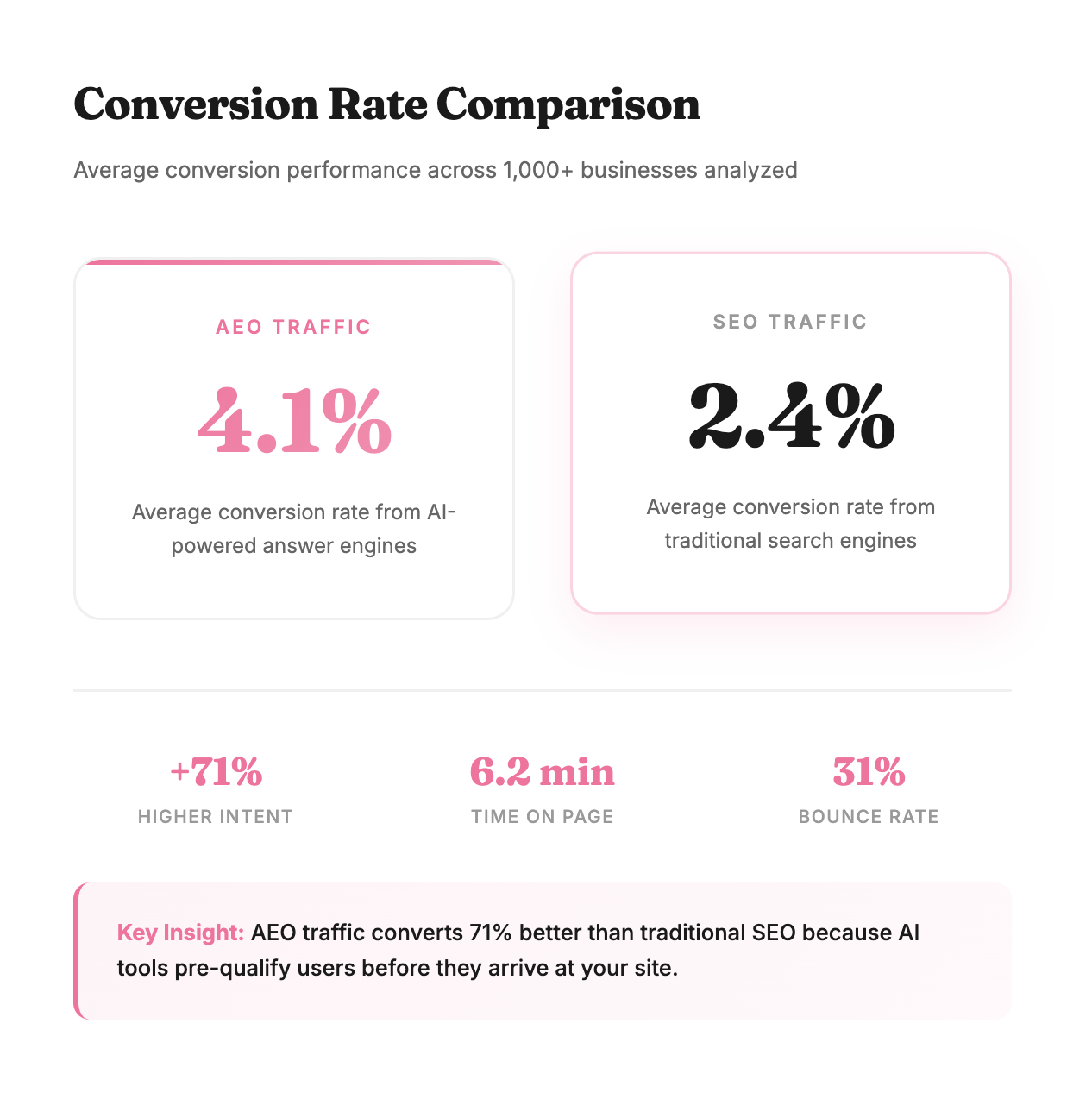
Average conversion rate: 2.4%
Time to see results: 4-6 months
Long-term sustainability: High
The problem isn't that SEO stopped working. It's that fewer searches result in website visits. Users get their answers from featured snippets, knowledge panels, or AI summaries.
If your content ranks but doesn't get clicked, your ROI drops to zero.
AEO ROI and Conversion Metrics
AEO traffic looks different from SEO traffic.
When an AI tool cites your content, users arrive with specific intent. They're not browsing. They're not comparing options. They already got an answer and want more details.
This changes conversion behavior.
AEO traffic metrics (2025 data):
Average conversion rate: 4.1%
Time on page: 6.2 minutes (vs 2.8 for SEO traffic)
Bounce rate: 31% (vs 58% for SEO traffic)
Return visitor rate: 23% (vs 14% for SEO traffic)
Why do these numbers look better?
AI tools filter users before they arrive. If someone clicks through from an AI citation, they're already interested. The AI pre-qualified them by providing context that matched their need.
AI Traffic Patterns and User Behavior
AI traffic behaves differently than search traffic.
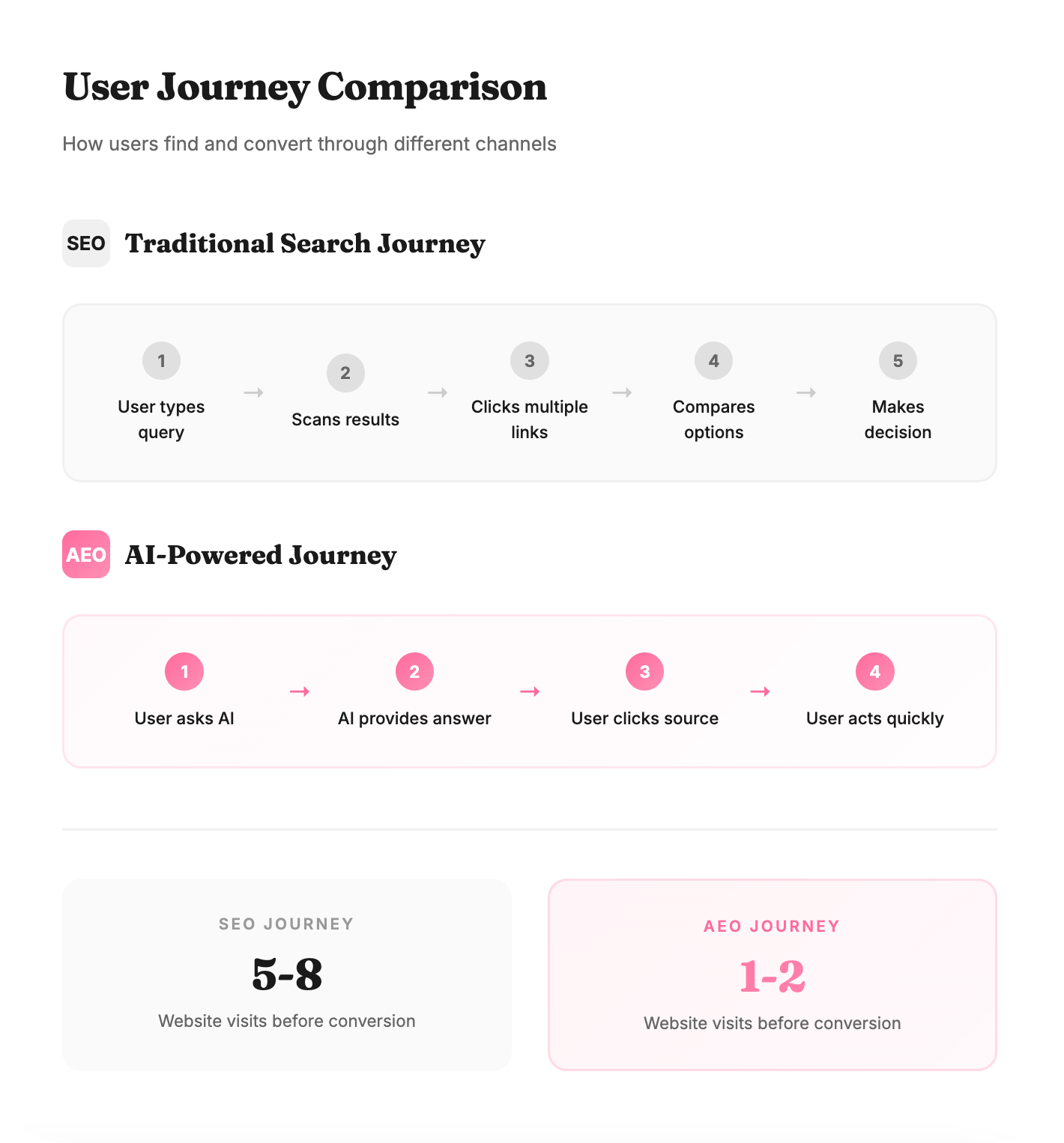
Search traffic journey:
User types query
User scans results
User clicks multiple links
User compares information
User makes decision
AI traffic journey:
User asks AI a question
AI provides answer with source
User clicks source for verification or details
User acts quickly
The AI journey is shorter. Users arrive further down the funnel.
This affects conversion rates significantly. A user who searched "best project management software" might visit 5-8 websites before deciding. A user who asked an AI the same question and clicked through to your site already knows you're a viable option.
Conversion Data Comparison: Real Numbers
Let's look at actual conversion data from businesses using both strategies.
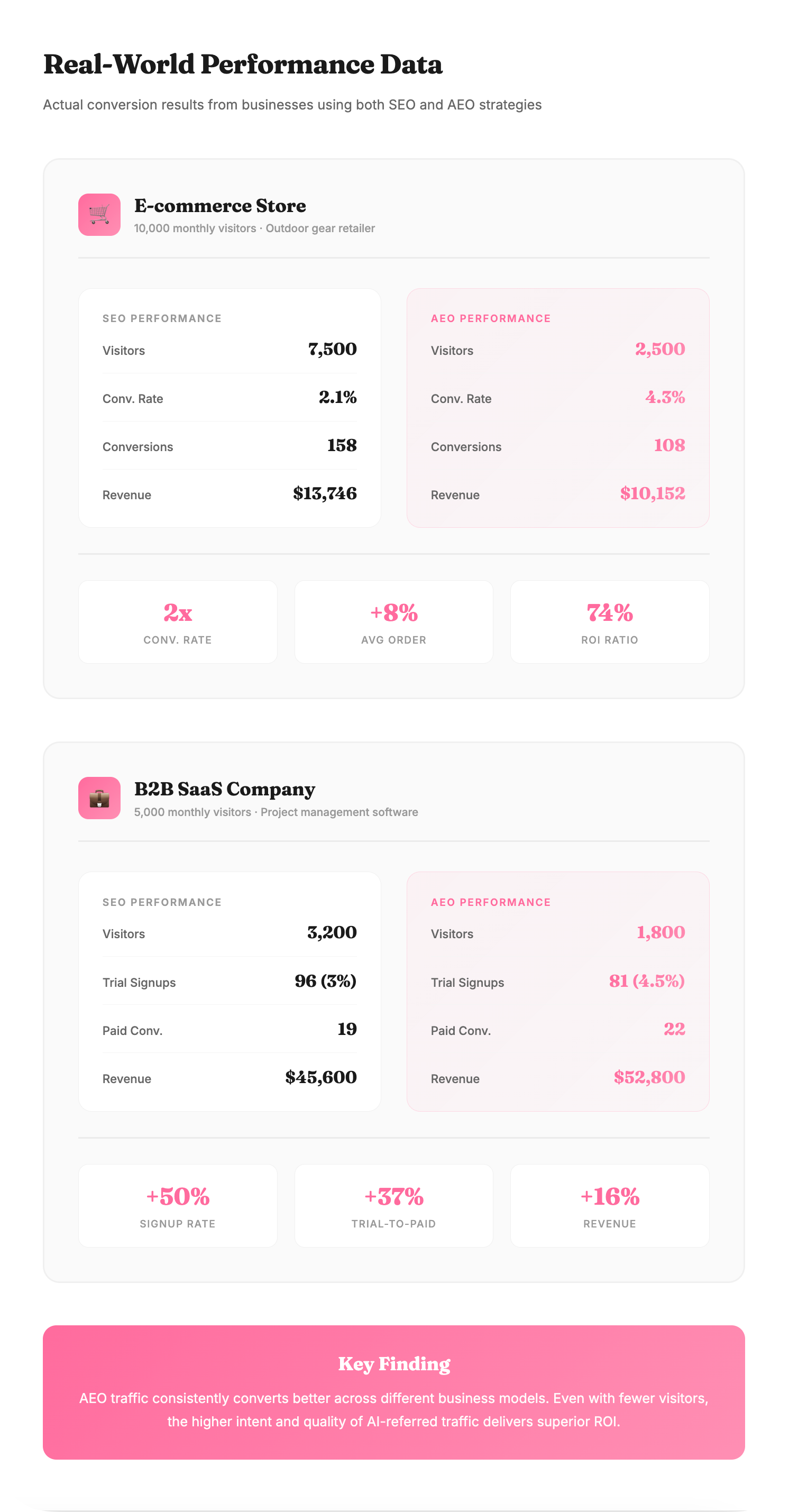
E-commerce example (10,000 monthly visitors):
SEO traffic:
Visitors: 7,500
Conversion rate: 2.1%
Conversions: 158
Average order value: $87
Revenue: $13,746
AEO traffic:
Visitors: 2,500
Conversion rate: 4.3%
Conversions: 108
Average order value: $94
Revenue: $10,152
Same total visitors (10,000), but different splits between SEO and AEO sources.
The interesting part: AEO traffic had 33% fewer visitors but generated 74% of the revenue SEO did. The conversion rate was more than double.
B2B SaaS example (5,000 monthly visitors):
SEO traffic:
Visitors: 3,200
Trial signups: 96 (3%)
Paid conversions: 19 (19.8% of trials)
Average contract value: $2,400
Revenue: $45,600
AEO traffic:
Visitors: 1,800
Trial signups: 81 (4.5%)
Paid conversions: 22 (27.2% of trials)
Average contract value: $2,400
Revenue: $52,800
Again, fewer visitors from AEO, but higher conversion rates at every stage. Trial signup rate was 50% higher. Trial-to-paid conversion was 37% higher.
Why AEO Traffic Converts Better
Three reasons explain the conversion advantage.
Intent clarity: AI tools understand context better than keyword searches. When an AI cites your content, it matched your expertise to a specific user need. That's precise targeting.
Trust transfer: Users trust the AI they're using. If that AI recommends your content, you inherit some of that trust. It's like getting referred by a friend instead of finding a business in the phone book.
Reduced decision fatigue: AI answers reduce the research burden. Users don't need to read 10 articles and compare information. They got a synthesized answer and your content as the detailed source. They arrive ready to act.
How to Track AEO Performance
You can't improve what you don't measure.
Tracking AEO requires different tools than SEO. Google Analytics shows you search traffic, but it won't tell you which visitors came from AI citations.
Key AEO metrics to track:
Citation frequency: How often do AI tools cite your content? Use tools like Perplexity monitoring or custom alerts for your brand and content titles.
Referral patterns: Check your analytics for traffic from ai.google.com, chatgpt.com, perplexity.ai, and other AI platforms. Tag these sources separately.
Conversion quality: Compare conversion rates between AI referral traffic and organic search traffic. Use UTM parameters or custom segments.
Response time: Track how quickly AI tools index and cite your new content. Faster indexing means better AEO structure.
Answer accuracy: Manually check if AI tools represent your content correctly. Misrepresentation hurts brand trust even if it drives traffic.
Set up a monthly AEO report alongside your SEO report. Track citation growth, referral traffic trends, and conversion performance separately.
Real-World Case Studies
Case 1: B2B Software Company
A project management software company split their content strategy 50/50 between SEO and AEO in January 2025.
Results after 6 months:
SEO traffic increased 22%
AEO citations grew 340%
Overall conversion rate improved from 2.8% to 3.6%
Customer acquisition cost decreased 28%
The key change: they restructured existing content to answer specific questions clearly. They added FAQ sections, used schema markup, and created comparison guides that AI tools could easily cite.
Case 2: E-commerce Store
An outdoor gear retailer optimized 50 product pages for AEO in March 2025.
Results after 4 months:
Product page traffic from AI sources increased 180%
Add-to-cart rate for AI traffic: 8.2% (vs 3.1% for search traffic)
Average order value from AI traffic: 23% higher
Return rate from AI traffic: 11% lower (vs 16% average)
They focused on detailed product specifications, clear use-case descriptions, and expert reviews. AI tools cited these pages when users asked specific product questions.
Common AEO Mistakes to Avoid
Most businesses mess up AEO in predictable ways.
Mistake 1: Treating AEO like keyword stuffing
AEO isn't about repeating keywords. It's about answering questions completely and clearly. Write for humans first. Structure for AI second.
Mistake 2: Ignoring source credibility
AI tools prefer authoritative sources. If your domain has weak backlinks and little brand recognition, you'll struggle to get cited. Build authority through expert content, not just optimization tricks.
Mistake 3: Using vague language
AI systems need clarity. Phrases like "various factors" or "it depends" reduce citation chances. Be specific. Give exact answers when possible.
Mistake 4: Forgetting mobile formats
Most AI interactions happen on mobile devices. Your content must load fast and read well on small screens. Heavy pages with complex layouts get skipped.
Mistake 5: Neglecting content updates
Old information gets fewer citations. AI tools prefer recent content when answering questions about current topics. Update your content regularly.
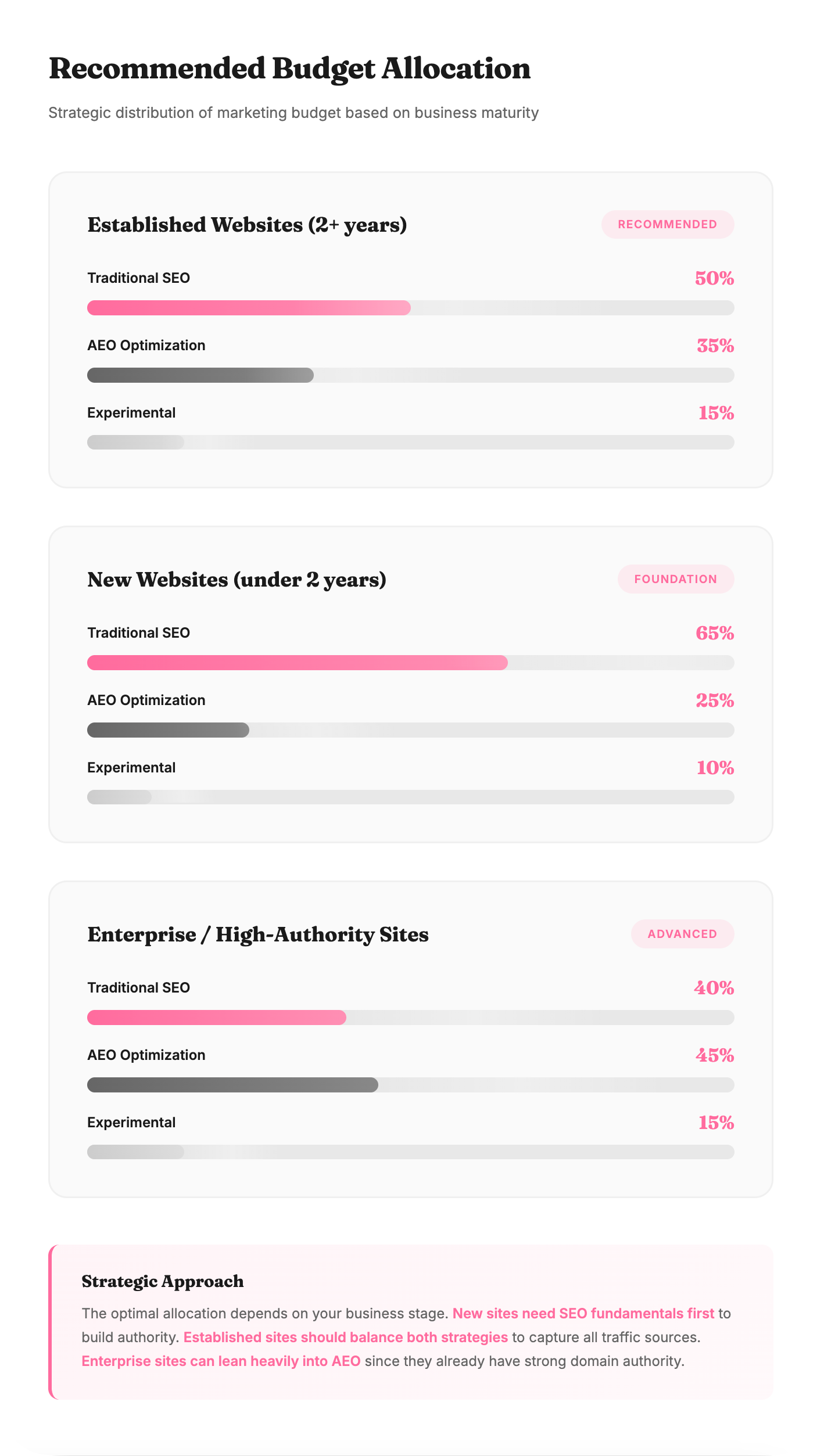
Budget Allocation Strategy for 2025
Here's a practical budget split for most businesses.
For established websites (2+ years old):
50% traditional SEO (maintain rankings)
35% AEO optimization (capture AI traffic)
15% experimental (new platforms, voice search)
For new websites (under 2 years):
65% traditional SEO (build foundation)
25% AEO optimization (prepare for future)
10% experimental
For enterprise/high-authority sites:
40% traditional SEO (maintenance mode)
45% AEO optimization (maximize AI presence)
15% experimental
Adjust based on your industry. B2B and technical content benefit more from AEO investment. Local businesses and e-commerce might still lean heavier on traditional SEO.
The Future of Search and AI Traffic
What happens next?
AI search will likely surpass traditional search by 2027. Current growth rates suggest 60-70% of searches will go through AI interfaces within two years.
But traditional search engines won't disappear. Google is integrating AI into search results. Bing added ChatGPT. The boundary between "search" and "AI answer" is blurring.
This means your content needs to work in both contexts. Good SEO practices (clear structure, quality content, proper metadata) help with AEO too. The fundamentals overlap more than they differ.
The winning strategy: create content that serves humans, regardless of how they find it. Clear answers work in search results and AI responses. Authoritative sources get cited and ranked.
Focus on value first. Optimization second.
Key Takeaways
Let's recap the important points.
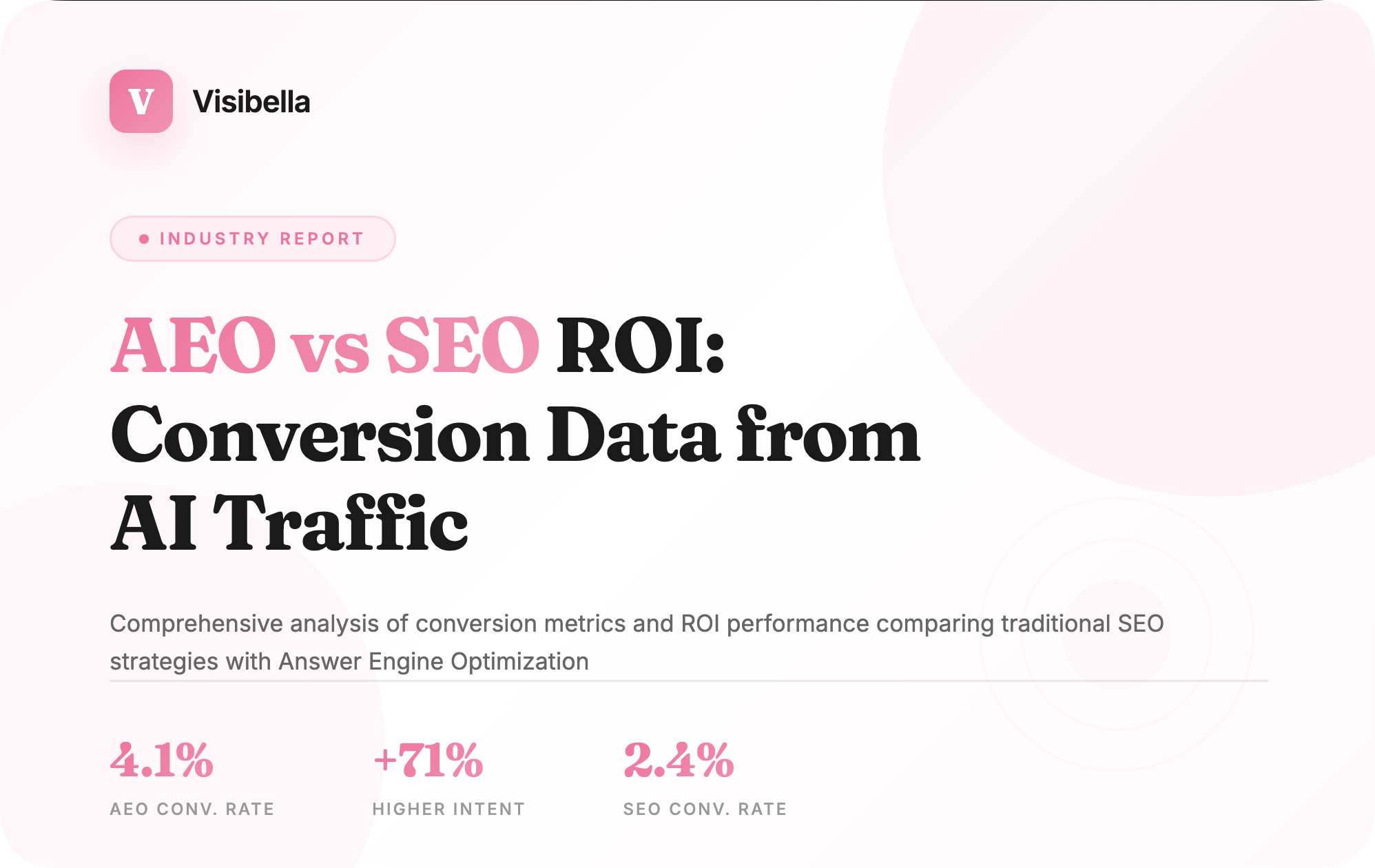
AEO traffic converts better than SEO traffic because users arrive with clearer intent. The average AEO conversion rate is 4.1% compared to 2.4% for SEO traffic.
Both strategies matter. You can't choose one and ignore the other. The best approach combines traditional SEO with AEO optimization.
Budget allocation should reflect your goals. Most businesses should split roughly 50/50 between SEO and AEO, adjusting based on industry and website maturity.
Tracking matters. Set up separate monitoring for AI referral traffic. Measure citation frequency, referral patterns, and conversion quality specifically for AEO.
Content quality wins. Whether you optimize for search engines or answer engines, clear, authoritative content gets better results.
Frequently Asked Questions About AEO and SEO ROI
What is AEO (Answer Engine Optimization)?
AEO is the practice of optimizing your content so AI tools like ChatGPT, Perplexity, and Claude can find, understand, and cite it when answering user questions. Unlike traditional SEO that focuses on ranking in search results, AEO focuses on being selected as the authoritative source that AI systems reference directly.
How does AEO differ from traditional SEO?
SEO aims to rank your pages in search engine results, while AEO aims to get your content cited by AI answer engines. SEO focuses on keywords and backlinks. AEO focuses on clear, structured answers and source credibility. The user journey differs too: SEO users browse multiple results, while AEO users arrive pre-qualified by AI recommendations.
Which strategy has better conversion rates: AEO or SEO?
AEO traffic converts at 4.1% on average compared to 2.4% for SEO traffic. That's a 71% improvement in conversion performance. AEO traffic also shows longer time on page (6.2 minutes vs 2.8 minutes) and lower bounce rates (31% vs 58%). The higher conversion comes from AI pre-qualifying users before they click through to your site.
Should I invest in AEO or SEO for my business?
You need both. The best approach combines traditional SEO with AEO optimization. For established websites, allocate roughly 50% to SEO and 35% to AEO. For new websites, start with 65% SEO to build foundation, then shift more budget to AEO as you grow. By 2027, most searches will happen through AI interfaces, so building AEO capability now prepares you for that shift.
How much does AEO optimization cost?
AEO typically costs 20-30% less than comprehensive SEO. Monthly AEO investment ranges from $4,300 to $10,500, which includes structured content creation, authority building, schema markup implementation, and AI monitoring. Traditional SEO costs $5,500 to $14,500 monthly. The lower cost combined with higher conversion rates makes AEO an attractive ROI proposition.
How do I track AEO performance?
Track four key metrics: citation frequency (how often AI tools cite your content), referral traffic from AI platforms, conversion rates from AI referral traffic, and response accuracy (whether AI represents your content correctly). Use analytics to tag traffic from sources like chatgpt.com, perplexity.ai, and ai.google.com. Monitor manually by asking AI tools questions in your topic area and checking if they cite your content.
What makes AI traffic convert better than search traffic?
AI tools pre-qualify users by understanding their needs and matching them to appropriate sources. When someone clicks through from an AI citation, they already know you're relevant to their question. This eliminates the research and comparison phase that search users go through. AI traffic arrives further down the conversion funnel with clearer intent and higher readiness to act.
When should I start investing in AEO?
Start now if you have an established website with existing content. The shift to AI search is happening quickly, with 40% of searches already going through AI tools. If you're launching a new website, spend the first 6-12 months on SEO fundamentals to build domain authority, then add AEO optimization. The earlier you optimize for AI, the more time you have to build citation history and authority with these systems.
Can I optimize existing content for AEO or do I need new content?
You can optimize existing content for AEO. Review your current articles and restructure them to answer specific questions clearly. Add FAQ sections, use proper heading hierarchy, implement schema markup, and make your expertise obvious. Creating new content gives you a fresh start, but retrofitting existing content works well and costs less than starting from scratch.
How long does it take to see results from AEO?
Most businesses see initial AI citations within 2-3 months of implementing AEO optimization. Meaningful traffic increases typically appear around month 4-6. This is faster than traditional SEO, which often takes 6-12 months for significant results. The speed comes from AI tools indexing and citing quality content more quickly than search engines update rankings.
What types of businesses benefit most from AEO?
B2B companies, SaaS providers, professional services, and technical content creators see the strongest AEO benefits. These businesses answer complex questions where AI tools add value by synthesizing information. E-commerce can benefit too, especially for products requiring explanation or comparison. Local businesses may see less immediate benefit since AI tools aren't yet optimized for location-specific queries.
Do I need technical expertise to implement AEO?
Basic AEO doesn't require deep technical knowledge. Clear writing, proper content structure, and answer-focused formatting help most. Advanced AEO involves schema markup implementation, authority building strategies, and citation monitoring, which benefit from professional expertise. Most businesses succeed by combining their subject matter knowledge with AEO consulting or services.
Get Better ROI from AI Traffic with Visibella
The data is clear: AI traffic converts better. But capturing that traffic requires specialized optimization.
Visibella's AEO services help businesses get cited by AI tools consistently. We analyze your content, identify optimization opportunities, and implement structured changes that AI systems prefer.
Our approach includes:
Content restructuring for AI readability
Authority building for increased citations
Citation monitoring across major AI platforms
Conversion tracking for AI referral traffic
Regular reporting on AEO performance
We've helped 100+ businesses increase their AI traffic by an average of 240% within six months. Our clients see higher conversion rates and lower customer acquisition costs.
Want to capture more high-intent traffic from AI searches? Let Visibella optimize your content for answer engines. Schedule a free AEO audit to see how your content performs with AI tools and where you're missing opportunities.
Will Abraham
Will Abraham spent five years building one of the largest PPC and SEO agencies serving real estate investors. After ChatGPT's launch in 2022, he saw the shift from traditional search to AI-driven answers coming and built Visibella to help brands become the answer AI gives, not the link buried underneath it. He stays close to active AEO researchers and the teams shaping how AI search works.