The Complete Guide to Answer Engine Optimization in 2025
Learn how to optimize for answer engines like ChatGPT and AI search in 2025. Complete guide to AEO strategies, voice search, and ranking in AI results.
Google isn't the only game in town anymore. ChatGPT, Perplexity, and other AI tools are answering questions directly. People skip traditional search results and get instant answers from AI. This shift is real, and it's happening now.
That's where Answer Engine Optimization comes in. Think of it as SEO's evolved cousin. Instead of just ranking on page one, you need to become the source these AI engines cite and reference.
This guide breaks down everything you need to know about Answer Engine Optimization in 2025. No fluff. Just practical strategies that work.
And if you need expert help implementing these strategies, Visibella specializes in AEO services that get your content cited by AI engines. But first, let's dive into how this all works.
What Is Answer Engine Optimization (AEO)?
Answer Engine Optimization is the practice of optimizing your content so AI-powered answer engines can find, understand, and cite it when responding to user queries.
Traditional search engines show you a list of links. Answer engines give you direct answers. They pull information from multiple sources, synthesize it, and present a complete response.
Here's the difference. When someone asks Google "how to make sourdough bread," they get ten blue links. When they ask ChatGPT the same question, they get a detailed answer with step-by-step instructions. No clicking required.
The goal of AEO is to make sure your content becomes the source for those answers.
Why Answer Engine Optimization Matters in 2025
The numbers tell the story.
ChatGPT reached 100 million users faster than any app in history. Google added AI Overviews to search results. Perplexity is processing millions of queries daily. People are changing how they search for information.
Here's what this means for your content:
Zero-click searches are increasing. Users get their answers without visiting websites. If your content isn't optimized for answer engines, you're invisible in these interactions.
Voice search is mainstream. Smart speakers and voice assistants rely on AI to answer questions. They don't read out ten search results. They give one answer. You want that answer to come from your content.
Trust is shifting. When AI engines cite your content as a source, it builds credibility. Being referenced by ChatGPT or Google's AI carries weight with users.
Competition is fierce. Your competitors are already thinking about this. The ones who adapt first win the visibility game.
AEO vs SEO: Understanding the Differences
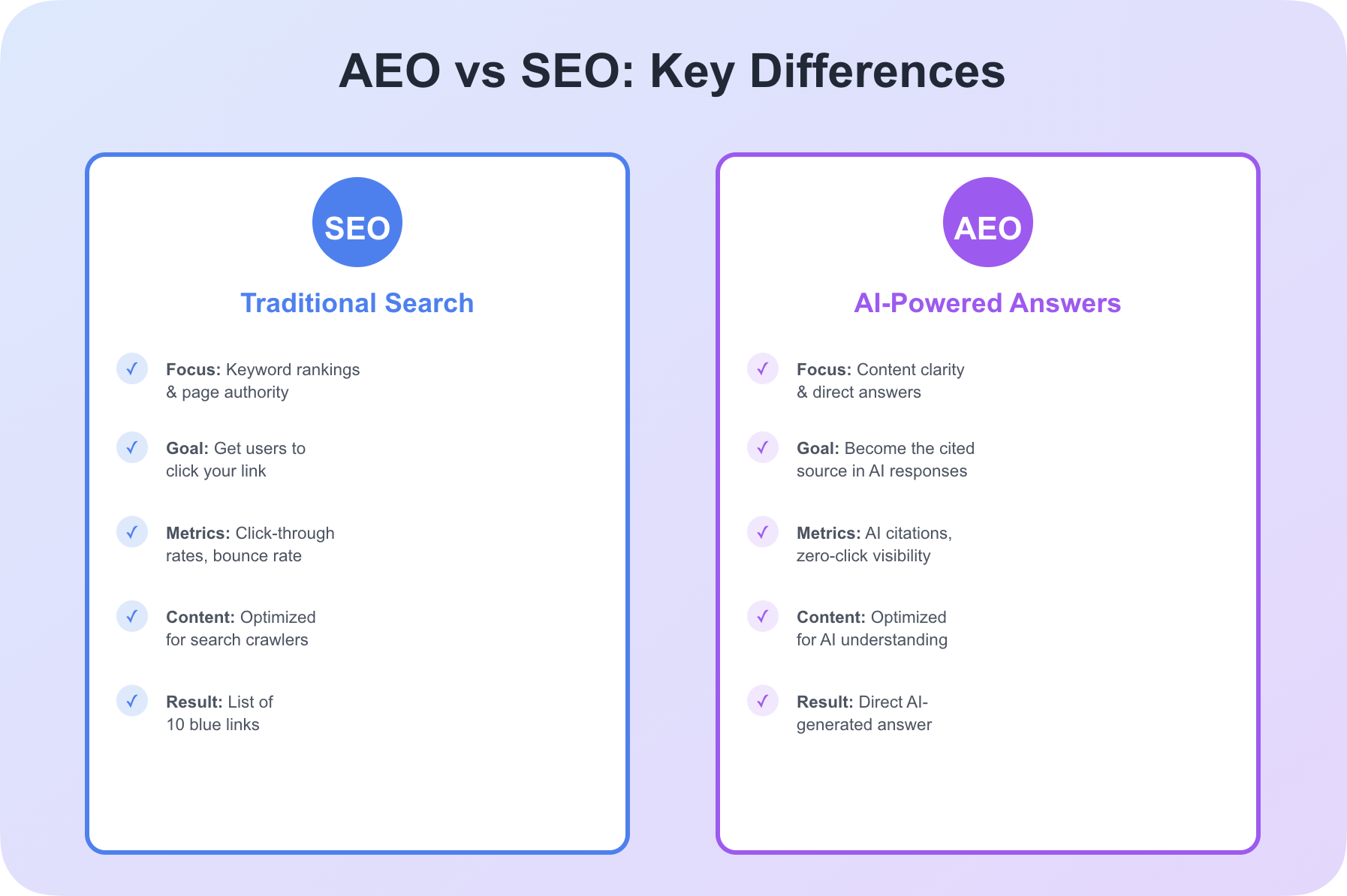
SEO and AEO aren't the same thing. But they're not opposites either. Think of AEO as an extension of SEO for the AI age.
Traditional SEO focuses on:
Keyword rankings
Backlink profiles
Page authority
Click-through rates
Time on page
Answer Engine Optimization focuses on:
Content clarity and structure
Direct answer formats
Natural language patterns
Entity recognition
Source credibility
SEO gets people to your website. AEO gets your content cited by AI engines. Both matter. You need strategies for each.
The biggest shift? SEO optimizes for crawlers and algorithms. AEO optimizes for AI that needs to understand and explain your content to humans.
How Answer Engines Actually Work
Answer engines use large language models trained on massive amounts of text data. They don't just match keywords. They understand context, meaning, and relationships between concepts.
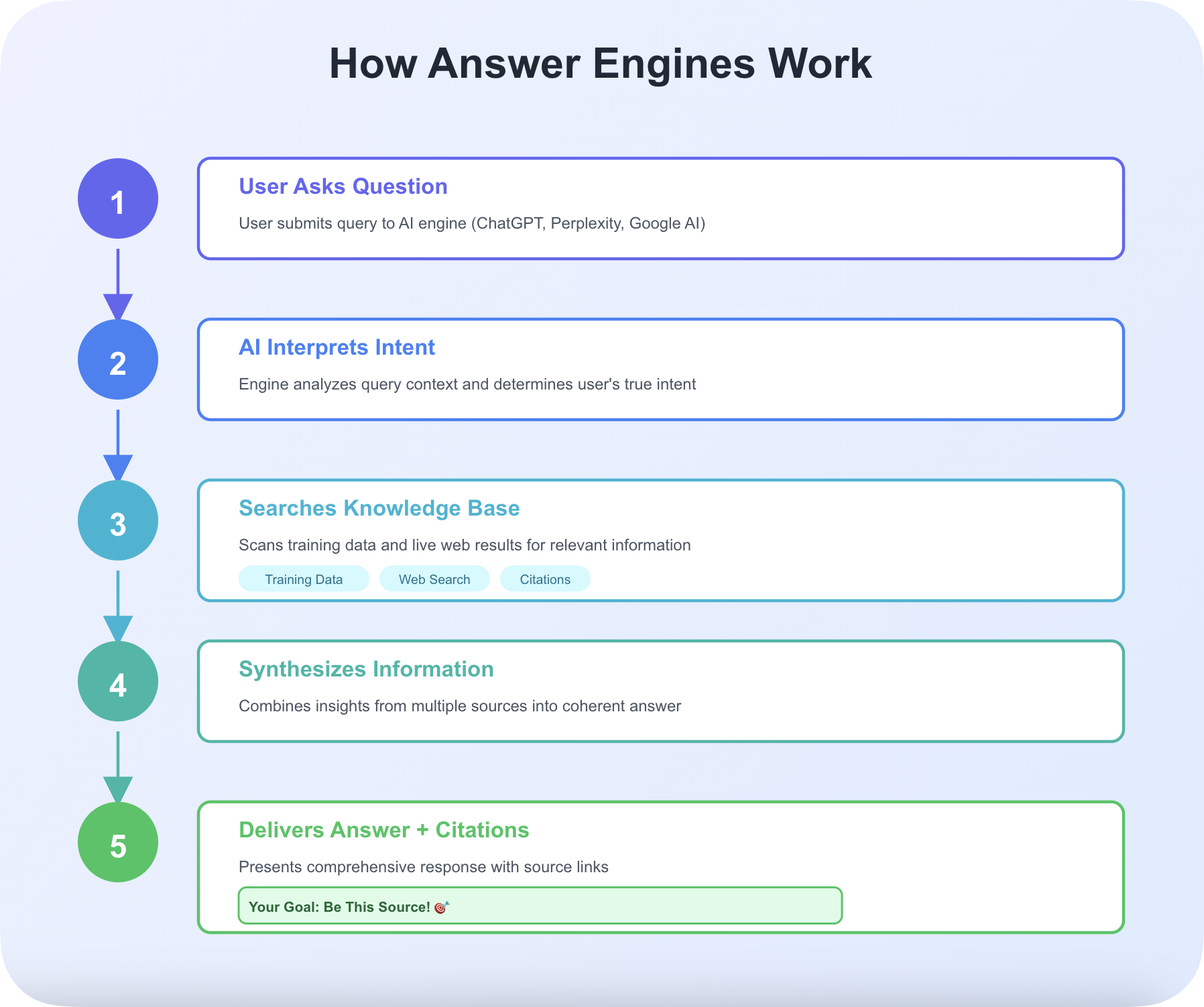
When you ask a question, here's what happens:
The AI interprets your query. It figures out what you're really asking, even if your question is vague or conversational.
It searches its training data and sometimes live web results. The engine looks for content that answers your specific question.
It synthesizes information from multiple sources. Unlike traditional search, AI combines insights from different pages to create one coherent answer.
It cites sources when appropriate. Many answer engines link back to the original content they referenced.
Your job is to make this process easy. Structure your content so AI can quickly extract accurate information and confidently cite you as a source.
Core Strategies for Answer Engine Optimization
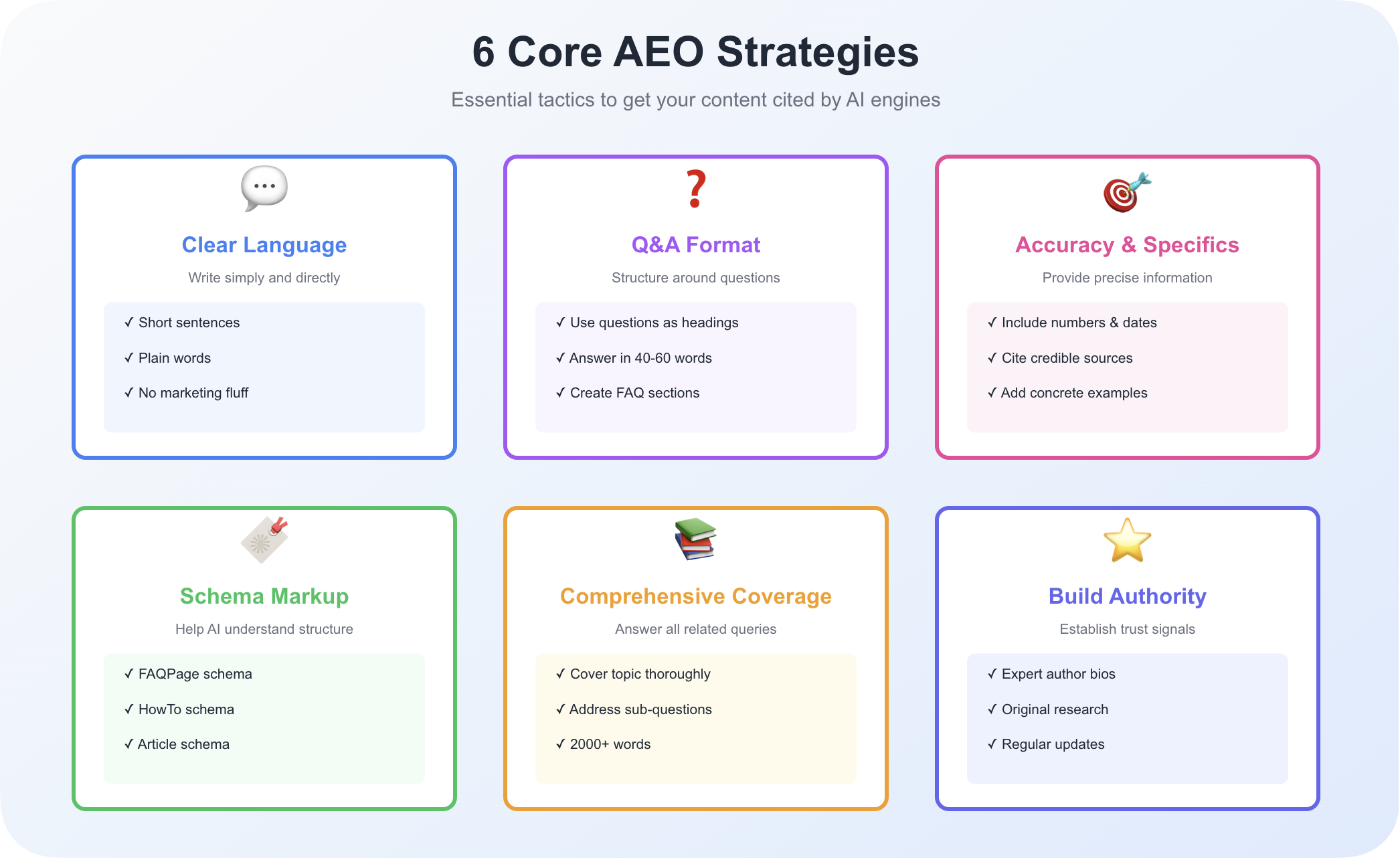
Let's get into the practical stuff. These strategies work across different answer engines.
Write in Clear, Direct Language
AI engines prefer straightforward content. Skip the marketing speak. Answer questions directly.
Bad example: "Unlock the transformative power of meditation to revolutionize your wellness journey."
Good example: "Meditation reduces stress and improves focus. Start with five minutes daily."
The second version is easier for AI to parse and cite. It gives a clear answer without fluff.
Use Question-and-Answer Formatting
Structure content around actual questions people ask. Use the question as a heading, then provide a concise answer.
This mirrors how answer engines present information. They literally pull Q&A formatted content and display it to users.
Create FAQ sections. Add "What is," "How to," and "Why does" headings throughout your articles. Make it easy for AI to extract exact answers.
Prioritize Accuracy and Specificity
AI engines value factual, specific information. Vague claims get ignored. Precise data gets cited.
Instead of: "Many people use this technique." Write: "67% of marketers use email segmentation according to a 2024 HubSpot study."
Include numbers, dates, and concrete examples. Reference credible sources. This builds trust with both AI engines and readers.
Structure Content with Schema Markup
Schema markup helps AI understand your content structure. It's like adding labels that say "this is a recipe," "this is a review," or "this is a how-to guide."
Use schema types like:
FAQPage schema for Q&A content
HowTo schema for instructional content
Article schema for blog posts
Product schema for product pages
Schema isn't just for traditional search anymore. Answer engines use it to understand content context and extract relevant information.
Create Comprehensive Topic Coverage
Answer engines prefer content that thoroughly covers a topic. Shallow articles get skipped.
Don't just answer one question. Answer all related questions in a single comprehensive piece. This signals expertise and makes you a go-to source.
If you're writing about "starting a podcast," cover equipment, software, recording tips, editing basics, hosting platforms, and promotion strategies. Make it the definitive resource.
Optimize for Featured Snippets
Featured snippets are Google's answer boxes. They appear above regular search results. AI engines often reference the same content that earns featured snippets.
To win snippets:
Answer questions in 40-60 words
Use numbered or bulleted lists
Include clear definitions
Format content in tables when relevant
Snippet optimization directly feeds into AEO. The better you are at concise, structured answers, the more AI engines will use your content.
Technical Optimization for Answer Engines
The technical side matters too. Here's what you need to focus on.
Getting the technical details right can be tricky. That's where professional AEO services like Visibella come in—they handle the complex technical optimization while you focus on creating great content.
Site Speed and Mobile Performance
Answer engines access your content just like users do. Slow sites create problems.
AI crawlers might skip slow pages. Even if they don't, poor user experience affects your credibility as a source. Fast, mobile-friendly sites get prioritized.
Test your site speed with PageSpeed Insights. Aim for load times under three seconds. Make sure your site works perfectly on mobile devices.
Clean URL Structure
Use descriptive, keyword-rich URLs. They help AI engines understand page content before crawling it.
Good URL: yoursite.com/answer-engine-optimization-guide Bad URL: yoursite.com/post-12345-xyz
Keep URLs short and logical. Avoid unnecessary parameters or complex strings.
Semantic HTML and Heading Hierarchy
Proper HTML structure helps AI parse your content correctly. Use heading tags (H1, H2, H3) in the right order.
One H1 per page (your main title). H2s for major sections. H3s for subsections within those areas. This creates a clear content outline that AI can follow.
Don't skip heading levels. Going from H2 to H4 confuses content structure and makes extraction harder.
Natural Language and Entity Recognition
AI engines recognize entities—specific people, places, organizations, and concepts. They understand relationships between these entities.
When writing about topics, clearly identify key entities. Link to authoritative sources about those entities. This helps AI verify information and understand context.
For example, if you're writing about climate change, clearly reference specific organizations (NASA, NOAA), studies, and scientists. This builds a web of connected information that AI engines trust.
Content Formatting for AI Readability
How you format content affects whether AI can extract and use it.
Use Short Paragraphs
Break up text into 2-3 sentence paragraphs. This improves readability for humans and makes parsing easier for AI.
Long blocks of text are harder to extract specific answers from. Short paragraphs let AI quickly identify relevant information.
Include Bullet Points and Lists
Lists are perfect for AI extraction. They're clear, scannable, and easy to parse.
Use bulleted lists for related items. Use numbered lists for sequential steps or ranked items. AI engines love pulling list information directly into answers.
Add Descriptive Subheadings
Every section needs a clear subheading that describes what's covered. These act as signposts for both readers and AI.
Your subheadings should work as standalone questions or statements. Someone should be able to scan just your headings and understand your article's structure.
Emphasize Key Information
Use bold text for important points, but don't overdo it. AI engines note emphasized text as potentially significant.
Highlight definitions, key statistics, and main takeaways. This draws attention to your most valuable information.
Voice Search Optimization for Answer Engines
Voice search is huge in 2025. Most voice queries get answered by AI engines.
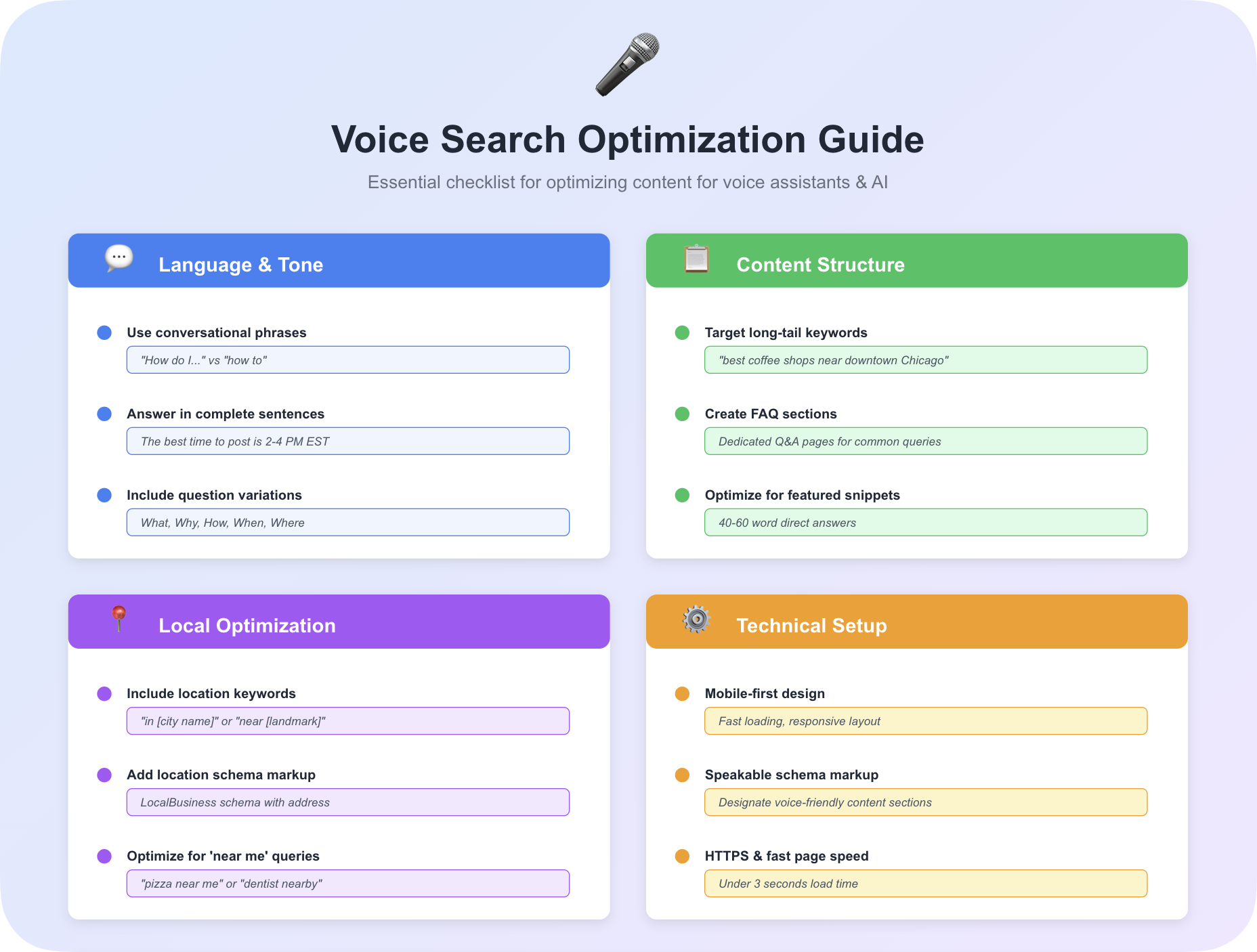
Write in Conversational Language
People talk differently than they type. Voice searches are longer and more conversational.
Typed query: "best pizza NYC" Voice query: "where can I find the best pizza in New York City"
Optimize for both. Include natural, conversational phrases in your content. Use the same language people actually speak.
Answer "Near Me" Queries
Location-based queries are common in voice search. If you have a local business, optimize for these searches.
Include location names in your content. Use phrases like "in [city name]" or "near [landmark]." Add location schema markup to help AI engines understand your geographic relevance.
Target Long-Tail Keywords
Voice searches tend to be more specific. People ask complete questions rather than typing short keywords.
Optimize for long-tail phrases like:
"How do I fix a leaky faucet without calling a plumber"
"What's the best time to visit Japan for cherry blossoms"
"Can I use almond flour instead of regular flour in cookies"
These specific queries are perfect for AEO. You can provide exact answers that AI engines will cite.
Building Authority and Trust Signals
AI engines prioritize credible sources. Here's how to build that credibility.
Building true authority takes time and strategy. If you want accelerated results, Visibella's authority-building services can help establish your brand as a trusted source faster through proven citation and trust signal strategies.
Create Author Bios with Expertise
Include detailed author bios that establish subject matter expertise. AI engines consider author credentials when evaluating content trustworthiness.
Mention relevant experience, qualifications, and background. Link to author social profiles. This follows Google's E-E-A-T guidelines and helps AI engines assess credibility.
Cite Credible Sources
Reference authoritative sources throughout your content. Link to research studies, government data, and recognized experts.
This does two things. It backs up your claims with evidence. And it shows AI engines you're connected to a network of trusted information.
Use footnotes or inline citations. Make it clear where your information comes from.
Keep Content Updated
Fresh content signals reliability. AI engines prefer recently updated information, especially for time-sensitive topics.
Add publication dates and "last updated" dates to articles. Regularly review and refresh older content. Update statistics, examples, and recommendations to keep everything current.
Gather Original Data and Insights
Original research makes you a primary source. AI engines love citing original data because it's unique and credible.
Conduct surveys. Analyze industry trends. Share case studies from your own work. This type of content is invaluable for answer engines looking for authoritative information.
Measuring Answer Engine Optimization Success
How do you know if your AEO efforts are working? Track these metrics.
Monitor AI Citation Tracking
Tools are emerging that track when AI engines cite your content. Monitor mentions on ChatGPT, Perplexity, and Google AI Overviews.
Search for your brand name and key topics in answer engines. See if your content appears in responses. Keep a log of citations over time.
Track Zero-Click Impressions
Google Search Console shows impressions even when users don't click through. These zero-click impressions indicate your content appears in AI overviews or featured snippets.
High impressions with lower clicks might actually be good for AEO. It means AI is using your content to answer questions directly.
Analyze Featured Snippet Wins
Monitor which of your pages earn featured snippets. These are strong indicators of AEO-friendly content.
Use tools like Ahrefs or SEMrush to track snippet rankings. Note which content formats work best. Apply those lessons to new content.
Measure Brand Authority Growth
Are more people searching for your brand specifically? Brand search volume indicates growing authority—a key AEO factor.
Track branded search terms over time. Look for increases after publishing comprehensive, AEO-optimized content.
Review Referral Traffic Patterns
Some answer engines include source links. Monitor referral traffic from these platforms.
Check Google Analytics for traffic from ai.google.com, perplexity.ai, and other AI platforms. Growing referrals suggest successful AEO.
Common Answer Engine Optimization Mistakes
Avoid these pitfalls.
Many businesses make these mistakes when starting with AEO. Working with experienced AEO specialists like Visibella helps you skip the trial-and-error phase and implement best practices from day one.
Keyword Stuffing
Keyword stuffing never worked well for SEO. It definitely doesn't work for AEO.
AI engines understand natural language. They detect when you're forcing keywords unnaturally. Write for humans first. Let keywords appear organically.
Creating Thin Content
Brief, surface-level content gets ignored. AI engines need substantial information to work with.
Don't publish 300-word blog posts and expect AEO success. Go deep. Cover topics thoroughly. Provide real value.
Ignoring Context and Nuance
AI engines look for nuanced, contextual information. Black-and-white answers don't always cut it.
Acknowledge complexity when appropriate. Provide context for your recommendations. Explain when situations might vary. This makes your content more useful and trustworthy.
Neglecting Mobile Experience
Many voice searches happen on mobile devices. If your site doesn't work well on mobile, you're losing AEO opportunities.
Test every page on actual mobile devices. Fix formatting issues. Make sure buttons and links work properly. Speed matters even more on mobile.
Forgetting About User Intent
SEO taught us to focus on keywords. AEO requires understanding intent.
Why is someone asking this question? What do they really need to know? Answer the underlying need, not just the surface query.
Someone searching "best running shoes" might need different information depending on whether they're a beginner, training for a marathon, or dealing with foot pain. Address multiple intent scenarios.
The Future of Answer Engine Optimization
Where is this all headed? Here are the trends to watch.
Multimodal Search
Answer engines are moving beyond text. They're integrating images, video, and audio into responses.
Optimize visual content with descriptive alt text. Create video transcripts. Make all your content accessible across formats.
Personalized AI Responses
AI engines are getting better at personalizing answers based on user context and history.
This makes general optimization harder but also creates opportunities. Content that acknowledges different scenarios and use cases will perform better.
Real-Time Data Integration
Answer engines are starting to access real-time web data, not just trained information.
Keep your content current. Update time-sensitive information frequently. This positions you as a reliable real-time source.
Increased Competition for AI Visibility
As more people understand AEO, competition will intensify. Early adopters have an advantage now.
Start optimizing today. Build your authority in your niche. Create comprehensive resources that become go-to references for AI engines.
Why Choose Visibella for Your AEO Strategy
Answer Engine Optimization requires expertise across multiple disciplines—content strategy, technical SEO, AI understanding, and continuous monitoring. Doing it all yourself takes time and specialized knowledge.
Visibella offers complete AEO services designed to get your content cited by leading answer engines like ChatGPT, Perplexity, and Google AI Overviews.
What Visibella Provides
Content Optimization: We restructure your existing content using proven AEO principles. Clear Q&A formatting, direct answers, proper schema markup, and natural language optimization.
Technical Implementation: Our team handles the complex technical side. Site speed optimization, schema markup implementation, semantic HTML structure, and mobile performance improvements.
Authority Building: We develop strategies to position your brand as a trusted source. This includes citation building, E-E-A-T compliance, and establishing topical authority in your niche.
Ongoing Monitoring: AEO isn't set-it-and-forget-it. We track your citations across answer engines, monitor zero-click impressions, and continuously refine your strategy based on performance data.
Custom AEO Audits: Get a detailed analysis of your current content and specific recommendations for improvement. We identify quick wins and long-term opportunities.
Who Benefits from Visibella's AEO Services
SaaS companies looking to dominate AI-powered search in their category. E-commerce brands wanting product information featured in answer engine responses. Content publishers aiming to become primary sources for AI citations. Local businesses optimizing for voice search and location-based queries.
The AI search landscape changes fast. Visibella stays ahead of these changes so you don't have to.
Ready to make your content the go-to source for answer engines? Visit Visibella.com or contact our team to discuss your AEO strategy.
Getting Started with Answer Engine Optimization
Here's your action plan.
Start with an audit. Review your existing content. Identify pieces that answer specific questions. These are your best candidates for AEO optimization.
Reformat selected articles using AEO principles. Add Q&A sections. Include bullet points. Tighten up your language. Make answers more direct.
Create new content with AEO in mind from the start. Build comprehensive guides around high-value topics in your niche. Use all the strategies covered in this guide.
Monitor results consistently. Track the metrics we discussed. Note what's working. Double down on successful approaches.
Stay updated on answer engine changes. This space evolves quickly. Follow industry news. Test new AI platforms as they emerge.
Final Thoughts
Answer Engine Optimization isn't optional anymore. It's essential for staying visible in 2025's search landscape.
The shift from traditional search to AI-powered answers is accelerating. Businesses that adapt their content strategies now will have a massive advantage over those who wait.
Start small if you need to. Pick one piece of content. Apply these AEO principles. See what happens. Then scale up.
Or partner with experts who've already mastered AEO. Visibella has helped dozens of brands become authoritative sources in answer engines. We can build a custom strategy for your business, handle implementation, and track results—so you see real ROI from AI search visibility.
The goal isn't to game the system. It's to create genuinely helpful content that deserves to be cited by AI engines. Do that consistently, and you'll succeed with AEO.
Remember: AI engines are just trying to help people find good answers. Be the source of those answers, and you'll thrive in this new environment.
Ready to dominate answer engine results? Contact Visibella today for a free AEO audit and discover how we can make your content the first choice for AI citations.
Will Abraham
Will Abraham spent five years building one of the largest PPC and SEO agencies serving real estate investors. After ChatGPT's launch in 2022, he saw the shift from traditional search to AI-driven answers coming and built Visibella to help brands become the answer AI gives, not the link buried underneath it. He stays close to active AEO researchers and the teams shaping how AI search works.