E-commerce AEO Strategy: Optimize Products for AI Shopping Assistants
Search is changing. Fast.
People aren't just typing queries into Google anymore. They're asking ChatGPT for product recommendations. They're using Perplexity to compare prices. They're talking to Alexa and Google Assistant to shop.
This shift requires a new approach: Answer Engine Optimization (AEO).
AEO focuses on optimizing your content so AI shopping assistants can find, understand, and recommend your products. Traditional SEO still matters, but AEO adds another layer. It's about making your product information clear, structured, and AI-friendly.
Here's the reality: AI assistants pull answers from various sources. If your product data isn't optimized, competitors will get recommended instead of you. This guide shows you exactly how to fix that.
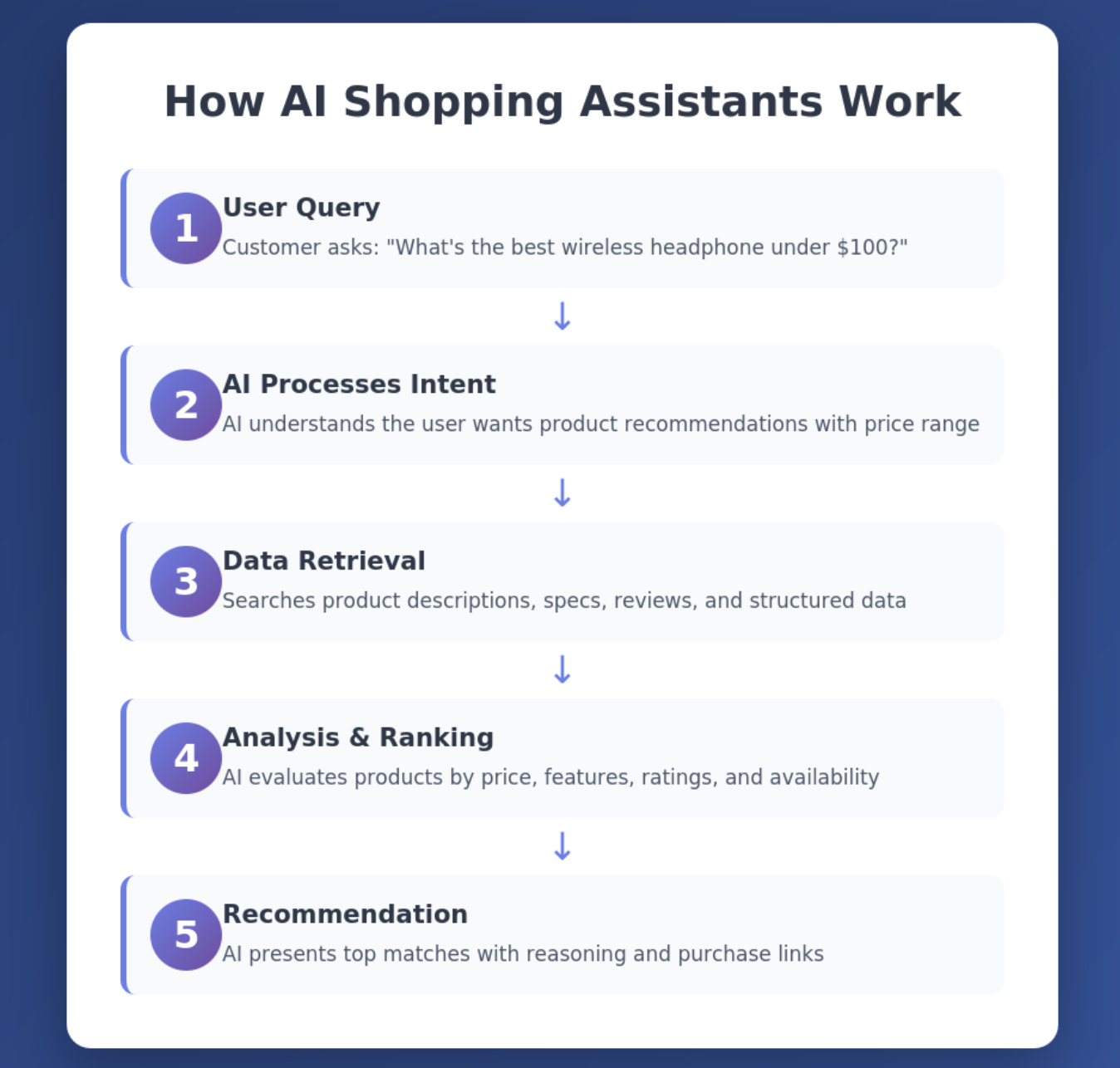
Before diving into strategy, you need to understand how these tools function.
AI shopping assistants use large language models (LLMs) to process queries and generate responses. When someone asks "what's the best wireless headphone under $100," the AI searches through:
The AI synthesizes this information and recommends products that best match the query.
Key difference from traditional search: AI assistants prioritize clarity and completeness. They favor products with comprehensive, well-structured information over those with vague descriptions or missing details.
Your product descriptions need to answer questions directly.
Bad example: "Premium headphones with amazing sound."
Better example: "Wireless over-ear headphones with 40mm drivers, 30-hour battery life, and active noise cancellation. Compatible with iPhone and Android devices."
See the difference? The second version gives specific, searchable information.
Use natural language. Write how people actually talk. If someone asks "do these headphones work with iPhone," your description should clearly state compatibility.
Include these elements in every product description:
Schema markup is code that helps AI understand your content. It's not visible to shoppers, but it's critical for AEO.
Implement these schema types for e-commerce:
When AI assistants crawl your site, schema markup gives them clean, structured data they can easily parse and use.
Most e-commerce platforms have plugins that add schema automatically. Use them. Then validate your markup with Google's Rich Results Test to make sure it works.
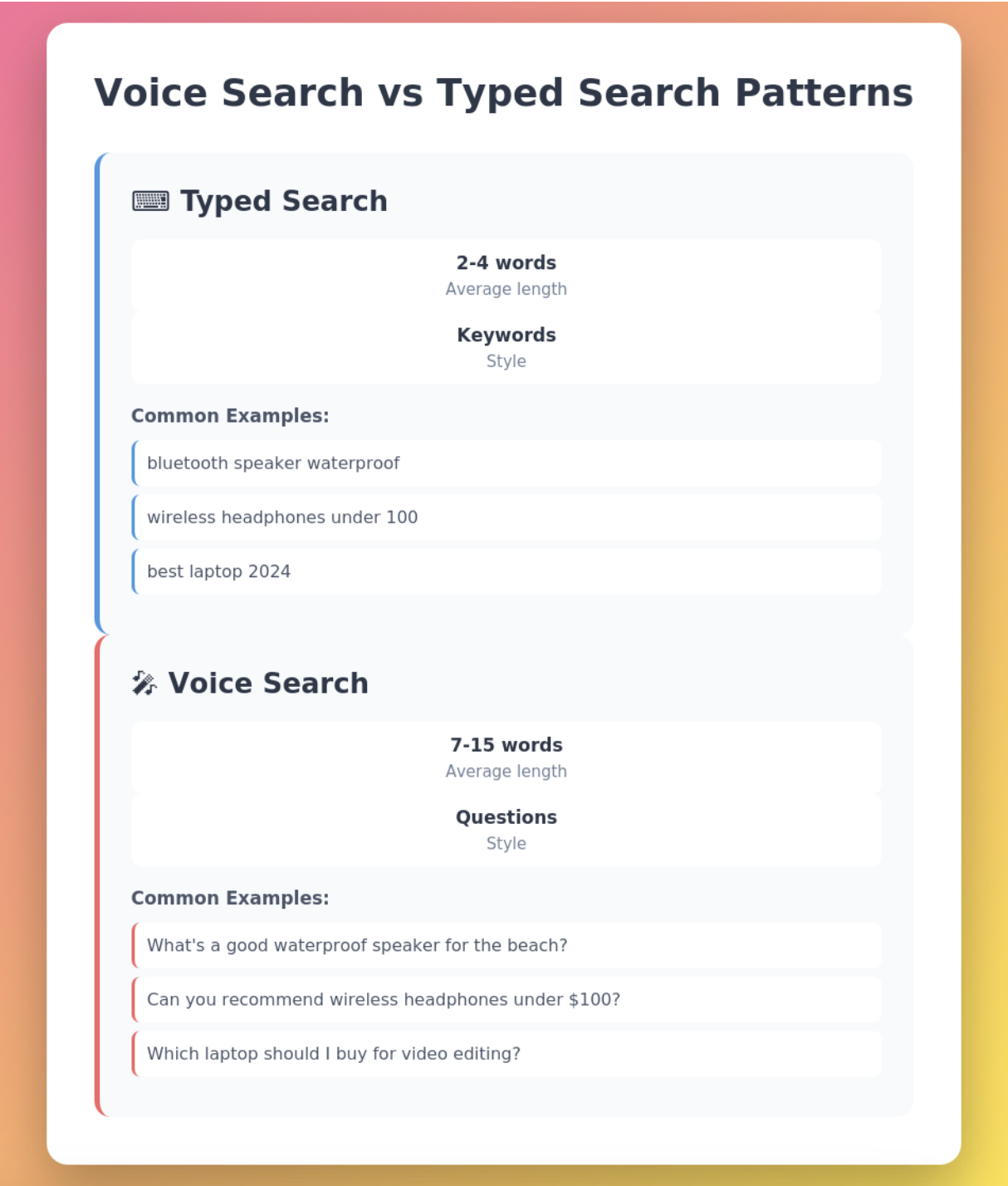
Voice search queries are different from typed ones.
Typed: "bluetooth speaker waterproof" Voice: "What's a good waterproof Bluetooth speaker for the beach?"
Voice queries are longer, more conversational, and question-based. Your product content needs to match this style.
Structure your product pages and blog content around questions people actually ask.
Examples:
Put these questions as H3 headings with clear, direct answers below them. This format works perfectly for voice assistants pulling quick answers.
Add an FAQ section to every product page. Answer 5-10 common questions about that specific product.
Questions to cover:
Keep answers short. One to three sentences works best. Voice assistants prefer concise responses they can read back to users.
AI shopping assistants love detailed specs. The more complete your technical information, the better your chances of being recommended.
Use tables to present specifications clearly. Include:
For Electronics:
For Clothing:
For Home Goods:
Don't leave fields blank. If something doesn't apply, explain why. AI assistants interpret missing information as incomplete data.
Reviews are goldmines for AEO. They contain natural language, real use cases, and answers to questions potential buyers have.
Ask customers specific questions in review requests:
Detailed reviews give AI assistants more context to work with. When someone asks "is this good for small apartments," an AI can pull from reviews mentioning apartment use.
Reply to both positive and negative reviews. Your responses add more context and show you're engaged.
When responding, include useful information:
These responses become additional content AI assistants can reference.
Blog content supporting your products helps AI assistants understand context and use cases.
Create guides that incorporate your products naturally. Focus on solving problems, not just selling.
Examples:
Use your products as examples within these guides. Explain why certain features matter and which products have them.
AI assistants often get queries like "X vs Y" or "what's better, X or Y?"
Create comparison content that helps:
Structure comparisons with clear categories:
This content positions you as helpful and authoritative, increasing the chance AI assistants cite your information.
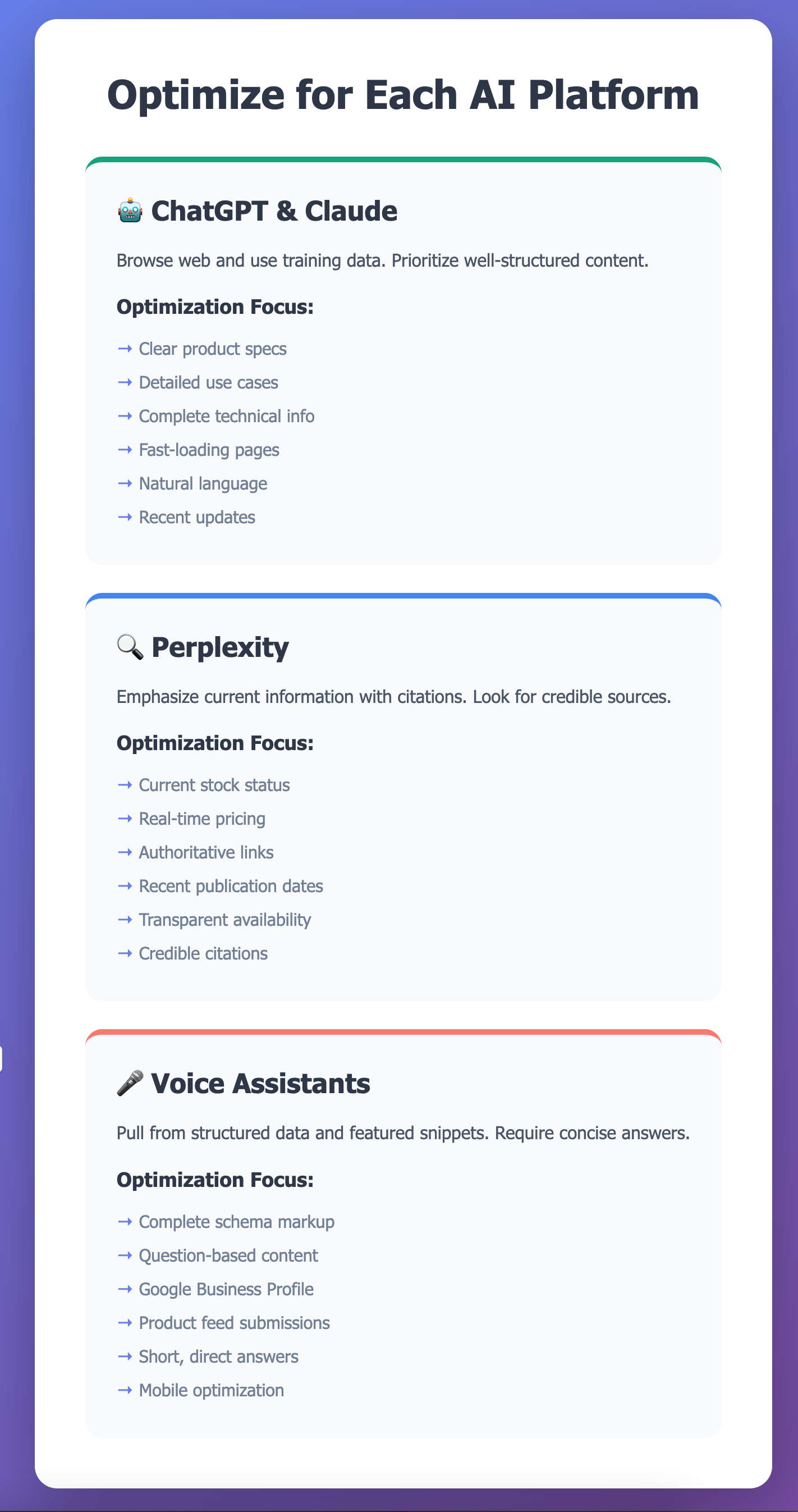
Different AI assistants pull information from different sources. Diversify your optimization strategy.
These assistants browse the web and use their training data. They prioritize:
Make sure your product pages load fast and are mobile-friendly. These assistants can access your site directly if needed.
These platforms emphasize current information and citations. They look for:
Keep your product pages updated with current stock status, pricing, and any new information.
Voice platforms pull from:
Optimize your Google Business Profile. Submit product feeds to Google Merchant Center. Claim your business on Amazon if selling there.
AI assistants favor sites that load quickly and work well on mobile devices.
Run your site through Google PageSpeed Insights. Fix issues that slow loading:
Test your site on various mobile devices. Navigation should be easy, and information should be readable without zooming.
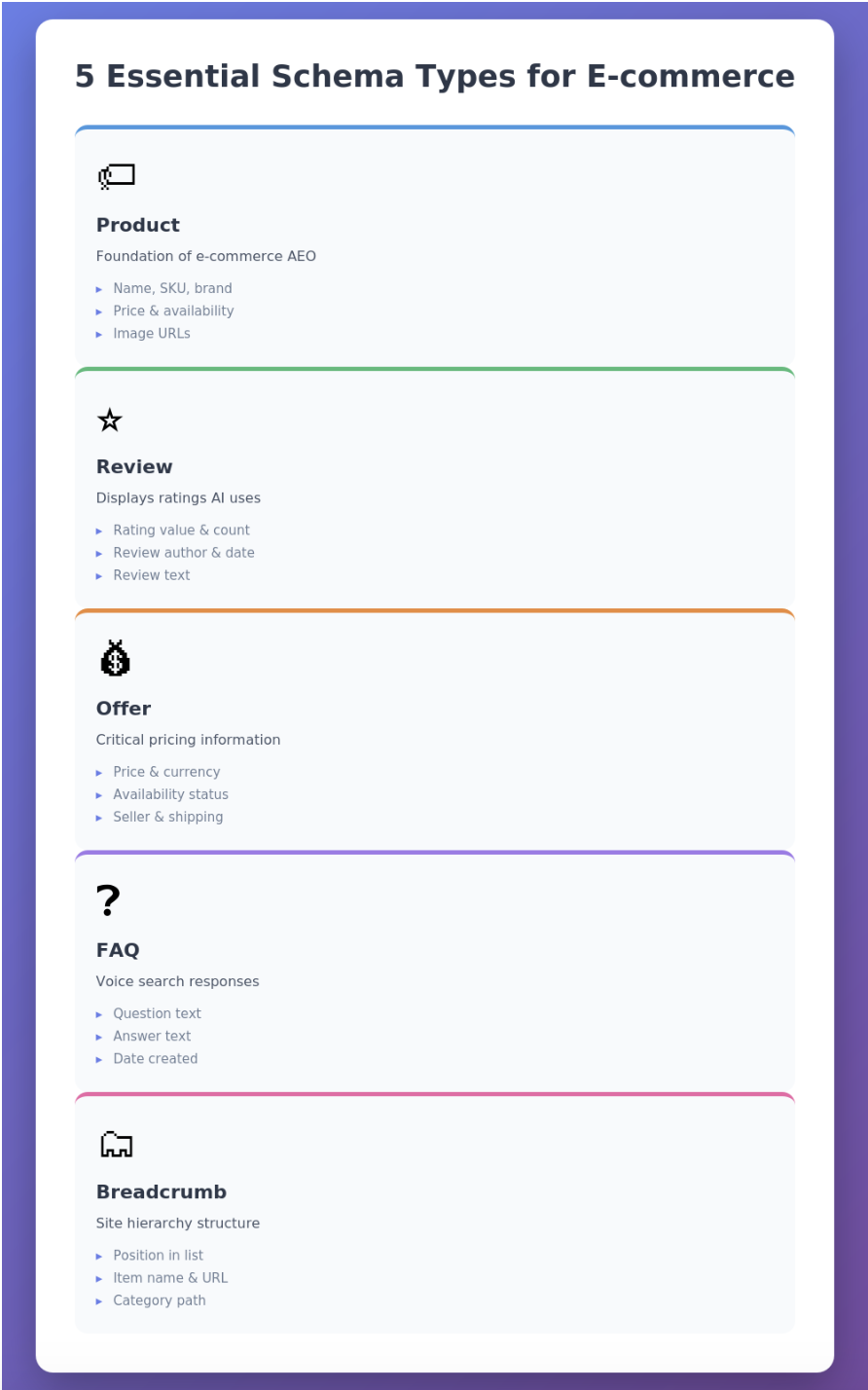
Schema markup needs to be accurate and complete. Common mistakes to avoid:
Use Google's Merchant Center to manage product feeds. Keep information synchronized between your site and feeds.
Submit XML sitemaps to search engines. Include:
Update your sitemap whenever you add new products or make significant changes.
AI assistants trust sources that demonstrate expertise in specific areas. You can't be everything to everyone.
Choose specific product categories or topics to dominate. Create depth, not just breadth.
If you sell outdoor gear, create comprehensive content around:
Publish consistently in these areas. Link related content together to show topical connections.
Links from respected sites in your industry signal authority to AI systems.
Ways to earn quality backlinks:
One quality link from a respected source beats dozens of low-quality directory links.
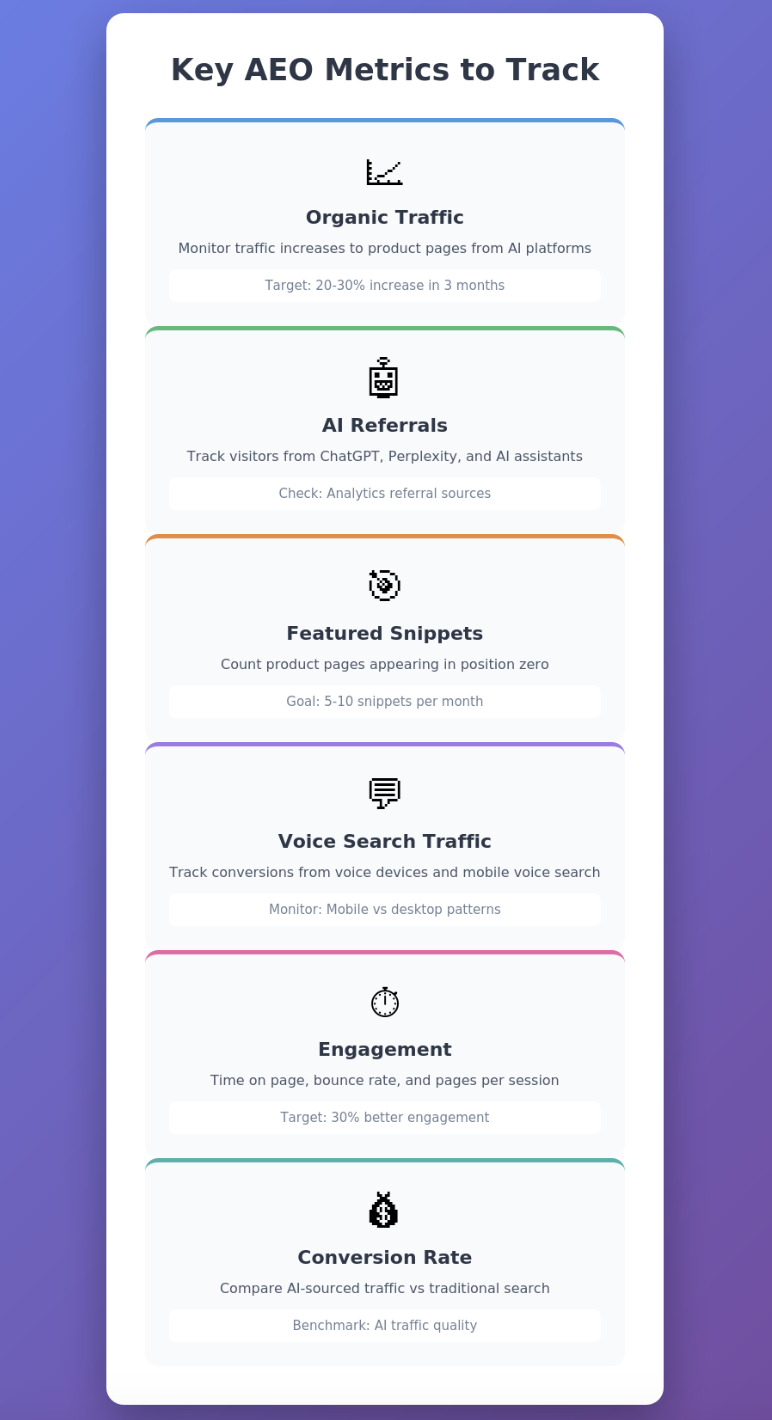
Track performance to see what works.
Use Google Analytics and Search Console to track these. Set up custom reports for AI-specific traffic sources.
AEO is still evolving. Test different approaches:
Document what improves performance. Double down on tactics that work.
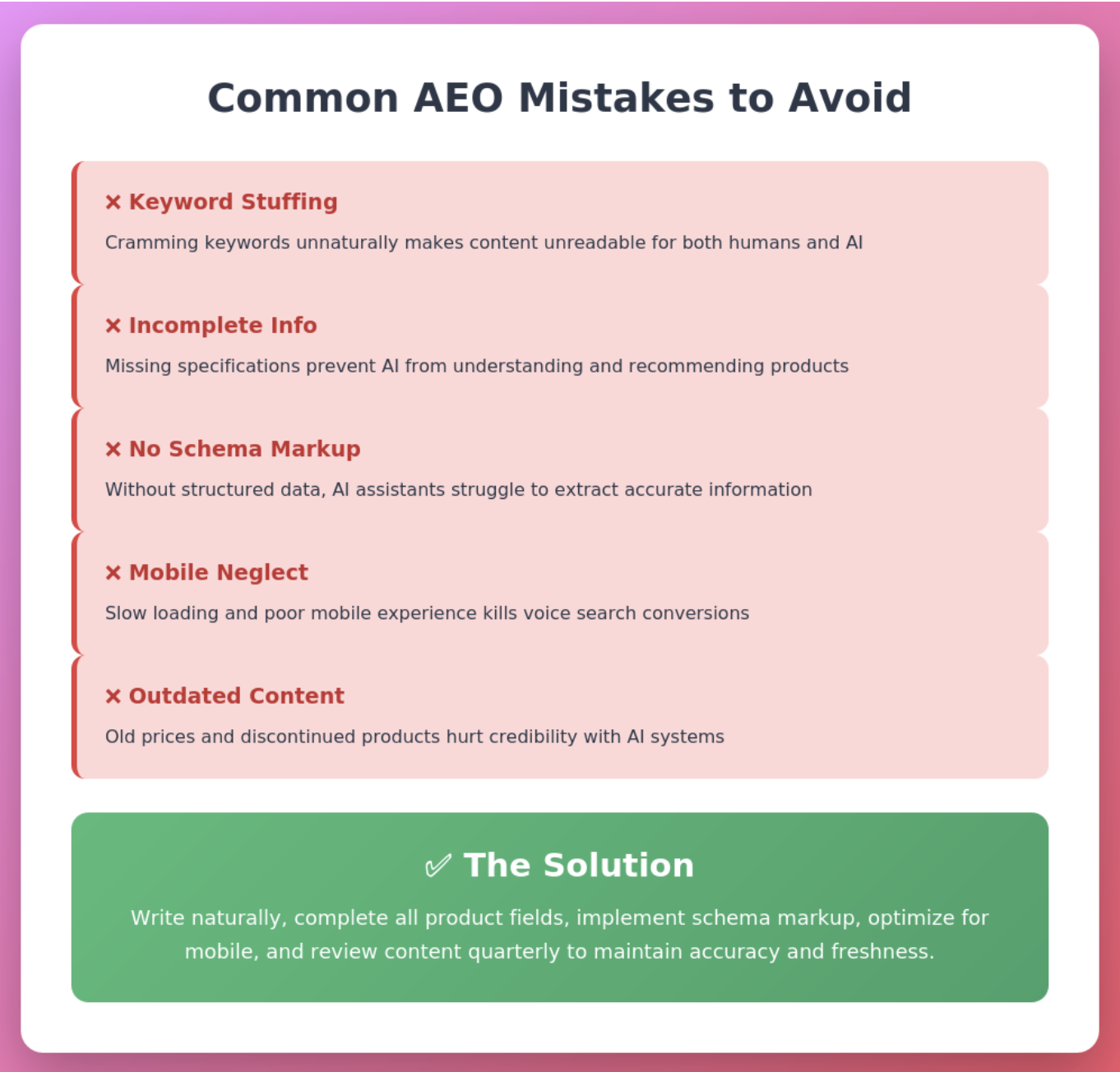
AI assistants are smarter than old search algorithms. They detect unnatural language.
Write for humans first. Include keywords naturally where they make sense. If it sounds robotic when read aloud, rewrite it.
Most voice searches happen on mobile devices. If your site doesn't work well on phones, you're losing potential customers.
Test everything on mobile. Make sure buttons are tappable, text is readable, and checkout is smooth.
Partial product information frustrates both users and AI assistants. Complete every field in your product catalog, even if it seems minor.
AI assistants can't recommend products they don't fully understand.
Old, outdated information hurts credibility. Review and update product pages regularly:
Set a schedule to review your most important product pages quarterly.
AI shopping is just getting started. Here's what's coming:
AI assistants will combine image recognition with product recommendations. Optimize your product images with:
AI will tailor recommendations based on user history and preferences. Focus on:
Shopping through chat interfaces will grow. People will have full conversations with AI assistants before buying.
Prepare by:
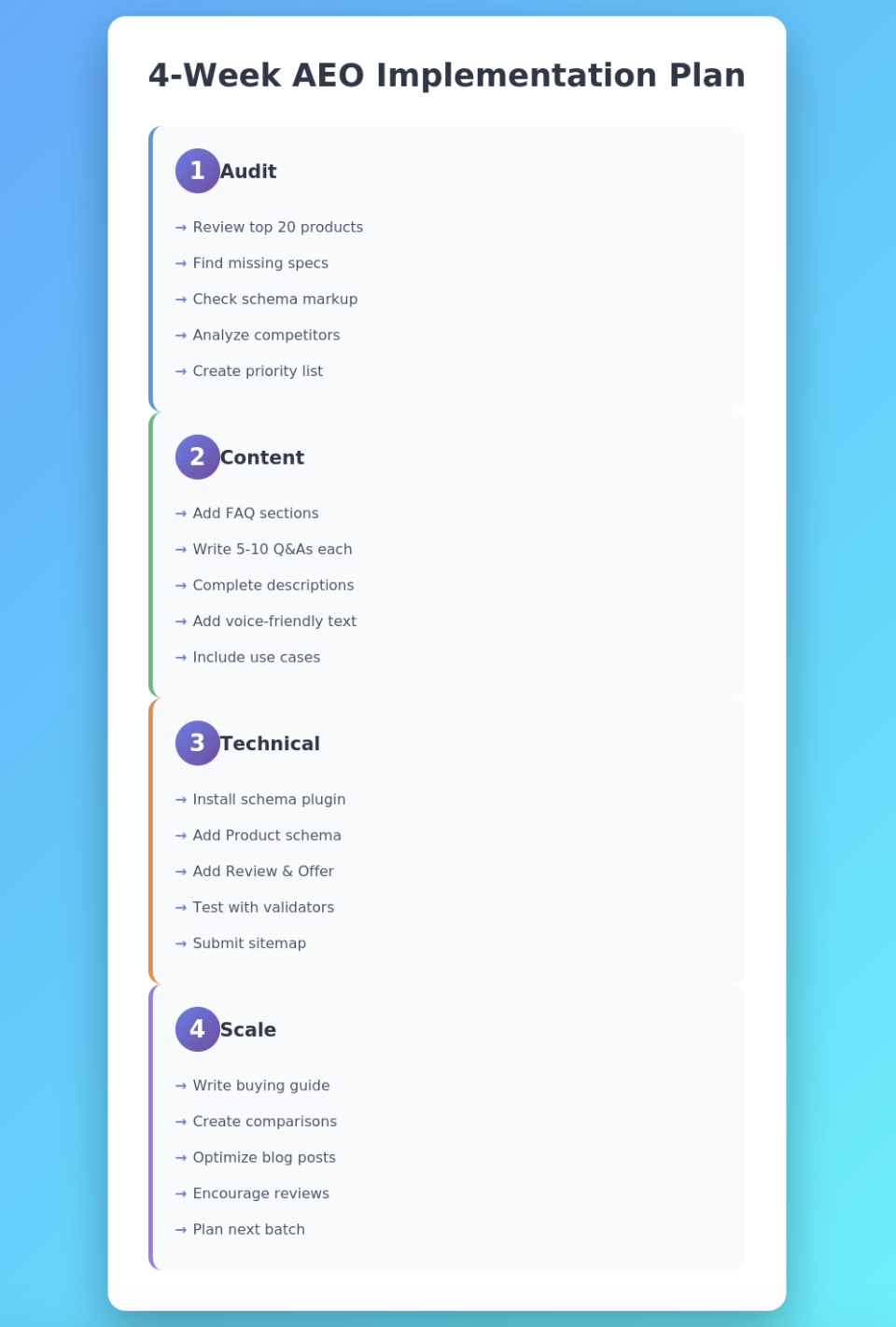
Don't try to do everything at once. Start with these priorities:
Week 1: Audit your top 20 product pages. Identify missing information and incomplete specifications.
Week 2: Add FAQ sections to those products. Answer 5-10 common questions for each.
Week 3: Implement basic schema markup using your platform's tools.
Week 4: Create one comprehensive buying guide related to your products.
Then expand from there. Add schema to more pages. Create more content. Improve product descriptions.
AEO isn't replacing SEO. It's adding to it.
The brands that win will optimize for both traditional search and AI assistants. They'll create clear, helpful, comprehensive product information that serves humans and AI equally well.
Start simple. Focus on making your product information complete and accessible. Answer questions directly. Structure your data properly.
The shift to AI-powered shopping is happening now. E-commerce brands that adapt early will have a significant advantage over those that wait.
Your products might be great. But if AI assistants can't find, understand, and recommend them, you're invisible to a growing segment of shoppers.