SEO vs AEO: Why SEO Still Matters in AI Search
Google Just Settled the SEO vs. AEO Debate
Google settles the SEO vs AEO debate. Discover what AI search means for your strategy, why SEO still matters, and how to optimize for generative search.
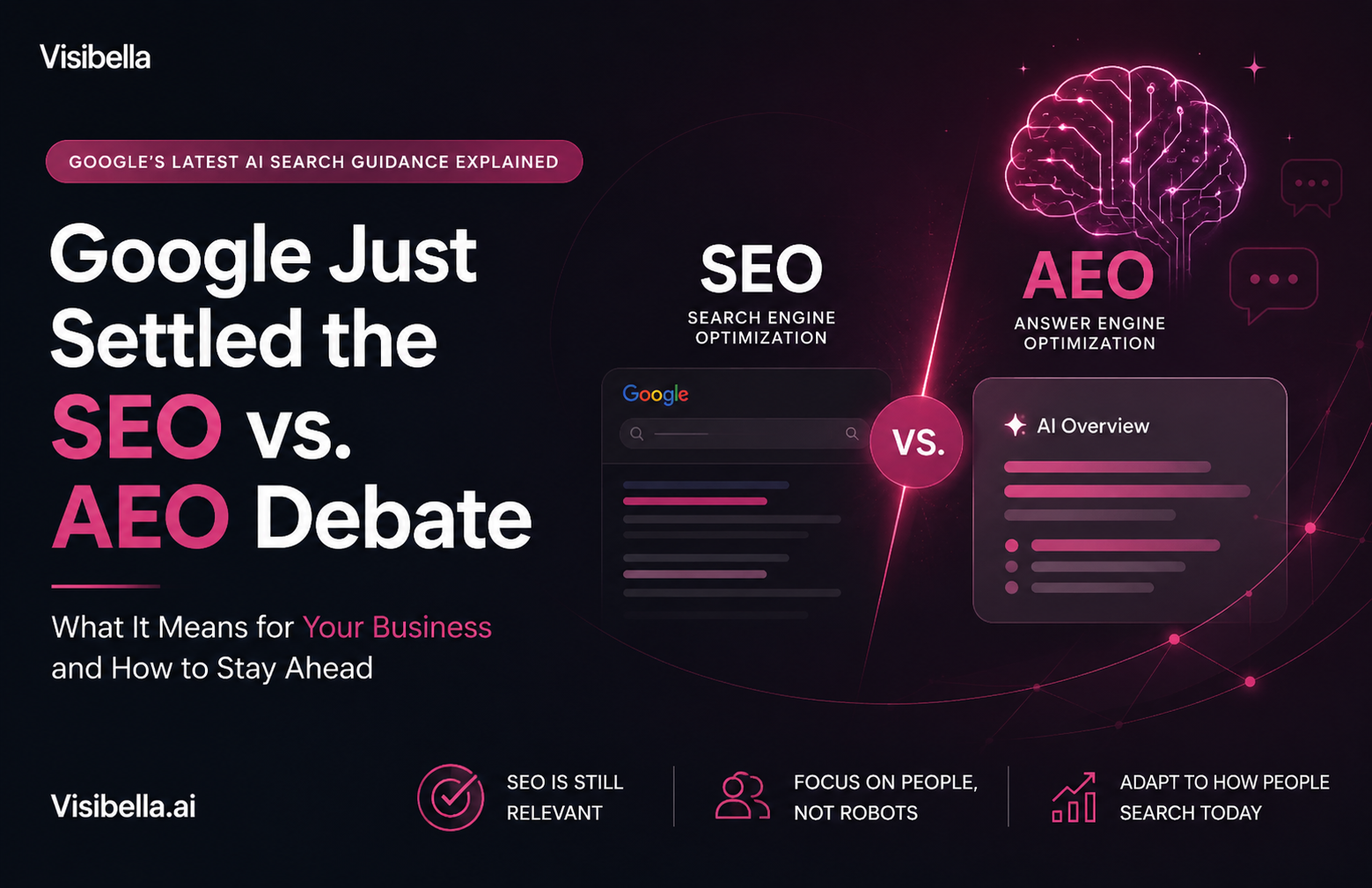
Google settles the SEO vs AEO debate. Discover what AI search means for your strategy, why SEO still matters, and how to optimize for generative search.
For the past two years, the marketing world has been having the same argument on a loop. Is AEO (answer engine optimization) a real, new discipline? Or is it just SEO wearing a fake mustache?
One camp swore AI search changed everything and your old SEO playbook was now landfill. The other camp rolled their eyes and called AEO a buzzword invented to sell people stuff they already had.
Last week, Google walked into the room and ended the argument. The company put out its first official guidance on optimizing for generative AI search, covering the AI Overviews and AI Mode features inside Google Search. And the answer to its own question, "Is SEO still relevant for generative AI search?", was refreshingly blunt. "In short, yes."
We have to be honest here. We have been saying this for a year. Anyone who has sat through a strategy call with us has heard the same line more times than they probably wanted to: good SEO is good AEO. Don't panic. Don't burn your playbook. Build on it. So when Google's guidance dropped, it didn't surprise us. It just backed us up in writing.
But "Google ended the debate" is not the same thing as "nothing changed." Plenty changed. So let's go through what Google actually said, what it means for your business, and the part that matters most: what Google quietly left out.
The big idea in Google's guidance is that their AI search features are not some separate machine bolted onto the side of Search. They run on the same ranking and quality systems that have always powered Google. When an AI Overview answers a question, it is reaching into Google's regular search index to do it.
Translation: the work that makes you show up in normal search is the same work that makes you show up in AI search. And Google was pretty clear about what that work looks like.
Make content that is actually worth reading. Google drew a hard line between "commodity content" and "non-commodity content." Commodity content is the generic stuff that restates what is already everywhere. Their example was a piece called "7 Tips for First-Time Homebuyers." You have read that article a hundred times. It could have been written by anyone, or by a machine, and it adds nothing new. Non-commodity content is the opposite. Google's example there was "Why We Waived the Inspection and Saved Money." That one has a real story, a real opinion, real experience behind it. One of those articles is replaceable. The other is not.
Keep the technical side clean. Crawlable pages, proper indexing, fast load times, a site that works on a phone, not a pile of duplicate pages. None of this is new advice. All of it still counts.
Write for people, not robots. Clear structure, real headings, content that is easy to move through. Google's recurring gut-check was simple: would an actual human visitor walk away from this page satisfied?
If you have been doing SEO properly this whole time, none of that is breaking news. That is the entire point. Google just made it official: the fundamentals carry over.
Here is the part you have to read carefully, because this is where people are about to get it wrong.
Google's guidance included a "mythbusting" section that pushed back on a few tactics that get marketed hard as "AEO." Google said you do not need special AI-only files. You do not need to chop your content into tiny machine-sized chunks. You do not need to rewrite your whole site into some secret "AI format."
Some people are going to read that section, do a victory lap, and announce that AEO is fake and there is nothing to do beyond regular SEO. We would pump the brakes on that, for two reasons.
First, Google's guidance is only about Google's own AI features. AI Overviews and AI Mode. That is it. It says nothing about ChatGPT, Perplexity, or Claude, and those platforms do not run on Google's systems at all. A growing chunk of your customers are asking those tools their questions, not Google. Google can tell you how Google works. It cannot tell you how the rest of the AI search world works, and it did not try to.
Second, let's be real about incentives. Google benefits from everyone staying calm and hearing "it is all just SEO, carry on as normal." That message is not wrong, exactly. It is just very, very convenient for Google. The fuller picture has more going on.
And this is where we see the real gap. "The foundation carries over" is true. But it is not the same as "do nothing." Most marketing teams are hearing the first half of Google's message and completely missing the second half. They treat "it is still SEO" as a permission slip to keep doing the exact same things they have always done, while the way people actually search is shifting under their feet. That is the part worth slowing down for.
So if the SEO foundation carries over, what is genuinely different about AI search?
It is not the optimization mechanics. It is how people search in the first place.
Think about how you used to use Google. You typed scraps. "Best CRM small business." "Plumber near me." Three or four keywords, then you scanned ten blue links and pieced the rest together yourself.
Now think about how people talk to AI. They ask the whole question, the way they would ask a friend who happens to know the answer. "What is the best CRM for a small real estate team that needs to track leads but does not want something bloated and overcomplicated?" Longer. More specific. Way more context packed in.
That shift changes what kind of content actually gets pulled into AI answers. From the work we do on AI visibility for clients, the content that gets cited the most tends to share a few traits. It answers specific questions directly. It is organized so the answer is easy to find. And it covers the longer, more detailed versions of what customers are asking, not just the short keyword phrases everyone else is fighting over.
That is exactly why we lean so hard on question-and-answer content and on the longer, more specific topics most businesses never bother to cover. And to be clear, that is not because Google told anyone to format their content a certain way. Google literally said you do not need formatting tricks. It is because when a customer asks an AI engine a detailed, specific question, the business that actually answered that exact question, in plain language, is the one that gets named in the response.
That is not a hack. It is the opposite of a hack. It is just genuinely answering the questions your customers are asking, which happens to be the same "valuable, non-commodity content" Google says it rewards. Everything points in the same direction.
If you take one thing away from Google's announcement, make it this. You do not need to panic, and you do not need to start over.
You need to do the fundamentals well. Genuinely useful content, solid technical SEO, a site built for humans. And you need to accept that the questions your customers ask have gotten longer, more specific, and more conversational, and your content has to actually keep up with that.
This is the approach we have been taking for our clients for a while now. We build AI search visibility on top of a strong SEO foundation, because the AI search channel is growing way too fast to treat as a side project. Google's guidance last week did not change how we work. It just confirmed it.
And if you are curious how your business shows up right now when someone asks an AI engine about your industry, that is a very knowable thing. It is honestly a pretty good place to start.