How AI Search Engines Work (ChatGPT, Gemini, Explained)
How AI Search Engines Work
Learn how AI search engines like ChatGPT, Gemini, and Perplexity retrieve sources, generate answers, and choose which websites to cite in their responses.
Learn how AI search engines like ChatGPT, Gemini, and Perplexity retrieve sources, generate answers, and choose which websites to cite in their responses.
Search is changing. For over two decades, finding information online meant typing a query into Google, scrolling through a page of blue links, and clicking through to websites. That model is no longer the default for millions of users. Today, AI search engines like ChatGPT, Google Gemini, and Perplexity are generating direct answers to questions, pulling from web sources, synthesizing information in real time, and presenting it in a conversational format.
This shift matters for every business with an online presence. When an AI engine answers a question, it doesn't just list ten websites. It picks the sources it trusts most, summarizes their content, and delivers a single response. If your brand isn't among those trusted sources, you're invisible in the fastest-growing discovery channel on the internet.
Understanding how these AI search engines work, how they retrieve information, rank sources, and decide what to cite, is now a critical skill for marketers, founders, and SEO professionals. This guide breaks down the mechanics behind generative search, explains how each major platform operates, and covers what you can do to show up in AI-generated answers.
AI search engines are platforms that use large language models (LLMs) to understand user queries, retrieve relevant information from the web, and generate direct, conversational answers instead of returning a traditional list of links. They combine the retrieval capabilities of a search engine with the language generation abilities of an AI model.
Traditional search engines like Google (in its classic form) work by crawling, indexing, and ranking billions of web pages. When you type a query, you get a ranked list of results based on relevance signals like backlinks, keyword matching, and domain authority. You then click through to find the answer yourself.
AI search engines skip that middle step. Instead of sending you to ten different websites, they read those websites for you, extract the relevant information, and present a synthesized answer. Platforms like ChatGPT, Gemini, and Perplexity each handle this differently, but the core concept is the same: the AI becomes the interface between the user and the web's information.
The practical difference is significant. In traditional search, every listed website has a chance to earn a click. In AI search, only the sources the model trusts enough to cite get visibility. This creates a winner-takes-most dynamic where source authority, content structure, and topical relevance determine whether your website appears in the answer at all.
Generative search refers to the use of AI models that generate answers directly, rather than simply listing pages that might contain the answer. This shift has been building since late 2022, when ChatGPT launched and demonstrated that conversational AI could handle complex questions with surprisingly useful responses.
Several factors are driving this transformation. Users have grown frustrated with ad-heavy search results, SEO-manipulated content, and the effort required to sift through multiple pages to find a clear answer. AI search engines solve this by delivering the answer upfront, in plain language, with citations users can verify.
The scale of adoption is hard to ignore. Google's AI Overviews now reaches more than 2 billion users per month. The Gemini app has crossed 750 million monthly active users. Perplexity processes around 30 million queries daily, with over 148 million monthly visits. ChatGPT, with over 300 million weekly active users, has become a primary research tool for a massive global audience.
For businesses, this means the traditional search funnel, where discovery starts with a Google search and ends with a website visit, is being compressed. Users are increasingly getting their answers without ever leaving the AI interface. The question is no longer just "how do we rank on Google?" but "how do we become the source AI engines trust and cite?"
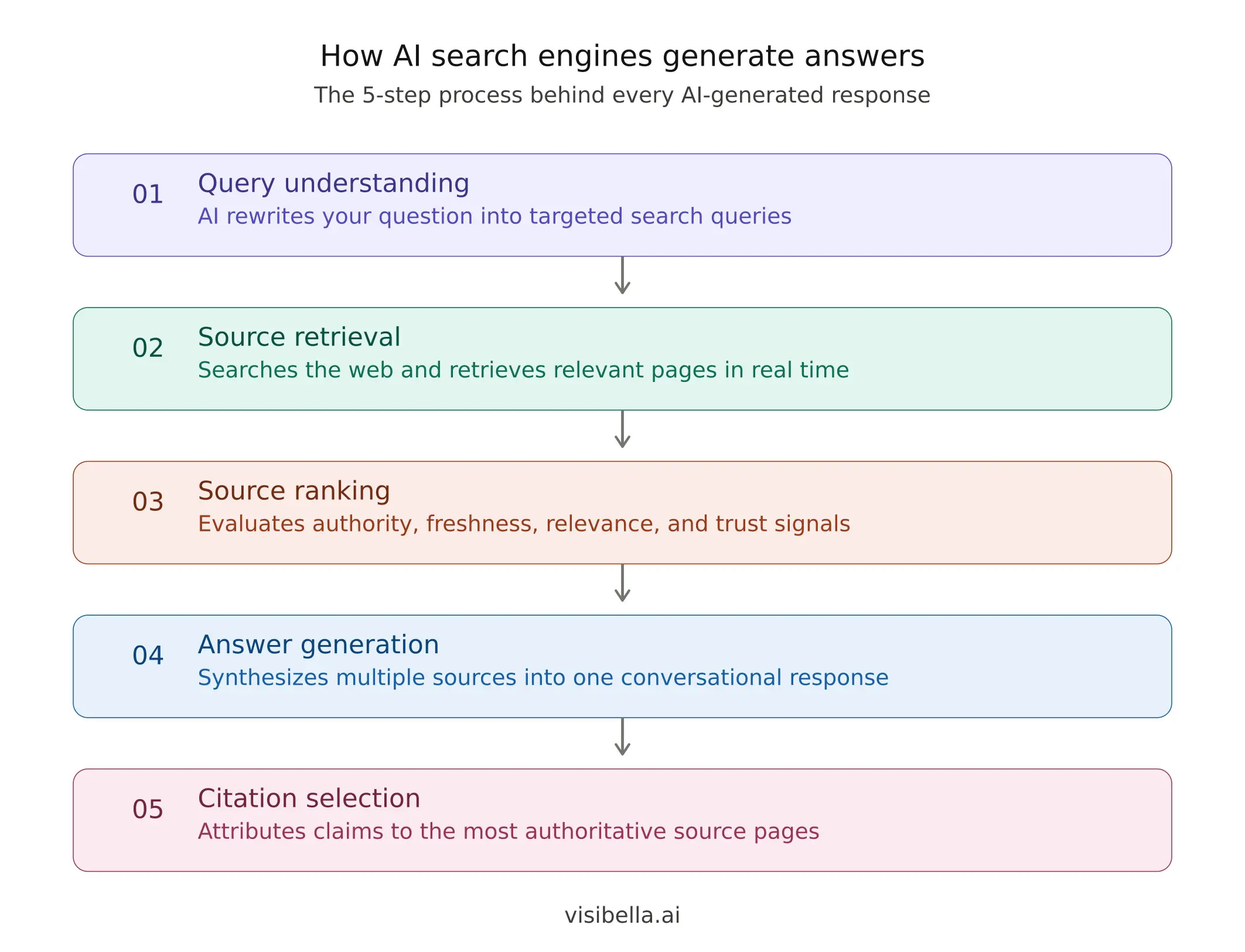
AI search engines follow a multi-step process to turn a user's question into a cited, conversational answer. While each platform has its own architecture, the general workflow involves five core stages: understanding the query, retrieving sources, ranking those sources, generating an answer, and selecting citations.
Every AI search engine is built on a large language model that has been trained on massive datasets of text including books, websites, code repositories, research papers, and more. This training gives the model a broad base of general knowledge. However, this knowledge has a cutoff date and can become outdated. That's why most AI search engines now supplement their training data with real-time web retrieval.
When a user asks a question, the AI engine doesn't just rely on what it "remembers" from training. It actively searches the web, sometimes issuing multiple parallel queries to find the most relevant and current information. This approach is known as retrieval-augmented generation, or RAG. The system finds relevant web pages, extracts key passages, and passes them to the language model as context for generating the answer.
Not all retrieved sources carry equal weight. AI search engines evaluate sources based on factors like domain authority, topical relevance, content freshness, factual consistency across multiple sources, and whether the content is structured in a way the model can easily parse. Pages that are well-organized, clearly written, and come from trusted domains are more likely to be selected.
Once the model has its context, a combination of its training knowledge and freshly retrieved web content, it generates a response. The model synthesizes information from multiple sources into a coherent, conversational answer. It doesn't copy and paste from any single page. Instead, it combines insights, rephrases information, and structures the response to directly address the user's question.
The final step is deciding which sources to cite. The model attributes specific claims to the web pages that supported them. Platforms like Perplexity show numbered inline citations. ChatGPT includes a "Sources" sidebar with clickable links. Google's AI Overviews show linked cards below the generated answer. The sources that get cited are the ones the model determined were most authoritative and directly relevant to the claims in the response.
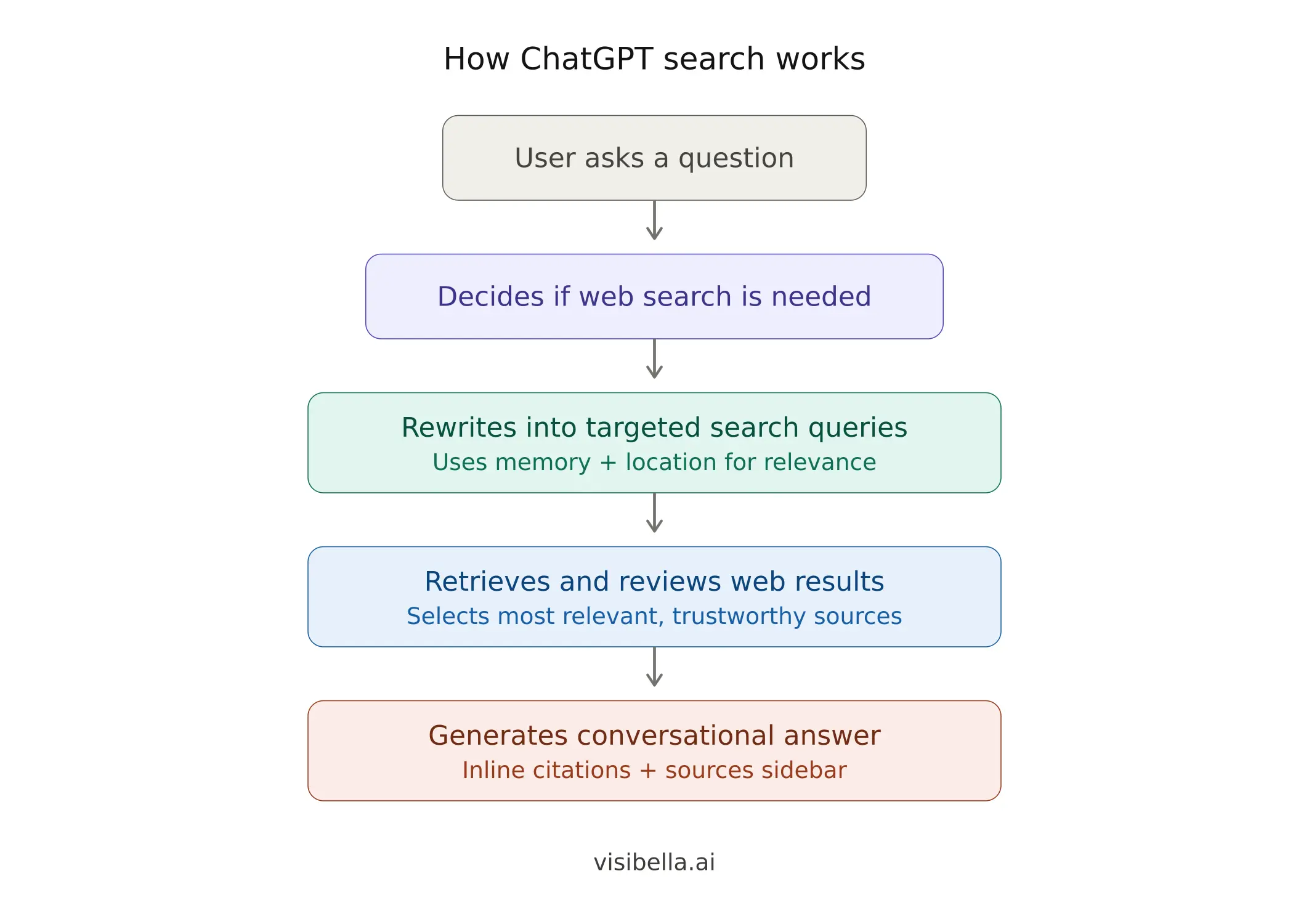
ChatGPT's search functionality, now available to all users, integrates real-time web retrieval directly into its conversational interface. When you ask a question that benefits from current information, ChatGPT automatically triggers a web search, retrieves relevant results, and synthesizes them into a conversational response with source links.
Here's how the process works. ChatGPT rewrites your natural language question into one or more targeted search queries. For instance, if you ask about the latest developments in a specific medical treatment, ChatGPT might generate multiple specific queries to search for clinical trial results, recent conference presentations, and expert commentary, all from a single question.
After retrieving results, ChatGPT reviews them, selects the most relevant and trustworthy sources, and generates a response that weaves those sources together into a clear answer. Every response that uses search includes inline citations and a sources sidebar where you can click through to verify the original content.
ChatGPT also uses memory and location context to improve search results. If you have memory enabled, the system can factor in your previous conversations and stated preferences to make search queries more relevant. It also uses general location data based on your IP address to deliver localized results when appropriate.
One key distinction: ChatGPT is selective about when it searches. For questions that can be answered reliably from its training data, like historical facts, well-established concepts, and general knowledge, it responds without searching the web. It reserves web search for queries where recency, specificity, or real-time data matters. This means getting cited by ChatGPT requires your content to be the kind of authoritative, well-structured resource that either earns its way into the model's training data or appears prominently in live search results.
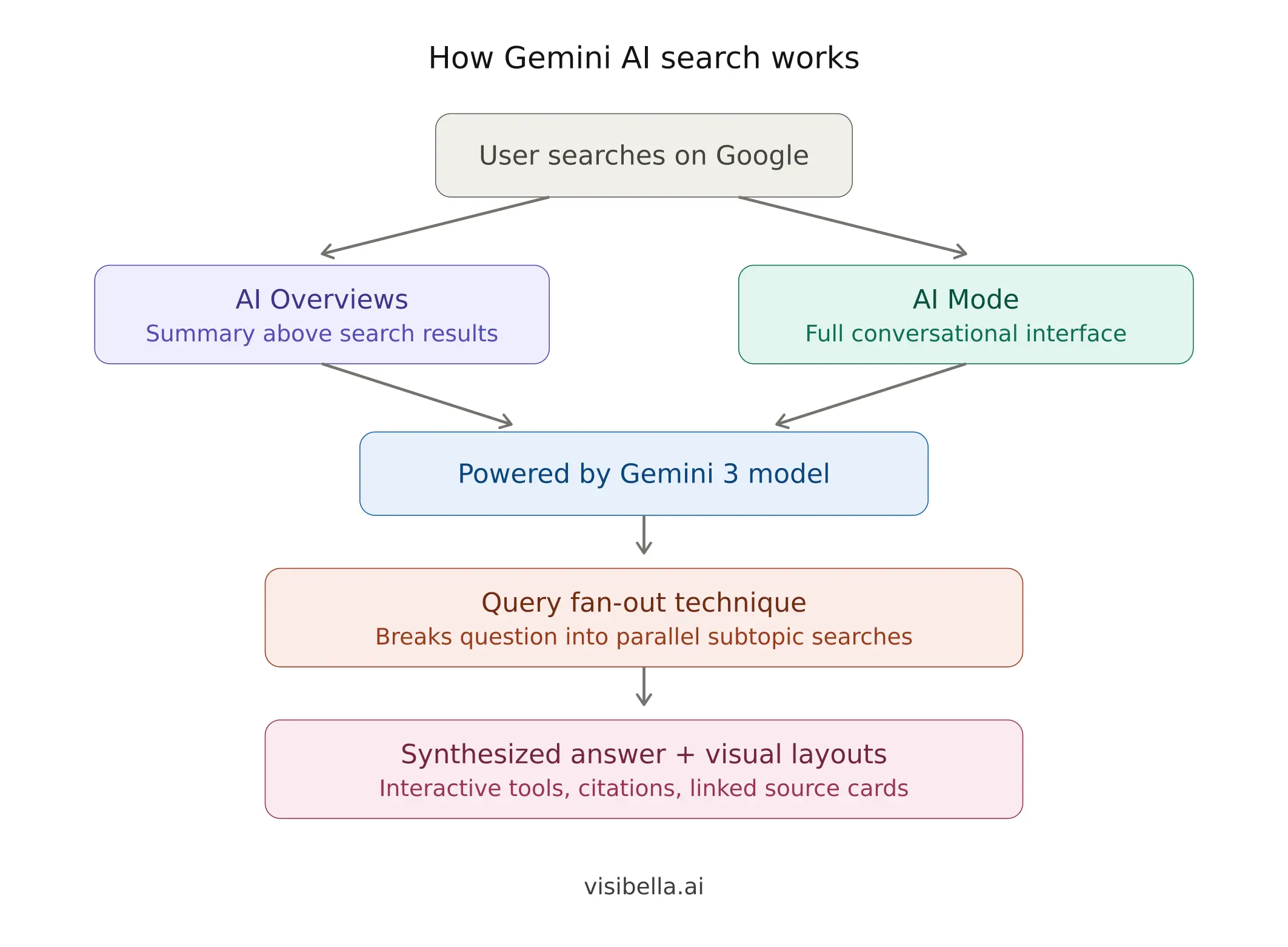
Google's approach to AI search is unique because it's built directly into the world's largest search engine. Gemini powers two key features: AI Overviews, which appear at the top of regular search results, and AI Mode, a dedicated conversational search experience.
AI Overviews are the AI-generated summaries you see above traditional search results for many queries. Powered by the Gemini 3 model, they provide a synthesized answer with links to source pages. Google has described this as a way to help users get a quick snapshot of the answer before deciding whether to explore further. These summaries now appear for billions of queries globally and reach an estimated 2 billion users monthly.
AI Mode goes a step further. When a user switches into AI Mode, they enter a full-page conversational interface where they can ask complex, multi-part questions and follow up naturally. Under the hood, AI Mode uses a technique Google calls "query fan-out." Instead of running a single search, the system breaks the question into multiple subtopics, runs parallel searches across different data sources, synthesizes the results, and presents a comprehensive answer with a citation panel.
What makes Gemini's search different from standalone AI chatbots is its direct access to Google's search index, the most comprehensive web index in existence. This gives Gemini an advantage in real-time information retrieval and a deeper pool of sources to draw from. The Gemini 3 model also generates dynamic visual layouts, including interactive tools, simulations, and calculators, directly in search responses.
For businesses, the implication is clear. Google's AI features are now the first thing many users see when they search. If your content isn't structured and authoritative enough to be cited in AI Overviews or AI Mode responses, your organic visibility takes a hit, even if you technically rank on page one of traditional results.
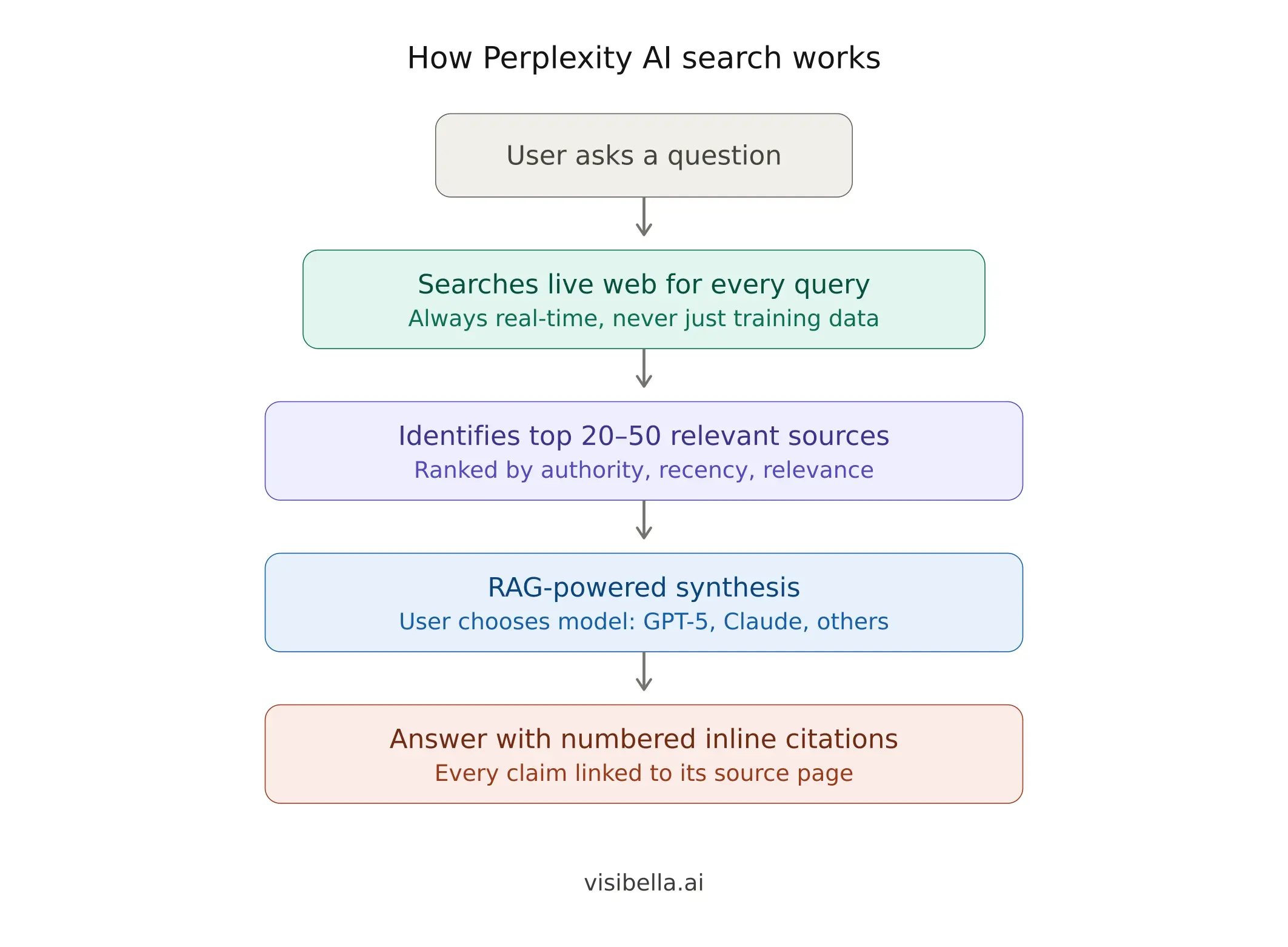
Perplexity positions itself as an "answer engine," a platform built from the ground up to deliver direct, citation-backed answers by searching the web in real time. Unlike ChatGPT, which supplements its training data with occasional web searches, Perplexity's default mode is to search the live web for every query.
When you ask a question, Perplexity searches the web, identifies the top 20 to 50 most relevant sources based on keyword match, authority, recency, and relevance, then extracts key passages from those sources. It passes this content to a language model, where users can choose from options like GPT-5, Claude, and others, which synthesizes the information into a coherent answer. Every claim in the response gets an inline numbered citation that links back to the original source.
This citation-first approach is what sets Perplexity apart. The transparency means users can verify every claim with a single click. It also means that when your content gets cited, users can click directly to your site, creating a measurable traffic channel that's more trackable than visibility in other AI platforms.
Perplexity uses retrieval-augmented generation (RAG) as its core architecture. Rather than relying primarily on the model's training knowledge, it grounds every answer in publicly available web content. This reduces hallucinations and makes the system particularly strong for current events, factual queries, and research tasks. The platform also offers Pro Search for deeper, multi-step research, and Deep Research for comprehensive reports that can analyze hundreds of sources in minutes.
For content creators and businesses, Perplexity represents the most transparent optimization opportunity among AI search engines. Because it searches the web in real time and shows exactly which sources it cites, you can directly observe whether your content is being selected and take specific steps to improve your citation rate.
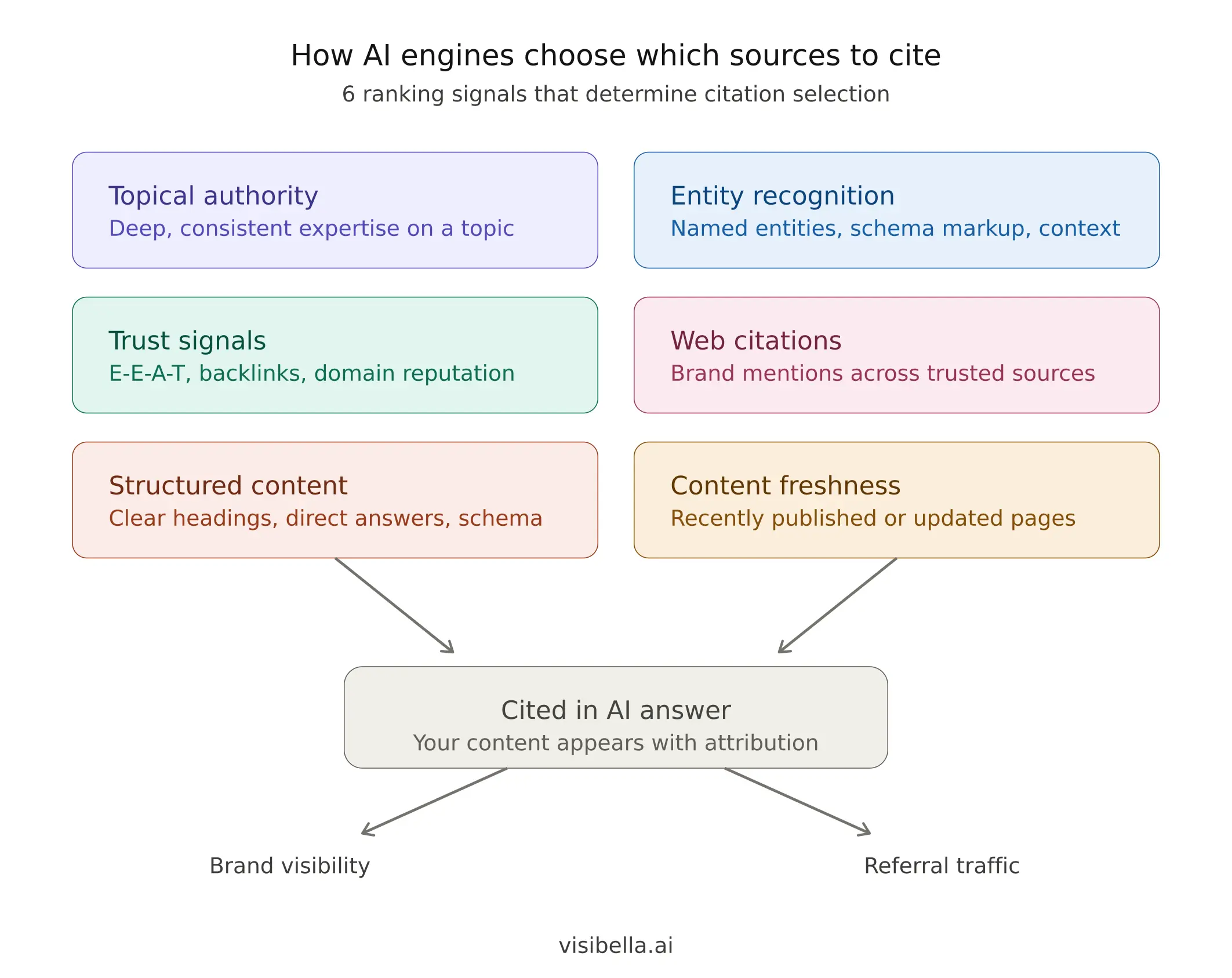
Understanding how AI engines select sources for citation is the key to visibility in generative search. While each platform has its own specifics, the common ranking signals that determine whether your content gets cited include several critical factors.
AI engines favor content from websites that demonstrate deep, consistent expertise on a topic. A site with dozens of interlinked articles covering every angle of a subject will be seen as more authoritative than one with a single blog post. Building topical authority requires sustained content development around specific subject areas.
Domain reputation matters. Sites with strong backlink profiles, established publishing histories, mentions in other trusted sources, and clear E-E-A-T signals (Experience, Expertise, Authoritativeness, Trustworthiness) are more likely to be cited. AI engines are designed to prioritize sources that are credible and verifiable.
AI models parse content more effectively when it's well-structured. Question-based headings, direct answers at the beginning of sections, clear definitions, and organized data make it easier for the model to extract and attribute information. This is a core principle of Answer Engine Optimization (AEO), which focuses on making content citation-ready for AI platforms.
AI models understand content in terms of entities like people, organizations, products, concepts, and the relationships between them. Content that clearly identifies and contextualizes entities using schema markup and consistent naming is easier for AI systems to interpret and cite accurately.
A major indicator of source trustworthiness is how widely the content or the brand behind it is referenced elsewhere on the web. Analysis has shown that branded web mentions have one of the strongest correlations with visibility in AI-generated answers. The more your brand, website, or content is cited by other authoritative sources, the more likely AI engines are to trust and cite it themselves.
For time-sensitive queries, AI engines heavily weight recency. Outdated content gets passed over in favor of recently published or recently updated pages. Maintaining a regular content update cadence is especially important for topics that evolve quickly.
Optimizing for AI search engines requires a different mindset than traditional SEO. The differences between AEO and traditional SEO are significant, and the goal isn't just to rank on a results page, it's to become the source that AI engines trust, extract from, and cite when generating answers. Here are the strategies that matter most.
Structure your content so AI models can easily extract answers. Use question-based headings. Lead each section with a direct, concise answer in the first 40 to 60 words. Follow with supporting detail, examples, and data. This format mirrors how AI engines process and select content for citation.
Don't publish isolated articles. Build comprehensive content hubs around your core topics. Interlink related articles. Cover subtopics, FAQs, comparisons, and implementation guides. AI engines look for breadth and depth when evaluating whether a source is authoritative on a subject.
Move beyond keyword targeting and focus on the concepts, entities, and relationships that define your topic. Use schema markup (Organization, Article, FAQ, HowTo) to help AI systems understand your content at a structural level. Cover related terms and questions naturally throughout your content.
Make sure your brand exists clearly across the web. Wikipedia pages, industry directories, social profiles, media mentions, and third-party reviews all contribute to your entity footprint. AI engines use these signals to assess whether your brand is a legitimate, trustworthy source.
Backlinks still matter, but in the context of AI search, brand mentions and citations on authoritative sites carry significant weight. Guest contributions, original research, data-driven reports, and expert commentary all build the kind of web presence that AI engines look for when selecting sources.
AI engines prioritize fresh information. Regularly audit and update your content. Add new data points, refresh examples, and update dates. A page that was last updated two years ago is less likely to be cited than one that was refreshed last month.
For businesses that want expert guidance on building visibility across AI platforms, working with a team that specializes in AI search optimization strategies can accelerate results and ensure your content meets the evolving standards AI engines use to select sources.
Some businesses are already seeing significant results from AI search visibility. The companies winning in this space share a few common characteristics.
They publish comprehensive, well-structured content that directly answers the questions their audience asks. They maintain strong entity presence across the web through consistent branding, media mentions, and authoritative third-party citations. They invest in schema markup and technical optimization that makes their content machine-readable. And they treat AI search visibility as a dedicated channel, not just a side effect of traditional SEO.
Businesses in competitive sectors like SaaS, financial services, healthcare, and e-commerce are finding that AI search visibility can influence buyer decisions before a user ever reaches their website. When an AI engine recommends your product or cites your expertise in a direct answer, that carries significant trust value, often more than a traditional organic listing.
The agencies and consultancies that specialize in this emerging field are seeing growing demand. A review of the top agencies focused on AEO strategies shows that the most effective approaches combine traditional SEO fundamentals with AI-specific optimization techniques, including structured content, entity optimization, citation tracking, and content strategies designed specifically for how AI engines evaluate and select sources.
The key lesson: businesses that start optimizing for AI search now will have a significant advantage as these platforms continue to grow and absorb more search behavior from traditional engines.
The trajectory is clear. AI search engines are becoming the primary way people discover information, evaluate products, and make decisions. Over the next decade, several trends will shape this evolution.
First, multimodal search will become standard. AI engines are already incorporating images, video, voice, and interactive elements into their responses. The next generation of AI search won't just give you text answers. It will generate interactive calculators, visualizations, and custom tools tailored to your specific question.
Second, personalization will deepen. AI search engines are building memory systems and user preference models that tailor results to individual needs. Over time, the answers two different users get for the same question may diverge significantly based on their history, context, and stated preferences.
Third, agentic search will emerge. AI models are evolving beyond answering questions to actually completing tasks like booking travel, making purchases, scheduling appointments, and executing multi-step workflows on behalf of users. When AI agents are choosing which businesses to interact with on a user's behalf, visibility and trust signals become even more critical.
Fourth, the importance of Answer Engine Optimization will grow. As more search traffic shifts to AI-generated answers, the businesses that have invested in structured, authoritative, citation-ready content will capture a disproportionate share of visibility. Those that haven't will find themselves increasingly invisible to the growing audience that relies on AI for information discovery.
The businesses that adapt now, by understanding how AI search engines work, building content strategies around citation-readiness, and learning how to rank on ChatGPT, Perplexity, and Gemini, will be positioned to thrive in a search landscape that looks fundamentally different from the one we've known for the past twenty years.
Traditional search engines return a list of ranked links. AI search engines use large language models to read, synthesize, and summarize web content into direct conversational answers with citations. Instead of sending users to ten websites, they deliver one comprehensive response.
ChatGPT automatically searches the web when your question requires current information, real-time data, or specific facts that may have changed since its training data was collected. For well-established facts or general knowledge, it responds from its training without triggering a web search.
AI Overviews is Google's feature that displays AI-generated summaries at the top of search results for relevant queries. Powered by the Gemini 3 model, it provides a quick synthesized answer with links to source pages, reaching over 2 billion users monthly.
Perplexity searches the live web for every query and shows numbered inline citations for every claim. ChatGPT uses its training data as a primary source and supplements with web search when needed. Perplexity's citation transparency makes it easier to track whether your content is being cited.
RAG is the process AI search engines use to ground their answers in real web content. Instead of relying only on training data, the model retrieves relevant web pages, extracts key information, and uses that content as context to generate a more accurate, current response.
AI engines evaluate sources based on domain authority, topical relevance, content freshness, how well the content is structured, whether the brand has a strong entity presence across the web, and how consistently the source is referenced by other trusted sites.
AEO is the practice of optimizing content specifically for AI answer engines rather than just traditional search rankings. It involves structuring content with direct answers, building topical authority, strengthening entity presence, and creating citation-ready content that AI platforms can easily reference.
Yes. Perplexity provides clickable citations that send referral traffic directly to cited sources. ChatGPT includes source links in its responses. Google's AI Overviews and AI Mode include links to source pages. The traffic volume depends on how often your content is cited and the visibility of the citation.
For Perplexity, check your referral traffic in Google Analytics for "perplexity.ai" as a source. For ChatGPT, monitor your referral logs. For Google AI features, Search Console data can help identify traffic from AI-enhanced search results. Citation tracking tools are also emerging in this space.
AI search optimization builds on SEO fundamentals but adds new requirements. Traditional SEO focuses on ranking in a list of results. AI search optimization focuses on being selected as a trusted source in generated answers. This requires structured content, entity optimization, schema markup, and a strong citation profile across the web.