What Is Answer Engine Optimization (AEO)? Complete Guide
What Is Answer Engine Optimization (AEO)?
Learn what Answer Engine Optimization (AEO) is, how AI search works, key AEO strategies, ranking factors, and how to improve your AI visibility.
Learn what Answer Engine Optimization (AEO) is, how AI search works, key AEO strategies, ranking factors, and how to improve your AI visibility.
The way people search for information has changed. Not gradually. Not hypothetically. It's happening right now, and most businesses haven't caught up.
In 2026, hundreds of millions of people ask ChatGPT, Perplexity, Gemini, and Google AI Overviews for answers every single day. They're not scrolling through ten blue links anymore. They're getting direct, conversational answers — often without ever clicking on a website.
Gartner predicted that traditional search engine volume would drop by 25% by 2026 due to AI chatbots and virtual agents. That prediction is playing out in real time. ChatGPT alone processes over 2.5 billion requests per day, Perplexity handles more than 60 million daily queries, and Google AI Overviews now appear in roughly 18% of all global searches.
Here's the problem: traditional SEO was built for a world where Google listed ten links and users clicked one. That world is shrinking. The new world rewards brands that AI systems can understand, trust, and cite. This is where Answer Engine Optimization comes in.
This guide breaks down everything you need to know about AEO — what it is, how it works, why it matters, and how to build a strategy that gets your brand into AI-generated answers.
Answer Engine Optimization (AEO) is the practice of optimizing your content so that AI-powered platforms — like ChatGPT, Perplexity, Google AI Overviews, Gemini, and Claude — can easily understand, extract, and cite your brand as a trusted source when generating answers to user queries.
Think of it this way. SEO helps your website rank in search results. AEO helps your brand become the answer.
The distinction matters more than most marketers realize. When someone asks ChatGPT "What's the best CRM for small businesses?" the AI doesn't return a list of links. It synthesizes information from multiple sources and delivers a direct recommendation. If your brand isn't structured, authoritative, and clearly positioned in the content that AI systems pull from — you're invisible to that buyer.
AEO encompasses several interconnected practices. It involves structuring content so AI models can easily parse and extract answers. It means building topical authority across your domain so AI systems recognize you as a credible source. It requires entity optimization — making sure AI models understand who you are, what you do, and why you matter. And it depends on earning citations across the web, because AI platforms cross-reference multiple sources before selecting which ones to feature.
The key shift is this: AEO measures success through citations, mentions, and brand visibility in AI-generated responses — not just rankings and clicks. In a world where 93% of AI search sessions end without a website click, getting cited in the answer is the new position one.
Understanding how AI answer engines work is essential before you can optimize for them. Traditional search engines use crawlers, indexes, and ranking algorithms. AI answer engines operate differently.
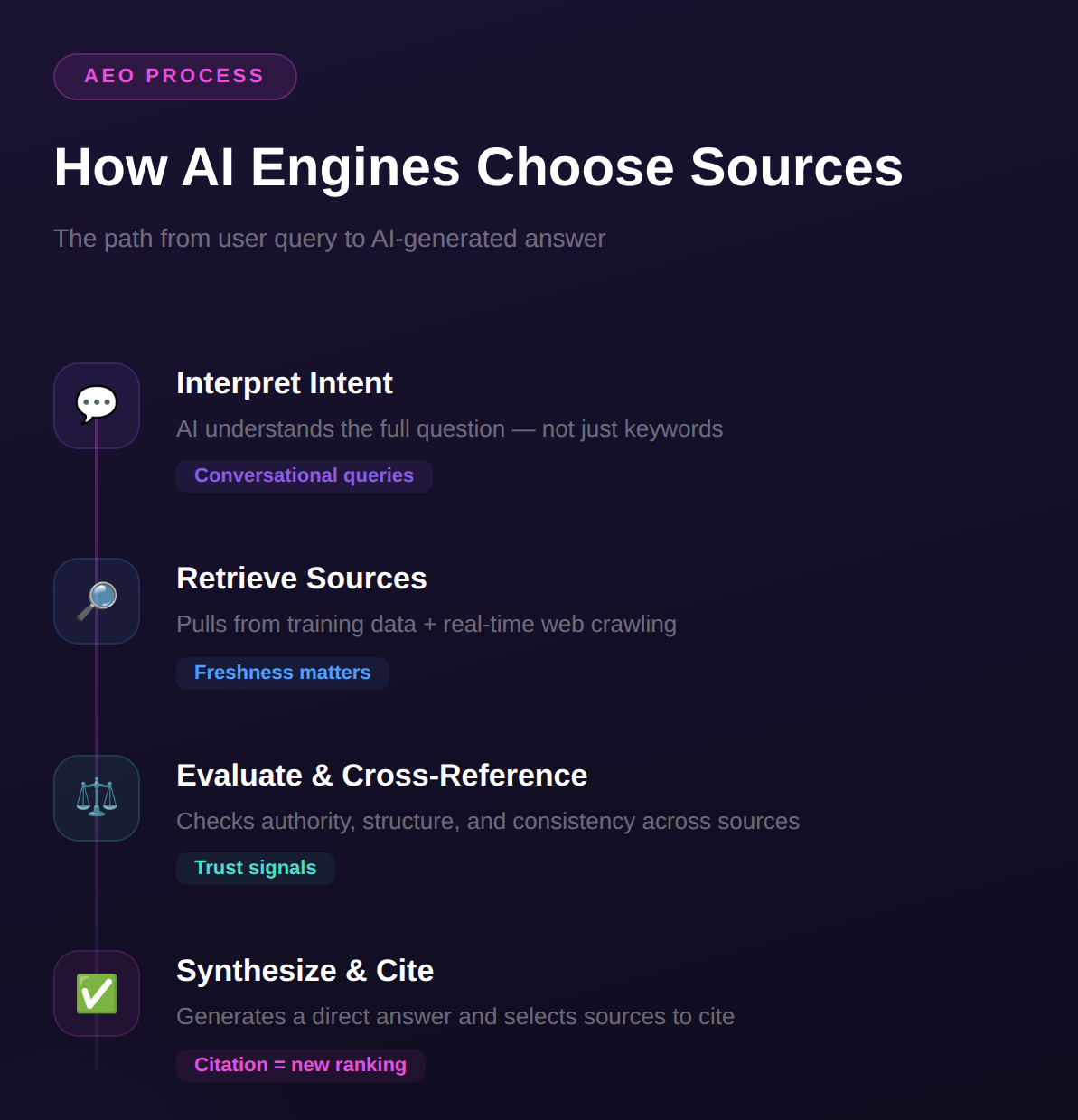
When a user asks a question on ChatGPT, Perplexity, or Google's AI Mode, the system follows a multi-step process. First, it interprets the user's intent — not just keywords, but the actual question behind the query. Then it retrieves relevant information from its training data and, in many cases, performs real-time web searches to pull current information. Finally, it synthesizes all of this into a coherent, direct answer, often citing specific sources.
This is fundamentally different from traditional search. Google's classic algorithm ranks pages based on relevance signals and lets users decide which result to click. AI answer engines make that decision for the user. They choose which sources to reference, which information to include, and how to present it.
Real-time retrieval is becoming increasingly important. Platforms like Perplexity and ChatGPT's browsing features actively crawl the web to find fresh information. Google AI Overviews pull from indexed pages and synthesize answers directly into the search results page. This means your content needs to be both permanently authoritative (for training data) and regularly updated (for real-time retrieval).
The practical implication is clear. AI models don't rank content the way Google does. They evaluate it for clarity, accuracy, authority, and structure. They look for content that directly answers specific questions, provides supporting evidence, and comes from sources they can trust. If your content meets those criteria, you get cited. If it doesn't, someone else does.
AEO and SEO are not competitors. They're complementary strategies that serve different stages of the modern search ecosystem. But the differences between them are significant enough that treating AEO as "just another SEO tactic" will leave you behind.
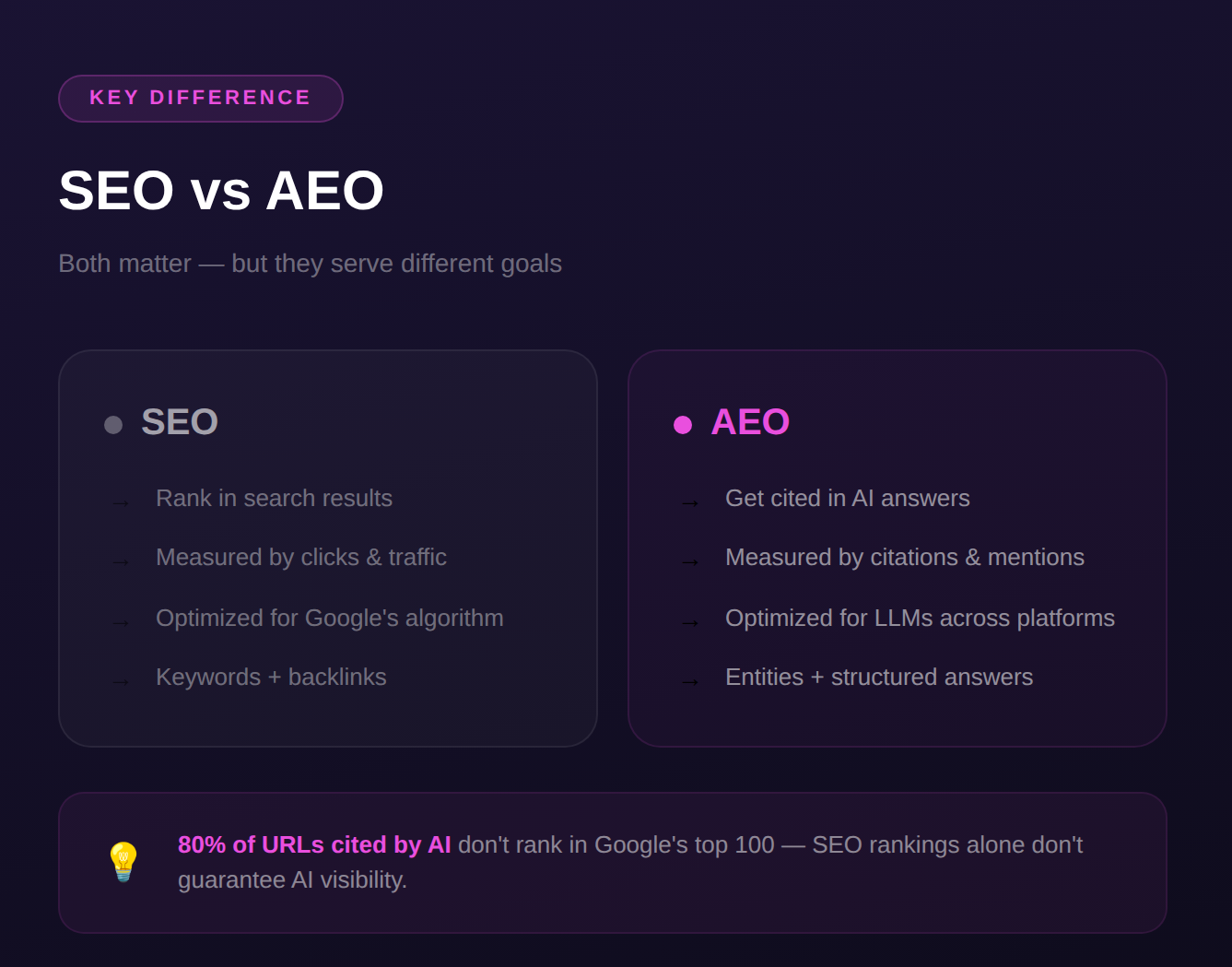
Traditional SEO focuses on getting your website to rank in organic search results. Success is measured through keyword rankings, organic traffic, click-through rates, and conversions. The core tools are keyword optimization, backlink building, technical site health, and on-page optimization.
Answer Engine Optimization focuses on getting your brand cited and recommended in AI-generated answers. Success is measured through AI citations, brand mentions in AI responses, share of voice across AI platforms, and referral traffic from AI tools. The core tools are structured content, entity optimization, topical authority, and citation building.
Here's where the overlap and divergence become important:
Where they align: Both require high-quality content. Both benefit from strong domain authority. Both reward topical expertise and E-E-A-T signals. A strong SEO foundation gives you a significant advantage in AEO because AI systems still rely heavily on web content as their source material.
Where they diverge: SEO optimizes for algorithms that rank pages. AEO optimizes for models that select sources. SEO targets keyword relevance. AEO targets answer completeness and clarity. SEO focuses primarily on Google. AEO spans ChatGPT, Perplexity, Gemini, Claude, Google AI Overviews, and voice assistants simultaneously.
One critical data point illustrates this divergence: research from Ahrefs found that roughly 80% of URLs cited in ChatGPT, Perplexity, and AI Mode do not rank in Google's top 100 results for the original query. That means traditional SEO rankings alone are not a reliable predictor of AI visibility. Content structure, authority signals, and citation patterns play a larger role in determining which sources AI systems choose.
The smartest approach in 2026? Build your strategy on strong SEO fundamentals, then layer AEO optimization on top. The two work together, but AEO demands specific tactics that traditional SEO frameworks don't address.
If the data above wasn't convincing enough, here's a more direct answer: AEO matters because AI search is where your customers are going — and many of them are already there.
ChatGPT has more than 900 million weekly active users. Google AI Overviews reach over 1.5 billion monthly users. Perplexity processes over 60 million queries daily and its user base has grown by 800% year-over-year. These aren't projections. These are current numbers.
The behavioral shift is just as significant as the platform growth. McKinsey found that 44% of AI-powered search users now consider AI their primary source of insight, compared to 31% who still rely most on traditional search. HubSpot's Consumer Trends Report shows that 72% of consumers plan to use AI-powered search for shopping more frequently. And according to SparkToro, nearly 60% of Google searches now end without a click.
For businesses, this creates both a risk and an opportunity.
The risk: If your brand isn't showing up in AI answers, your competitors are. Buyers are forming opinions about products, services, and companies inside AI chat interfaces before they ever visit a website. And unlike traditional search where you might appear on page two, in AI search you're either in the answer or you don't exist.
The opportunity: AEO is still early. Most businesses haven't started optimizing for AI visibility. The brands that build their AEO foundations now will compound their advantage as AI search continues to grow. It's similar to the early days of SEO — the companies that invested before everyone else caught on reaped outsized rewards for years.
The competitive window is narrow but wide open. Businesses that invest in answer engine optimization today are building long-term visibility that will be extremely difficult for latecomers to replicate.
This is the question that matters most for any AEO strategy. If you understand how AI platforms decide which sources to include in their answers, you can engineer your content to be selected.
AI models evaluate sources based on several factors, and these factors work together — not in isolation.
Authority and trust signals. AI systems prefer sources with established credibility. This includes domain authority, backlink profiles, brand recognition, and presence across multiple trusted platforms. Wikipedia, Reddit, and major publications are heavily cited across ChatGPT, Perplexity, and Google AI Overviews. But niche-authoritative sites can outperform larger brands in their specific domains. Research from Profound revealed that a relatively unknown site outranked Forbes in the fast-food sector within AI answers — proof that topical authority can trump raw domain size.
Content structure and clarity. AI models need to extract specific answers from your content. Pages with clear headings, direct answer paragraphs, structured data markup, FAQ sections, and well-organized information are significantly easier for AI to parse. BrightEdge found that sites implementing structured data and FAQ blocks saw a 44% increase in AI search citations.
Freshness and recency. BrightEdge research also showed that pages updated within 60 days are 1.9 times more likely to appear in AI answers than older content. AI systems prioritize current information, especially for queries where recency matters.
Cross-platform corroboration. AI models cross-reference multiple sources before selecting which ones to cite. If your information is consistent across your website, third-party publications, review sites, and industry directories, AI systems are more likely to trust and cite you.
Entity clarity. AI systems map the world using entities — brands, people, products, concepts. If your content clearly defines and reinforces your entity identity with consistent naming, internal linking, and supporting pages, AI can confidently identify who you are and what you're an authority on.
Based on current research and platform behavior, here are the factors that most influence whether your content gets cited in AI-generated answers.
AI systems don't just evaluate individual pages — they assess whether your entire domain demonstrates deep expertise in a subject area. A single blog post about CRM software won't get you cited. A comprehensive content hub covering CRM selection, implementation, pricing comparisons, integrations, and best practices will.
Building topical authority means creating interconnected content clusters that thoroughly cover a subject from multiple angles. Each piece should link to related content on your site, creating a web of expertise that AI models can map and trust.
Question-based headings, direct answer paragraphs (40-60 words that concisely answer a specific question), comparison tables, numbered lists, and clear section hierarchy are all retrieval signals for answer engines. They're not just formatting preferences — they're the structural cues AI models use to identify extractable answers.
Schema markup amplifies this. Applying FAQ schema, HowTo schema, article schema, and organization schema gives AI systems machine-readable context about your content. Schema adoption has risen 35% from 2023 to 2026, and websites with author schema are three times more likely to appear in AI answers.
Entity SEO is about making sure AI systems clearly understand your brand as a distinct entity. This involves maintaining consistent NAP (Name, Address, Phone) information across the web, optimizing your Google Knowledge Panel, building a strong Wikipedia presence if applicable, and ensuring your brand is accurately represented across data aggregators and industry directories.
AI models use entity relationships to determine authority. The more clearly defined your entity is — and the more connected it is to relevant topics and other authoritative entities — the more likely AI systems are to cite you.
How often other credible sources reference your brand, data, or content affects your AI visibility. Content with original statistics, proprietary research, and unique data points gets cited more frequently both by other publishers and by AI systems. This creates a compounding effect: more third-party citations lead to more AI citations.
SE Ranking's study of 2.3 million pages found that domain authority is the number one predictor of AI citations, with high-traffic sites earning three times more AI citations than low-traffic ones.
Your website needs to be technically sound for AI crawlers. This includes allowing AI bots like GPTBot and CCBot access to your content (check your robots.txt), maintaining fast load times, using clean URL structures, implementing proper SSL, and ensuring your content is accessible and crawlable.
Some publishers have blocked AI crawlers to protect their content. The trade-off is real: brands that restrict AI access may protect their content but lose AI visibility entirely.
Here's a practical framework for building your AEO strategy from the ground up.
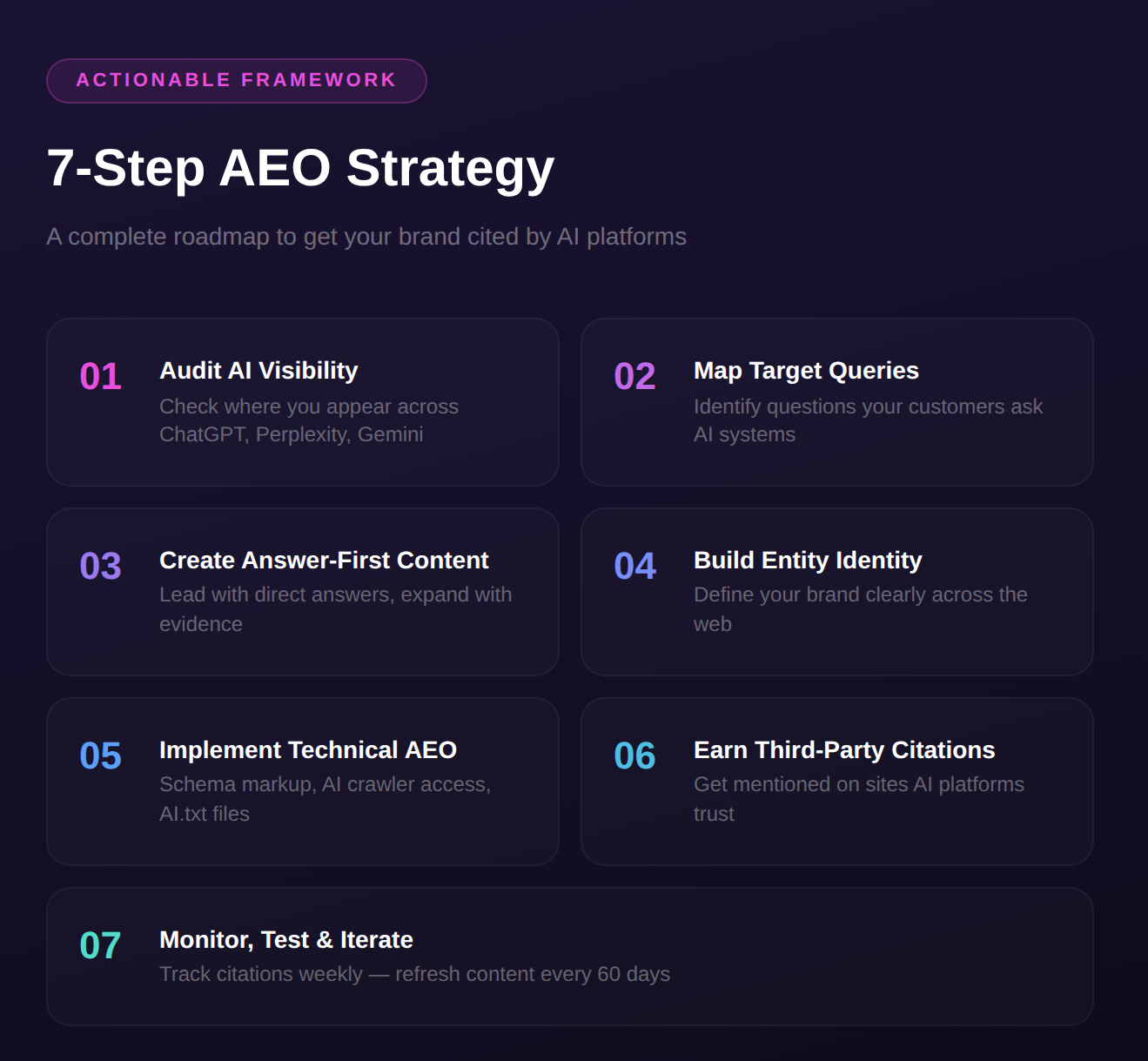
Before optimizing, you need to know where you stand. Search for your brand name and key product terms across ChatGPT, Perplexity, Gemini, and Google AI Overviews. Note whether your brand is mentioned, cited, or completely absent.
Tools like Profound, Peec AI, and Otterly can automate this tracking across multiple AI platforms. Set up baseline measurements for citation frequency, brand mention share, and sentiment in AI responses.
Identify the questions your ideal customers are asking AI systems. These aren't just keywords — they're full conversational queries like "What's the best email marketing tool for ecommerce?" or "How do I improve my website's conversion rate?"
Use tools like AlsoAsked, AnswerThePublic, and Google's People Also Ask to build a comprehensive query map. Group these into topic clusters that align with your expertise.
For each target query, create content that leads with a direct, complete answer in the first 40-60 words, then expands with supporting detail, evidence, and context.
Structure every page with question-based H2 and H3 headings. Include FAQ sections. Add comparison tables for competitive queries. Use numbered steps for process-oriented content. Every structural element should make it easier for AI to extract a clear, citable answer.
Ensure your brand entity is clearly defined across the web. Optimize your Google Business Profile, maintain consistent information across directories, and build your presence on platforms AI systems frequently cite — including Wikipedia (if notable enough), industry review sites, and authoritative publications.
Add comprehensive schema markup to your site: Organization, Article, FAQ, HowTo, and Product schemas at minimum. Verify that AI crawlers can access your content by checking your robots.txt for GPTBot, CCBot, and other AI user agents. Create an AI.txt file if appropriate to guide AI interaction with your content.
AI systems cross-reference sources. Being mentioned on other authoritative sites increases the likelihood that AI will cite you directly. Invest in digital PR, contribute expert commentary to industry publications, produce original research that others want to reference, and build relationships with the publishers that AI platforms cite most frequently.
AEO is not a set-and-forget strategy. AI systems update constantly, citation patterns shift, and platform behaviors evolve. Track your AI visibility weekly. Test different content structures. Refresh content regularly — pages updated within 60 days perform significantly better in AI answers.
If you're looking for expert help building your AEO strategy, specialized AEO agencies can accelerate the process with proven frameworks and platform-specific expertise.
Several patterns emerge when you study brands that consistently appear in AI-generated answers.
NerdWallet and Bankrate dominate financial queries across ChatGPT and Perplexity. Their success comes from structured comparison content, comprehensive guides that answer specific questions with clear data, and a massive backlink profile that reinforces their authority in the financial space. They don't just rank well in Google — they've built content architectures that AI systems find easy to parse and trust.
HubSpot consistently appears in marketing and sales AI queries. Their strategy relies on deep topic clusters — hundreds of interconnected pages covering every facet of marketing, sales, and customer service. This signals to AI systems that HubSpot is a comprehensive authority on these subjects.
Ulta Beauty saw its AI visibility index triple between April 2025 and January 2026 according to Similarweb's tracking. Their approach involved expanding their content footprint in ways that AI retrieval systems reward, focusing on product education, beauty guides, and comparison content.
Reddit is among the most cited platforms across multiple AI systems. This isn't because Reddit has the most authoritative content. It's because Reddit provides diverse perspectives, real user experiences, and conversational answers that AI models find highly relevant for many query types.
The pattern across all these examples is consistent: structured content, deep topic coverage, consistent entity identity, and a presence across multiple platforms that AI systems check against each other.
Brands that are still relying solely on traditional SEO tactics are missing these opportunities. The companies seeing the strongest AI visibility have adapted their content strategies specifically for how AI models discover, evaluate, and select information sources.
Most businesses new to AEO make similar mistakes. Avoiding these will save you months of wasted effort.
Treating AEO as a one-time project. AI systems are constantly evolving. Citation patterns shift monthly. Content that gets cited today might get replaced next quarter. AEO requires ongoing monitoring, content refreshes, and strategy adjustments. Companies that treat it as a checklist instead of a continuous process fall behind quickly.
Ignoring multi-platform differences. ChatGPT, Perplexity, Google AI Overviews, and Gemini all have different citation behaviors. Research from Superlines found that the same brand can see citation volumes differ by 615 times between different AI platforms. Optimizing for one platform while ignoring others means missing massive segments of your audience.
Focusing on keywords instead of entities. Traditional keyword optimization is table stakes. AEO requires entity-level thinking — defining your brand, products, and people as clear entities that AI systems can map and reference. If AI doesn't know what your brand is or what it does, no amount of keyword optimization will get you cited.
Blocking AI crawlers. Some brands have blocked GPTBot, CCBot, and other AI crawlers in their robots.txt files out of concern for content protection. The trade-off is direct: block AI access and you lose AI visibility entirely. The brands winning in AEO are making their content accessible and easy for AI to process.
Creating thin content around AI-friendly formats. Adding FAQ schema to shallow content doesn't work. AI systems evaluate the substance of your content, not just its structure. FAQ sections with two-sentence answers won't compete against comprehensive, evidence-backed responses. Structure enables extraction, but quality determines selection.
Neglecting third-party presence. Your website is only one piece of the puzzle. AI systems cross-reference information across multiple sources. If your brand only exists on your own domain with no third-party mentions, reviews, or citations, AI models have less reason to trust and cite you.
The trajectory of AI search is clear, even if the specifics are still unfolding.
AI will mediate more of the customer journey. Today, AI search is primarily used for informational queries. But ChatGPT's Agent Mode, Instant Checkout features, and deep integrations with commerce platforms signal a future where AI handles everything from research to purchase. The brands embedded in AI answers at the top of the funnel will have enormous advantages as AI captures more of the buyer journey.
Voice and agentic search will accelerate. Voice commerce is projected to hit $80 billion by 2026. AI agents that can book flights, purchase products, and manage tasks are already launching. These agents need structured, trustworthy content to make decisions on behalf of users. AEO principles — clarity, structure, authority — are exactly what agentic AI requires.
The GEO market is expanding rapidly. The Generative Engine Optimization market was valued at $848 million in 2025 and is projected to reach $33.7 billion by 2034. That growth reflects the massive investment businesses are beginning to make in AI visibility.
Citation patterns will become more sophisticated. Today, AI citation behavior is relatively simple. Tomorrow, AI systems will likely evaluate content freshness in real time, weigh first-party data more heavily, and factor in user engagement signals. Brands that build deep, authoritative content libraries now will be positioned to benefit from these evolving algorithms.
Multi-modal content will matter more. AI systems are already processing video, audio, podcasts, and images alongside text. Brands that produce content across multiple formats — and optimize each for AI retrieval — will capture visibility across a broader range of queries and platforms.
The businesses that win the next decade of search won't be the ones with the most backlinks or the highest keyword rankings. They'll be the ones whose content AI systems consistently choose to cite, recommend, and trust. That's the fundamental promise of Answer Engine Optimization — and the window to build that foundation is right now.
For businesses ready to take action, working with an experienced AEO partner can help you build a strategy that covers every platform, every query type, and every stage of the AI-driven customer journey.
Answer Engine Optimization is the practice of optimizing your content and online presence so that AI-powered platforms like ChatGPT, Perplexity, Google AI Overviews, and Gemini can understand, trust, and cite your brand when generating answers to user queries. It focuses on earning citations and mentions in AI-generated responses rather than traditional search rankings.
SEO focuses on ranking in traditional search engine results through keywords, backlinks, and technical optimization. AEO focuses on being selected and cited by AI answer engines through structured content, entity clarity, topical authority, and cross-platform presence. SEO measures clicks and rankings. AEO measures citations, mentions, and share of voice in AI responses.
Yes. SEO and AEO are complementary. A strong SEO foundation — quality content, domain authority, technical health — gives you an advantage in AEO. But SEO alone won't guarantee AI visibility. You need additional AEO-specific tactics like structured answer formatting, entity optimization, and AI crawler accessibility.
AI platforms evaluate sources based on authority and trust signals, content structure and clarity, freshness, cross-platform corroboration, and entity recognition. Pages with clear answers, structured formatting, schema markup, and strong domain authority are more likely to be cited.
Tools like Profound, Peec AI, Otterly, and HubSpot's AI Search Grader help track how often your brand appears in AI-generated answers across different platforms. You can also manually test queries in ChatGPT, Perplexity, and Google AI Overviews to assess your current visibility.
AEO is a medium-to-long-term strategy. Some improvements — like adding schema markup and restructuring existing content — can produce results within weeks. Building comprehensive topical authority and earning third-party citations typically takes three to six months to show measurable impact on AI visibility.
If AI visibility is important to your business, you should allow AI crawlers (GPTBot, CCBot, and others) to access your content. Blocking these crawlers removes your content from AI consideration entirely. Check your robots.txt file to verify access.
Absolutely. Topical authority can trump raw domain size in AI citations. A small business with deep, well-structured expertise in a specific niche can outperform larger competitors in AI answers for queries related to that niche. The key is comprehensive coverage, clear entity identity, and consistent content quality.
Content that directly answers specific questions performs best. This includes comprehensive guides with question-based headings, comparison pages, FAQ sections, how-to content, and data-driven research. The most cited content formats combine clear structure with substantive, evidence-backed answers.
No. AEO applies to any business that depends on organic discovery. B2C brands, ecommerce companies, local businesses, SaaS companies, and service providers all benefit from AI visibility. As more consumers use AI-powered search for shopping and research, AEO becomes relevant across every industry.
This guide is published by Visibella, an Answer Engine Optimization agency that helps brands get cited and visible across AI platforms including ChatGPT, Perplexity, Gemini, and Google AI Overviews.