How to Track Leads and Traffic From AI Search
How to Track Leads and Traffic From AI Search
Learn how to track AI search traffic and leads using GA4, branded searches, UTM links, AI visibility tools, and customer attribution.
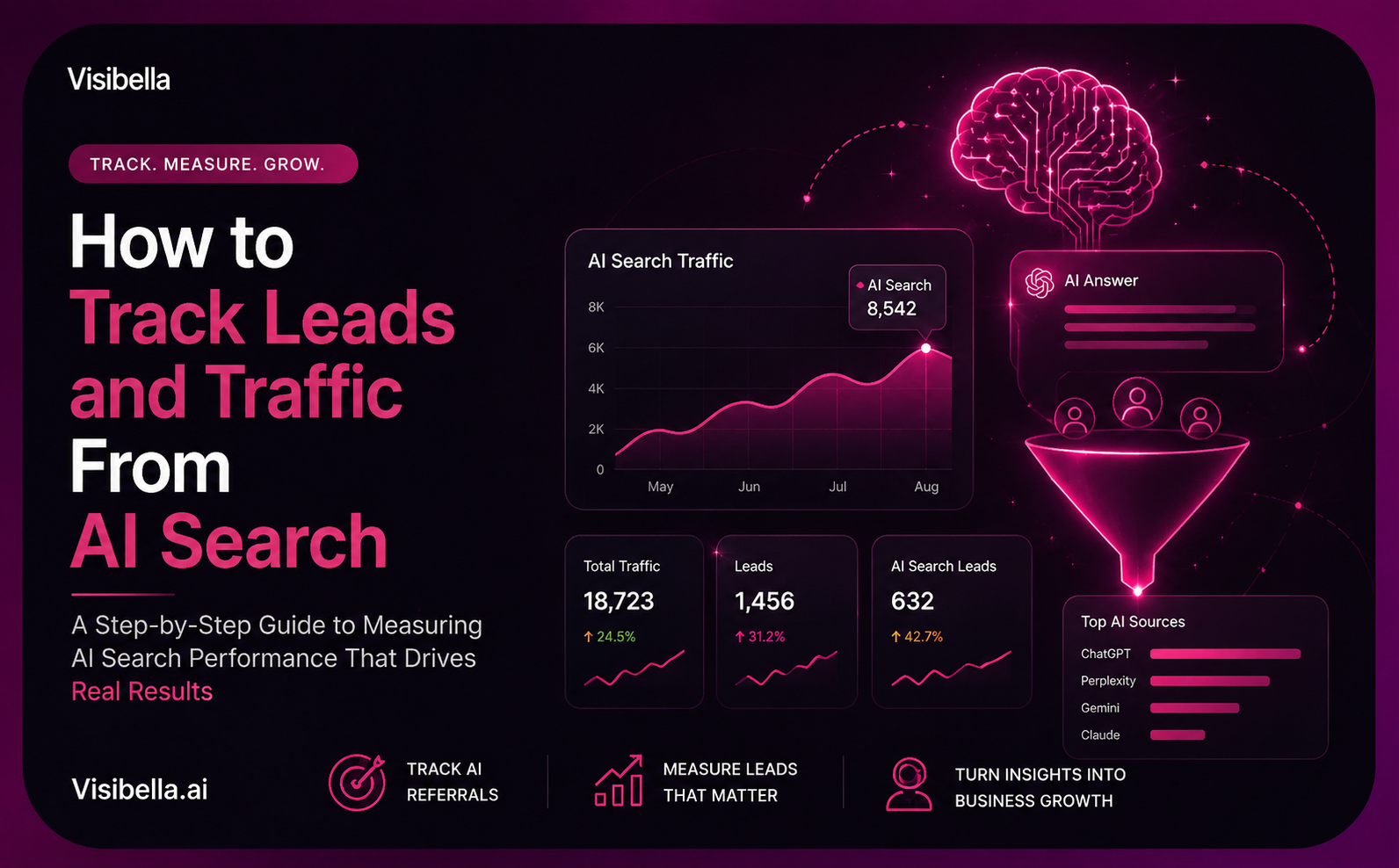
Learn how to track AI search traffic and leads using GA4, branded searches, UTM links, AI visibility tools, and customer attribution.
"How do I know AI search is actually driving results?"
It's the question we get more than any other. The short answer: because AI assistants rarely send a trackable click, you can't rely on one metric the way you do with classic SEO. Instead, you track AI search attribution by layering several signals together, watching branded search volume for lifts, monitoring your visibility for high-intent prompts in a tool like Peec AI, isolating AI referral traffic in GA4, tagging AI-cited links with UTM parameters, and asking leads directly how they found you. No single method is definitive, but stacked together they give you a clear, reliable read.
The rest of this post breaks down each method and why it matters.
Business owners see the case for showing up in ChatGPT, Perplexity, and Google AI Overviews, but they want to know it's working before they commit. That's fair. AI search attribution isn't as clean as classic SEO, where a Google Search Console report shows you exactly which query sent which click.
When someone gets an answer from an AI assistant, they usually don't click a link. They read the response, absorb the recommendation, and then act on it, often by searching your brand name directly in Google or typing your URL. The influence is real, but the click trail is broken. The AI did the persuading; the browser gets the credit.
That's the core challenge. No single tool captures the full picture, so we track attribution through a combination of methods. Each one covers a blind spot the others miss, and together they give you a reliable read on whether AI search is moving the needle.
This is the strongest signal we have. When someone discovers you through an AI assistant, their next move is usually to look you up by name. So a rising trend in branded searches, people Googling your company name, your product, or "[your name] reviews," is one of the clearest fingerprints of AI-driven discovery.
We monitor branded search volume in Google Search Console and Google Trends. When branded queries climb without a corresponding paid campaign, PR push, or seasonal spike to explain it, that lift is very likely coming from AI search. It's the digital version of "where did you hear about us?", answered at scale.
If you rank consistently in AI answers for the prompts your customers are actually asking, you can reasonably assume you're capturing that traffic, even when the click itself is invisible.
We use Peec AI to track this. Peec monitors how often your brand appears across AI engines for a defined set of industry-relevant prompts and reports a visibility percentage. A high visibility score for the prompts that matter, the questions a real buyer would type before making a decision, means you're the answer being handed to that buyer. There are other tools in this space, but Peec is the one we've standardized on for its prompt-level tracking.
The key is prompt selection. Visibility for a generic, low-intent prompt tells you little. Visibility for "best [service] in [city]" or "[product] vs [competitor]" tells you you're winning the conversations that end in a purchase.
Some AI platforms do pass links, and when a user clicks one, you can capture it. In Google Analytics 4, you can build an exploration that isolates traffic from AI sources like ChatGPT, Perplexity, Gemini, and Claude by filtering session source for their referral domains.
We set up a dedicated LLM exploration in GA4 that groups these referrers into a single channel so you can see AI-sourced sessions at a glance, along with what those visitors do once they land. Be prepared for the number to look small. Direct clicks from AI tools are only a sliver of your true AI-driven traffic, because most users never get a link in the first place. This report is real and worth having, but treat it as the floor of your AI traffic, not the ceiling.
Wherever you control a link that appears in AI-cited content, your own pages, Reddit threads, directory listings, and comparison content we build to earn citations, you can attach UTM parameters. When those links get surfaced and clicked through an AI answer, the UTM tags let you attribute the visit precisely in GA4 rather than lumping it into generic referral or direct traffic.
This won't cover organic mentions where the AI links straight to your homepage, but for the placements we actively build, it turns otherwise fuzzy traffic into clean, labeled data.
The lowest-tech method is still one of the most valuable. Add a "How did you hear about us?" field to your contact forms, and train your sales team to ask new leads where they found you. When people start saying "ChatGPT recommended you" or "I asked an AI for the best option," that's ground-truth attribution no analytics tool can replicate.
We increasingly hear this from clients' customers, and it's often the moment a skeptical business owner becomes a believer. Self-reported attribution is imperfect, but at the point of conversion it's remarkably honest.
There's no single dashboard that shows AI search attribution the way Google Search Console shows SEO. The users don't click, the platforms don't report uniformly, and the influence happens inside a conversation you can't see.
So instead of chasing one perfect metric, we triangulate. Rising branded search tells you discovery is happening. Prompt visibility tells you you're the answer being served. GA4 and UTM tracking capture the direct clicks that do come through. And self-reported attribution confirms it from the customer's own mouth. No single one of these is definitive, but stacked together they give you a clear, defensible picture of whether AI search is working.
That's the approach that gets you the most accurate read on your AI search performance and it's exactly how we track it for the businesses we work with.
Want to know how visible your business is in AI search today? Get in touch with Visibella for an AI visibility audit.