Let me guess how you found this.
You opened ChatGPT, typed in something like "best [your industry] company" or "who should I hire for [the thing you do]," and hit enter fully expecting to see your name. You've been in business longer. Your reviews are better. Your work is genuinely better. You know it is.
And then ChatGPT confidently rattled off three or four names, and one of them was that competitor. You know the one. The one whose work makes you wince a little.
So you're sitting there going: how is this possible? I'm better than them. Everyone knows I'm better than them. Why does the robot not know I'm better than them?
Okay. Deep breath. Let's actually answer this, because the real reason is not what most people assume, and once it clicks, the fix stops feeling mysterious.
The short version
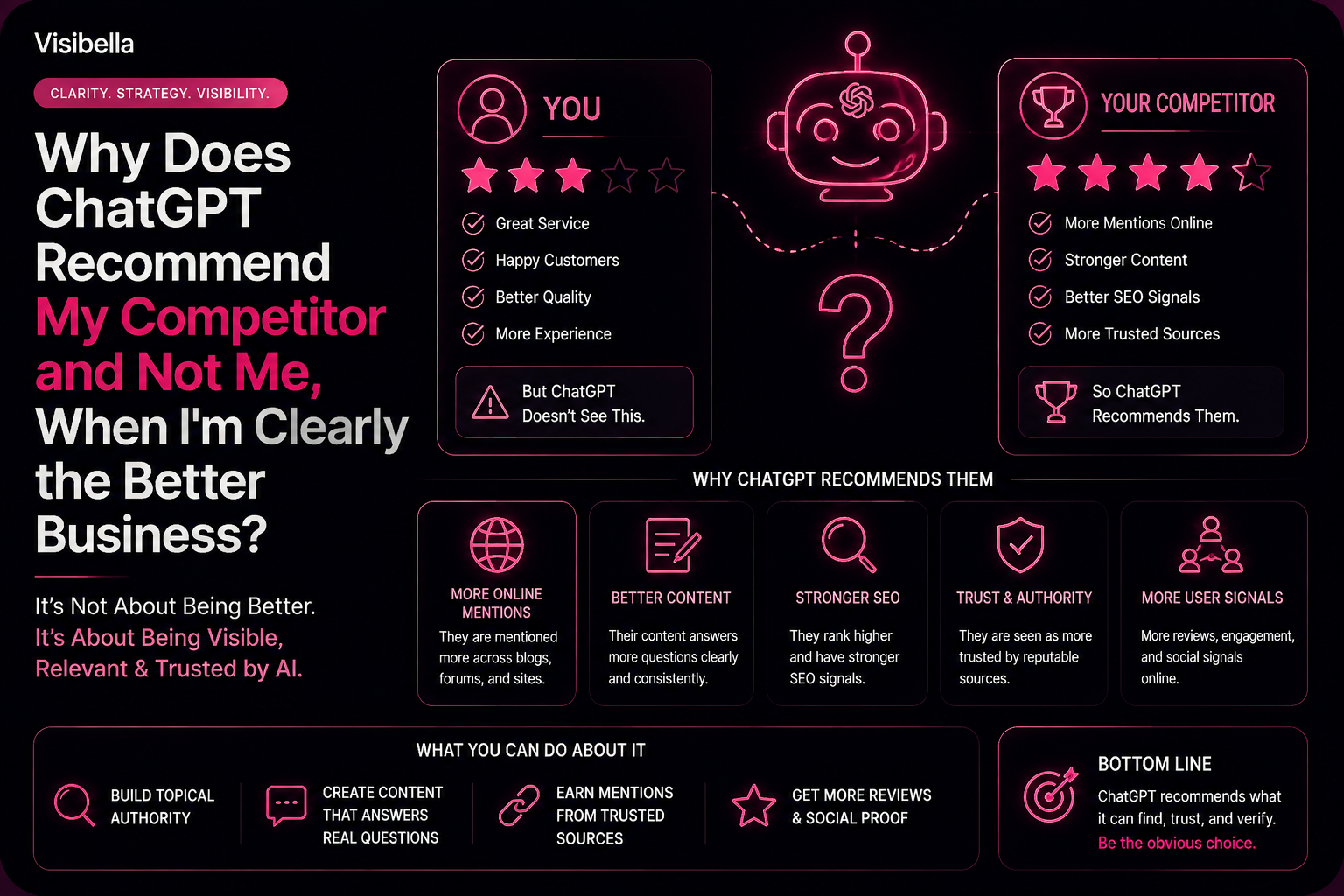
ChatGPT is not judging your business. It's judging the evidence about your business.
That's the whole thing. That's the sentence I want tattooed on the inside of your eyelids.
ChatGPT has never used your product. It's never met your team. It has no opinion about whether you're better. What it has is a giant pile of text from across the internet, and when someone asks it a question, it grabs the sources it can find, reads them, and builds an answer out of whatever it can actually verify.
So the real competition was never "your business vs. their business." It was "the evidence about you vs. the evidence about them." And if their evidence is clearer, more plentiful, and easier for a machine to read, they win the recommendation. Even if your actual business would win in real life every single time.
Better product, worse evidence, loses. That's the uncomfortable rule.
Wait, so it's not about who's actually better?
Correct, and I know that's annoying.
Think about how ChatGPT is even answering the question. When someone types "best commercial plumber in Austin," the model doesn't pull up a ranked list like Google. It fans that question out into a bunch of smaller searches (category, location, comparisons, reviews, pricing) and then reads whatever comes back to assemble an answer it can defend.
Notice the word defend. The model is basically trying to give an answer it won't get in trouble for. It wants to recommend the brand it can back up with sources. If your competitor shows up in a "best plumbers in Austin" listicle, has a pile of recent reviews, and has pages that clearly say what they do and who they serve, then the model has a safe, easy, defensible pick.
And you? If the only place on the internet that says you're great is your own website, the model has nothing external to lean on. You're not a bad option to it. You're an unverifiable one. And when in doubt, it reaches for the safer choice.
That's the quiet tragedy here: you're not usually losing because the model thinks you're worse. You're losing because the model can't confirm you're better.
So why does the model trust my competitor more?
Usually it comes down to a few things stacking up in their favor. Here are the big ones.
They show up on other people's websites, not just their own. This is the single most important one, so I'm putting it first. There's data floating around suggesting brands are something like 6x more likely to get cited through third-party sources than through their own site. Listicles, "best of" roundups, comparison articles, review sites, forum threads, local blogs, award pages. When a bunch of independent sources all mention a brand in the same context, the model gets confident. When a brand only talks about itself, the model stays skeptical. You can be the loudest voice on your own website and still lose to a competitor who got mentioned in three "top 10" lists.
Their reviews are recent, not just numerous. A stack of glowing reviews from 2022 does less than a steady trickle of fresh ones. Recency signals that you're active and still good now, which is exactly what the model wants to be able to say.
Their website is actually readable by a machine. This one is invisible to you and enormous. More on it in a second because it deserves its own section.
Their name is consistent everywhere. If your business is styled one way on your site, another way on Google, another on Yelp, and a slightly different way in that one news mention, the model may not realize those are all you. It splits your credit across what looks like several different weaker entities instead of one strong one. Boring problem, real consequences.
Their pages actually answer questions. Pages that plainly state "here's who this is best for, here's the pricing, here's how it works" give the model quotable, liftable answers. Pages full of "we're passionate about excellence and committed to our valued customers" give it nothing to work with. Brand poetry does not get cited. Clear answers do.
Let's talk about the technical thing, because this is where a lot of great businesses quietly lose
Here's a scenario that happens constantly.
Two businesses. Yours is better. But your competitor's website is built so a machine can read every inch of it cleanly, and yours... isn't. Their pages have proper structure. Their business info is marked up with schema, which is basically a behind-the-scenes label system that spells out for machines "this is the business name, this is the service, this is the location, this is the price, these are the reviews." Your site has all that same information, technically, but it's buried in a slick design, or locked inside images, or structured in a way that a crawler chokes on.
Guess who gets cited?
Here's the part that stings: if an AI engine can't cleanly read your website but it an cleanly read your competitor's, your competitor is going to get cited more often. Full stop. It doesn't matter that the same facts exist on both sites. The one the machine can actually parse is the one that makes it into the answer. You can be sitting on better information and still lose because theirs is legible and yours isn't.
Schema markup, clean heading structure, crawlable pages, machine-readable business details. This stuff feels like invisible plumbing that nobody sees, and that's exactly why it gets skipped. But it's often the difference between "the model confidently recommends you" and "the model can't quite make you out, so it moves on." Technical structure isn't the boring part of AEO. It's frequently the whole ballgame.
The good news: this is fixable, and it's usually one of the fastest wins available, because you're not building authority from scratch. You already have the substance. You just have to make it readable.
Okay, I'm convinced it's not personal. How do I actually fix it?
Roughly in order of impact:
- Get mentioned on sources that aren't you. Aim for the "best of" lists, roundups, and comparison articles in your category. Get onto relevant review platforms and keep them active. This is the heaviest lever, and it's also the slowest, so start now.
- Fix the technical readability. Schema markup, clean structure, crawlable pages, consistent business info. Make sure a machine can read your site as easily as it can read your best competitor's. Fastest category of win on this list.
- Clean up your name and info everywhere. One consistent business name, address, and description across your site, Google, directories, and any press. Consolidate your entity so all your credit lands in one place.
- Rewrite your key pages to actually answer questions. Plain statements of who you're for, what you cost, how you work. Give the model something quotable instead of a vibe.
- Keep it fresh. Recent reviews, updated pages, current info. Staleness reads as "maybe they're not around anymore," which is the last thing you want the model thinking.
None of this is about gaming anything or tricking the model. It's the opposite. It's making the true thing (that you're the better business) legible and verifiable to a machine that can only go on evidence. You're not manipulating the answer. You're finally giving it the proof it needed all along.
The honest takeaway
If ChatGPT is recommending a weaker competitor over you, it is almost never because the model decided they're better. It's because they left a clearer trail of evidence across the internet, and their website is easier for a machine to read. You've been winning the actual work and losing the paper trail.
That's genuinely good news, because a trail is something you can build. A machine-readable site is something you can fix. Your product being great was always the hard part, and you already did that.
Want to know exactly why the model is picking them and not you? That's the thing we do. Get your free AEO visibility report and we'll show you precisely how ChatGPT, Gemini, Perplexity, and the rest currently see your brand, where your competitors are beating you, and what's actually fixable. If you'd rather just talk it through with a human, book a demo and we'll walk you through your specific situation.
You built the better business. Let's make the machines admit it.