AEO for SaaS Companies
AEO for SaaS Companies: Complete Optimization Guide for B2B Software
How do B2B SaaS companies get their products recommended by AI assistants when potential customers ask for software solutions? The answer lies in Answer Engine Optimization (AEO), also called Generative Engine Optimization (GEO). Unlike traditional SEO that focuses on ranking web pages, AEO structures your content so AI models like ChatGPT, Perplexity, and Claude can easily extract, understand, and cite your information when users search for solutions.
For B2B software companies, this means optimizing every piece of content—product pages, documentation, feature descriptions, and comparison guides—to appear in AI-generated recommendations. When someone asks "What's the best project management tool for remote teams?" you want your product mentioned in that answer.
This complete guide covers everything you need to know about implementing AEO for your SaaS company, from technical setup to content strategy.
Answer Engine Optimization is the practice of structuring your content so AI systems and search engines can extract clear answers from it. For B2B software companies, this means making your product information, features, pricing, and use cases easily discoverable and citable by AI tools like ChatGPT, Claude, Perplexity, and Google's AI Overviews.
Think about how people search today. Someone might ask "What's the best CRM for small teams?" and get an immediate answer from an AI tool. That answer might reference your product, or it might not. AEO makes sure you're in the conversation. The goal is simple: be the source that answer engines trust and cite.
If you're new to this concept, you can learn the fundamentals of AEO to understand how it differs from what you've been doing with traditional SEO.
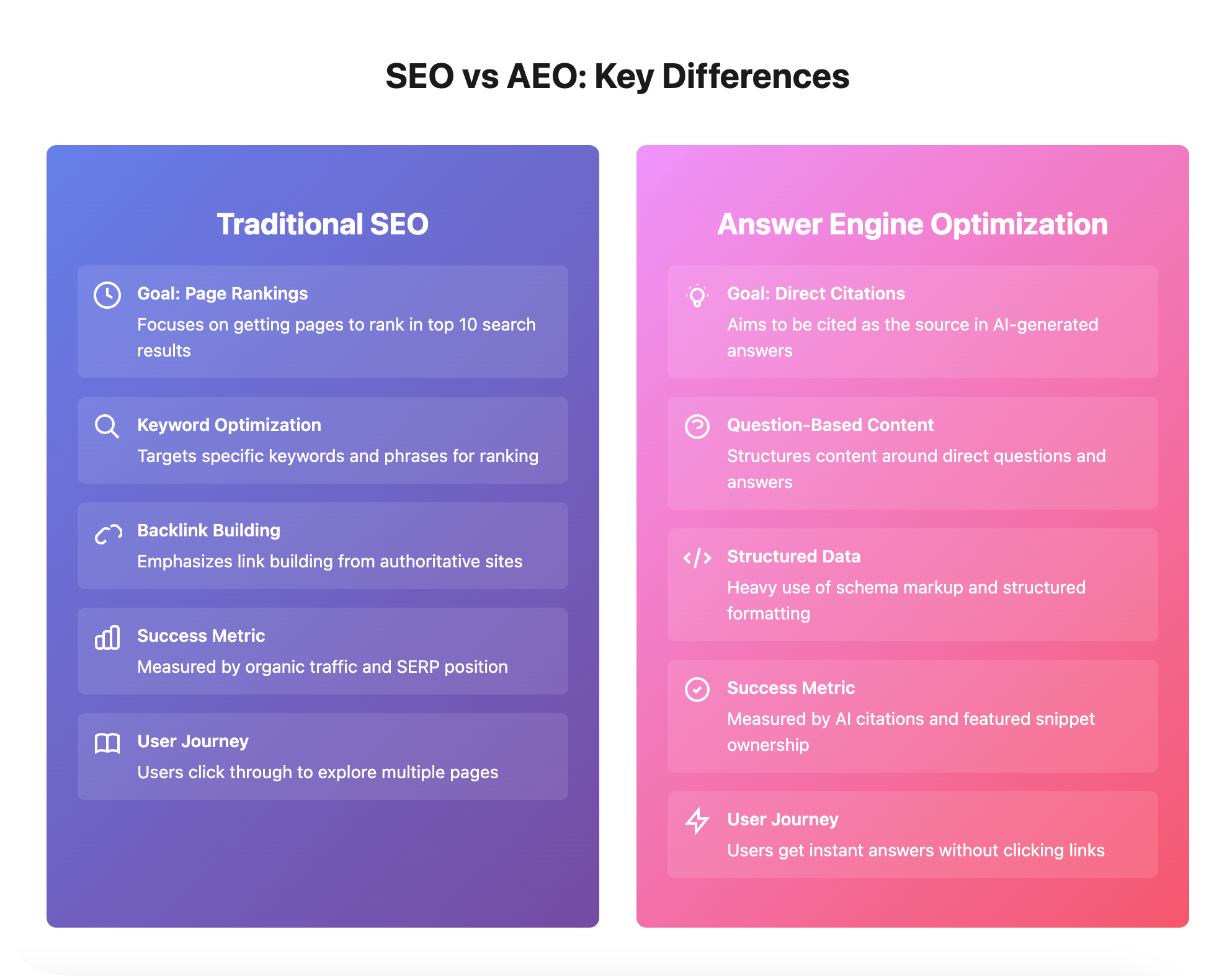
Many B2B marketers ask about the differences between AEO and SEO, and understanding this distinction is crucial for your optimization strategy.
SEO focuses on ranking your page in search results. You optimize for keywords, build backlinks, and improve page speed. Success means appearing in the top 10 results where users can click through to your website.
AEO targets direct answers. You structure content so machines can understand and extract specific information. Success means being the cited source in AI-generated responses, featured snippets, and voice search results—often without the user needing to visit your website at all.
Here's a practical example: With SEO, you write a blog post titled "10 Best Project Management Tools" and hope it ranks on page one. With AEO, you structure that same content with clear definitions, comparison tables, and FAQ sections that AI can parse and reference directly in their responses to users.
Both matter for modern SaaS marketing. But AEO addresses how people actually find information in 2025—through conversational AI interfaces rather than traditional search result pages.
B2B software purchases are research-heavy. Decision-makers ask dozens of questions before committing to a purchase. They compare features, read reviews, and look for specific capabilities across multiple tools before making a final decision.
Answer engines are becoming their first stop for this research. Tools like ChatGPT, Claude, and Perplexity provide instant, synthesized answers without requiring users to visit multiple websites. If your content isn't optimized for these platforms, you're essentially invisible during the critical early research phase when buyers are forming their consideration sets.
Consider the typical buying journey: A potential customer asks "Does [your category] integrate with Salesforce?" If answer engines can't find that information clearly stated on your site, they'll cite your competitor instead. This means you lose the opportunity to even be considered in the evaluation process.
AEO also improves traditional SEO performance. Google increasingly shows direct answers through featured snippets and AI overviews at the top of search results. The same optimization techniques that help ChatGPT cite your content also help Google feature it prominently, giving you visibility in both traditional and AI-powered search experiences.
Search behavior has fundamentally changed over the past two years. Users want answers, not links to explore. Traditional search required significant effort—you'd scan through multiple pages, read various articles, and piece together information yourself. That process is rapidly disappearing, especially for B2B software research.
Now users type questions into AI assistants and expect complete, synthesized answers immediately. This isn't just about convenience; it reflects how AI tools have trained people to interact with information differently. Several platforms are driving this change, and getting your brand cited in ChatGPT has become a critical marketing objective for B2B companies.
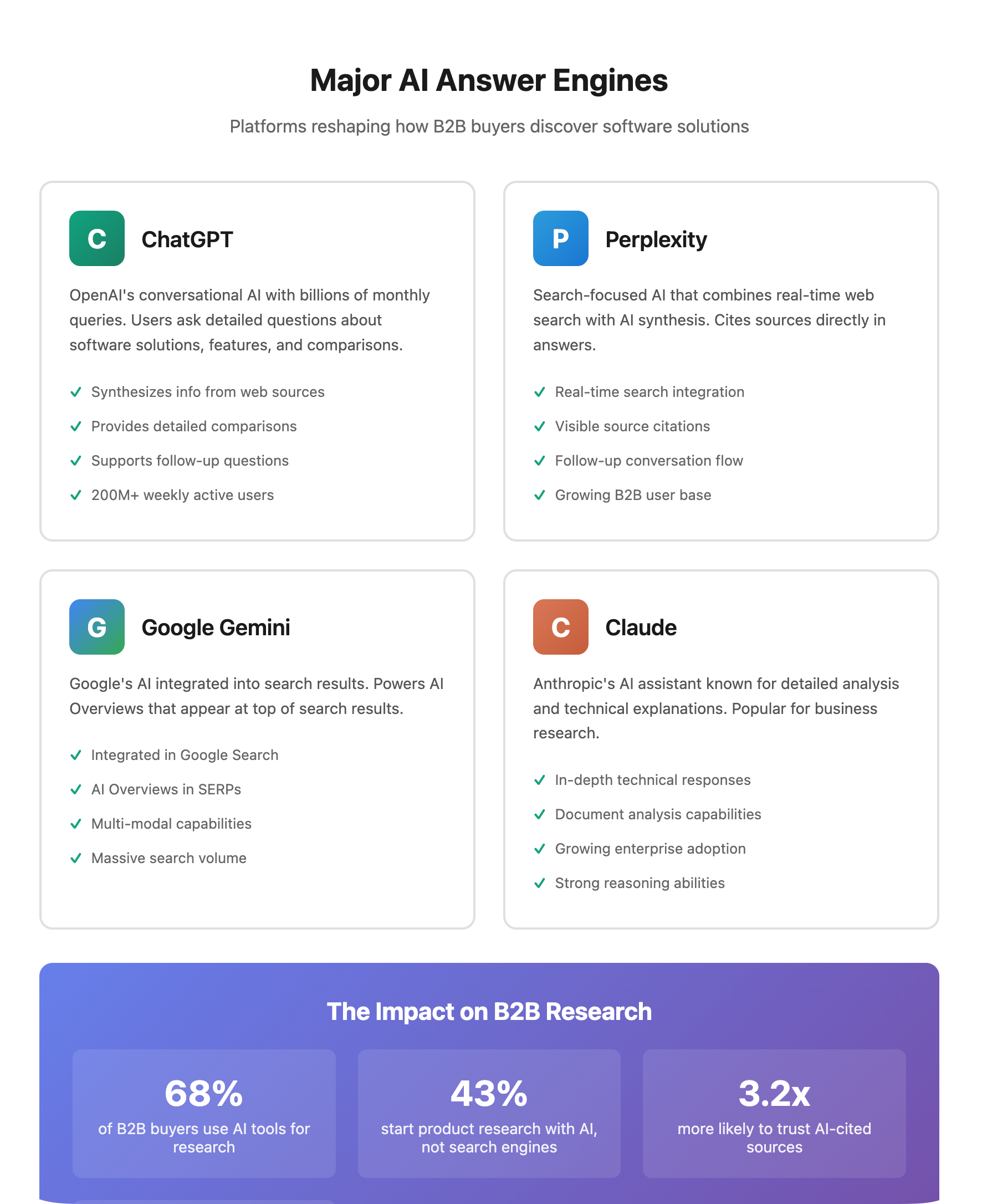
ChatGPT processes billions of queries monthly and has become a primary research tool for business software buyers. Users ask it everything from technical integration questions to product comparisons, and ChatGPT synthesizes information from across the web to provide comprehensive answers.
Perplexity combines search with AI-generated answers and explicitly cites sources. It presents a complete response upfront while providing links to the original sources, making it particularly valuable for users who want both quick answers and the ability to verify information.
Google's AI Overviews appear at the top of traditional search results, pulling from multiple sources to create comprehensive answers. Getting featured here means massive visibility since these overviews appear before traditional search results for many queries.
Claude (Anthropic's AI assistant) is increasingly used by technical teams and developers for research. Its strength in analyzing documentation and technical content makes it particularly relevant for B2B SaaS companies with complex products.
These platforms don't just compete with Google—they're fundamentally changing how people expect information to work and what counts as a "search" in the first place.
B2B buyers are adopting AI tools for software research faster than many marketers expected, and they're asking increasingly sophisticated questions.
They use AI to create comparison matrices instantly. Instead of manually researching five CRM options across multiple websites, they ask an AI assistant to summarize key differences in features, pricing, and ideal use cases. The AI pulls from various sources and presents a structured comparison table in seconds.
They ask highly specific technical questions that would be difficult to answer through traditional search. Questions like "Does [Tool] support SAML SSO with Okta?" or "What's the API rate limit for the enterprise tier of [Platform]?" require precise answers that AI tools can extract from documentation and support pages.
They expect immediate, contextual responses tailored to their specific situation. A question like "What's the best project management tool for a remote team of 15 people in the healthcare industry?" requires understanding multiple variables, and AI tools excel at synthesizing this type of contextual answer.
This creates both a challenge and an opportunity for SaaS marketers. If your content isn't AEO-optimized, you lose visibility at this critical research stage. But if you optimize correctly, you become the authoritative source that AI tools consistently reference, putting you at the top of buyers' consideration lists.
Let's get into the practical strategies that actually work for SaaS companies. For a broader overview of these techniques across industries, check out this comprehensive answer engine optimization guide.
Structured data tells search engines and AI systems exactly what your content means—it's like adding clear labels to everything on your site so machines can understand it without guessing.
For SaaS companies specifically, this means implementing schema markup for software applications. You mark up your product with specific properties including software category, pricing model, key features, operating system compatibility, and more. When an AI processes your page, this structured data provides immediate context about what your product does, what problems it solves, and what features it offers.
Start with SoftwareApplication schema on your product pages. Include properties like:
Add Organization schema to your homepage. This establishes your company's identity, location, founding date, and relationships to other entities. Search engines use this to build their knowledge graph about your business, which helps them understand your authority and credibility.
Implement WebPage and Article schema for all content. These schemas help search engines understand the purpose and structure of each page, making it easier for AI to extract relevant information.
The implementation requires adding JSON-LD code to your site's HTML. Most modern CMS platforms support this through plugins or built-in features. Test everything using Google's Rich Results Test tool to ensure your markup is error-free and follows current best practices.
Featured snippets are those answer boxes at the top of Google results—they're essentially Google's version of AI answers, and they're incredibly valuable for SaaS visibility. Getting into featured snippets requires specific content formatting that makes it easy for Google to extract and display your answer.
Start by identifying questions your target audience actually asks. Use tools like AnswerThePublic, Google's "People Also Ask" section, or your own customer support tickets to find real questions. These show exactly what information people are searching for related to your software category.
Structure your content using this proven format:
For list-based snippets (like "What features should project management software have?"), use bullet points or numbered lists. Make each point clear and self-contained so it can stand alone if extracted.
For comparison snippets, create HTML tables that directly contrast features, pricing tiers, or capabilities. Tables are particularly effective for SaaS content since buyers constantly compare options.
The key to featured snippet success is directness. Don't bury the answer three paragraphs deep in flowery introduction text. Put the direct answer immediately after the question heading, then provide supporting information. This format serves both human readers who want quick answers and AI systems that need to extract precise information.
Building your content around actual questions people ask aligns perfectly with how AI tools process queries and formulate responses. This question-based approach should form the foundation of your entire content strategy.
Create a comprehensive question database by gathering questions from multiple sources:
Group these questions into logical categories such as features, implementation, pricing, integrations, security, use cases, and industry-specific applications. This categorization helps you create comprehensive content that addresses related questions together.
Create content that answers multiple related questions comprehensively. Each piece shouldn't just address one narrow question but should provide a complete resource on a topic. For example, an article titled "How to Choose Project Management Software for Remote Teams" might address:
Use a clear Q&A format for FAQ sections. Write each question exactly as people ask it (not a corporate-sanitized version), then provide a direct answer followed by additional context if needed. This format is easily parsed by AI systems and serves human readers well.
This question-focused approach serves both humans and AI optimally. People find the information they need quickly by scanning questions. AI tools can easily extract specific answers to cite in their responses. And search engines can feature your content in snippets for relevant queries.
Technical implementation separates companies that talk about AEO from those who actually achieve results. The following technical elements are non-negotiable for B2B SaaS companies serious about AI visibility.
Product schema forms the foundation of your technical AEO strategy—it tells search engines and AI systems exactly what you sell and how your product works.
Implement SoftwareApplication schema on all product pages with these critical properties:
Name and description: Your product name and a clear, keyword-rich description that explains what problem you solve. Avoid marketing jargon; be specific about functionality.
Application category: Be as specific as possible. "Project Management Software for Healthcare Teams" is significantly better than generic "Business Software" because it helps AI systems understand your exact niche.
Operating system compatibility: List all supported platforms explicitly (Windows, macOS, Linux, Web-based, iOS, Android). This helps AI answer specific compatibility questions.
Software version and release date: Keep these current and update them with each product release. Freshness signals matter for AI systems determining which sources to cite.
Pricing information using nested Offer schema: Include your pricing tiers, what's included at each level, billing cycles, and currency. Structure this as nested Offers within your SoftwareApplication schema.
Feature list as an array: List key features descriptively but concisely. Each feature should be understandable without additional context.
Aggregate rating data: If you have reviews on G2, Capterra, or your own site, include aggregated rating information. This appears in search results and influences AI recommendations.
Validate your schema regularly using Google's Rich Results Test and Schema Markup Validator. Google's guidelines evolve, and broken schema can actually hurt your visibility. Set a quarterly reminder to check all product pages after any site updates or CMS changes.
FAQ schema is one of the most powerful tools for Answer Engine Optimization because it directly feeds Google's featured snippets and provides structured Q&A data that AI systems can easily extract and cite.
Create comprehensive FAQ sections on your homepage and all product pages that address the questions your customers actually ask. Don't just answer questions you want to answer—address the real concerns, objections, and information gaps that prospects have during their research.
Structure your FAQ schema properly. Each question-answer pair should be marked up as a separate entity within the FAQ schema. Include the complete question text exactly as people ask it and the full answer (not just a fragment).
Keep individual FAQ answers between 40-150 words for optimal performance. Answers shorter than 40 words often lack sufficient value to be featured. Answers longer than 150 words are too long to fit in featured snippet spaces and may be truncated or ignored.
Update your FAQ content regularly based on new customer questions, product changes, and market evolution. Search engines and AI systems favor fresh, actively maintained content over stale FAQs that haven't been touched in years.
Avoid duplicating questions across different pages. If the same question appears on multiple pages with FAQ schema, Google may ignore your schema entirely or show inconsistent results. Each FAQ question should have one canonical answer on one primary page.
Target a mix of informational and commercial questions. Include questions about how your product works (informational) as well as pricing, implementation, and buying process questions (commercial). This captures prospects at different stages of the buying journey.
Google's Knowledge Graph is the information database that powers many search features, including the information panels that appear for brand searches. Getting your company properly represented in the Knowledge Graph improves visibility across all Google properties and helps AI systems understand your company's identity and authority.
Start by claiming and completing your Google Business Profile thoroughly. Even if you're not a local business, having a verified Google Business Profile provides authoritative information that Google uses for its Knowledge Graph. Add your website, all social media profiles, business hours, detailed description, and relevant categories.
Claim and optimize your Crunchbase listing. Google pulls significant company information from Crunchbase for technology companies. Ensure your profile includes founding date, funding information, key personnel, product descriptions, and headquarters location. Keep this information current as your company evolves.
Maintain perfectly consistent NAP information (Name, Address, Phone number) across the entire web. Inconsistencies confuse search engines and can prevent proper Knowledge Graph association. Use exactly the same business name format everywhere, including punctuation and capitalization.
Build citations on authoritative industry directories. Focus on B2B software-specific directories like G2, Capterra, Software Advice, TrustRadius, and GetApp. These authoritative signals help establish your company's legitimacy and expertise in the software space.
Link all your social profiles to your website using rel="me" attributes. This HTML attribute confirms ownership and helps search engines connect your various online properties in the Knowledge Graph, creating a comprehensive view of your company's digital presence.
Create a Wikipedia page if your company meets notability guidelines. This is challenging and requires meeting Wikipedia's strict standards for notability (significant coverage in independent, reliable sources). However, a Wikipedia page is one of the strongest possible Knowledge Graph signals. Don't attempt this unless you genuinely qualify—inappropriate Wikipedia pages get deleted quickly.
Secure media coverage and press mentions in authoritative publications. Coverage in industry publications, tech news sites, and mainstream media helps establish your company's significance and provides the external validation that Knowledge Graph algorithms look for.
Your content strategy determines whether answer engines view you as an authority worth citing or just another vendor making claims. The following approaches have proven effective for B2B SaaS companies building AI visibility.
Answer-first content gets directly to the point without lengthy introductions or unnecessary context—this format is essential for AEO because both AI systems and human readers want immediate answers.
Structure every piece of content around a core question or problem. State it clearly in your title and opening paragraph, then provide the answer within the first 100 words. This doesn't mean creating short, shallow content. After delivering the immediate answer, expand with details, examples, supporting evidence, and additional context.
Think of this as an inverted pyramid structure: most critical information first, supporting details after. A traditional blog post might spend 300 words setting context before getting to the point. An answer-first post delivers the key information immediately, then provides context for readers who want deeper understanding.
Use clear, descriptive headings that work as standalone questions. Instead of vague headers like "Implementation" or "Overview," use specific questions: "How Long Does Implementation Take?" or "What Technical Requirements Are Needed?" These question-based headers make it easy for AI systems to locate relevant information.
Break complex answers into numbered steps when appropriate. If someone asks how to implement your software or how to accomplish a specific task, provide clear numbered steps with specific instructions for each. This format is highly effective for featured snippets and easy for AI to extract and present.
Include concrete examples for abstract concepts. When explaining a feature or capability, show it in action with a real-world scenario. Describe specific use cases with concrete outcomes rather than speaking in abstract benefits. "Our automation feature saves teams an average of 5 hours per week by eliminating manual data entry between systems" is far more effective than "Our automation feature improves efficiency."
This structure serves multiple audiences effectively: humans can scan and find information quickly, AI tools can extract precise answers to cite, and search engines can easily feature your content in snippets and AI overviews.
Topic clusters organize your content around core themes in a hub-and-spoke model. This structure helps establish topical authority with both search engines and AI systems, making it clear that you have comprehensive expertise in specific areas.
Create pillar pages for your main topics—these are comprehensive resources that broadly cover important subjects. A B2B SaaS company might have pillar pages for topics like:
Each pillar page should provide comprehensive coverage of its topic, typically 3,000-5,000 words that thoroughly address all major aspects of the subject. These pages target high-volume, competitive keywords and serve as the authoritative resource on their topics.
Create cluster content that dives deep into specific subtopics. These pages link back to the pillar page and to related cluster content, forming an interconnected web of expertise. For example, a project management software company with a pillar page on "Project Management Best Practices" might create cluster content including:
This structure signals comprehensive expertise to AI systems. When answer engines see interconnected, thorough coverage of a topic area, they're significantly more likely to cite your content as an authoritative source. The internal linking structure also helps search engines understand topic relationships and your areas of specialization.
Internal linking is critical in the cluster model. Every cluster page should link back to its pillar page using relevant anchor text. Related cluster pages should link to each other where contextually appropriate. This creates clear information architecture that both humans and AI can follow to understand your expertise.
Update pillar pages regularly as you create new cluster content. Add links to new cluster articles, refresh statistics and examples, and ensure the pillar page remains the most comprehensive single resource on its topic.
You need both types of content because they serve different purposes in your AEO strategy and capture different types of queries.
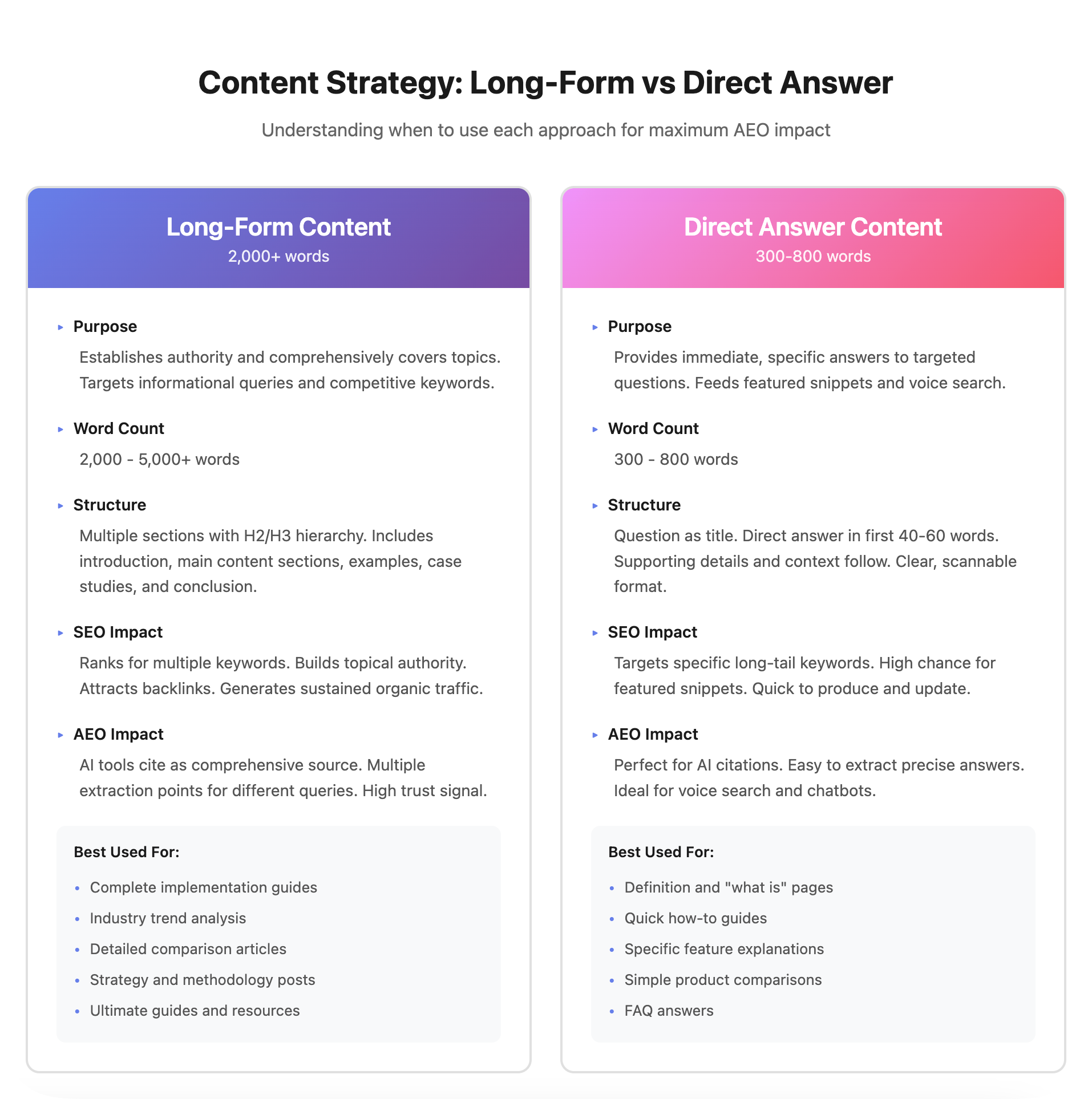
Long-form content (2,000+ words) establishes authority and expertise. It comprehensively covers topics, demonstrates deep knowledge, and ranks for multiple related keywords simultaneously. These pieces build trust with both human readers and AI systems by showing you understand topics thoroughly, not superficially.
Create long-form content for:
Long-form content also tends to accumulate backlinks more effectively because it provides value worth referencing. This social proof further reinforces your authority with AI systems.
Direct answer content (300-800 words) targets specific questions and feeds featured snippets. These focused pieces get straight to the point and provide clear, actionable answers without extensive background information.
Create direct answer content for:
Balance both formats in your content calendar. Use long-form content to demonstrate comprehensive expertise and rank for competitive, high-volume terms. Use direct answer content to capture specific long-tail questions and maximize your chances of being featured in snippets and AI responses.
A practical ratio might be one long-form pillar piece monthly with 2-3 direct answer pieces weekly. This provides both depth and breadth while keeping your publishing cadence sustainable.
Voice search and conversational AI require different optimization approaches because people speak differently than they type. If you want to understand how to rank on ChatGPT, Perplexity, and Gemini specifically, optimizing for natural language patterns is essential.
Conversational keywords reflect natural speech patterns and question phrases rather than the shortened keyword phrases people type into traditional search boxes. Instead of typing "best CRM small business," someone speaking to an AI assistant asks "What's the best CRM for a small business?" or "Which CRM should I use for my 10-person company?"
Identify conversational query patterns by analyzing:
Optimize heavily for question phrases using who, what, when, where, why, and how. These words dominate voice queries and conversational searches. Your content should address full question variations like:
Include location-specific information when relevant. Voice searches often carry local intent even for B2B software. Queries like "software companies near me" or "CRM providers in [city]" are increasingly common as people seek local implementation partners or vendors with regional presence.
Use natural, conversational language throughout your content. Write as if you're explaining something to a colleague in person, not reciting from a technical manual. Avoid overly formal corporate speak that doesn't match how people actually talk about software solutions.
Target long-tail conversational phrases that include multiple qualifiers. "Best project management software for small marketing agencies with remote teams" is how people actually speak to AI assistants, not how they type traditional searches. These highly specific queries often have less competition and higher conversion intent.
Natural Language Processing (NLP) is how AI systems understand context, meaning, and relationships between concepts in your content. Optimizing for NLP means writing clearly and naturally while making relationships between entities explicit.
Include synonyms and related phrases naturally throughout your content. Don't robotically repeat "project management software" 50 times. Use natural variations like "PM tools," "project coordination platforms," "team management systems," and "project tracking solutions." This helps NLP systems understand that you're discussing the same concept while making content more readable for humans.
Answer questions completely and contextually. If someone asks about your pricing, don't just list numbers. Explain what's included at each tier, describe who each plan best suits, clarify how billing works, mention any setup fees or discounts, and compare value across tiers. Complete answers help NLP systems understand full context and provide better responses to nuanced questions.
Use entity recognition strategically by referencing specific entities. Name specific technologies, platforms, industries, and company types. When discussing integrations, explicitly name the platforms you integrate with rather than vague references to "popular tools." When explaining use cases, specify the industries and company sizes you serve. These explicit entity references help AI understand your exact positioning and relevance.
Maintain clear relationships between related concepts. When discussing features, explain how they connect to outcomes. When covering integrations, describe the workflows they enable. When presenting use cases, connect them to specific industries and company characteristics. These explicit relationships help NLP systems understand context and extract accurate information.
Write in active voice whenever possible. Active voice is more natural, clearer, and easier for NLP systems to parse accurately. "Our software automates workflow approvals" is clearer than "Workflow approvals are automated by our software." Active voice also creates more engaging content for human readers.
Define technical terms and acronyms at first use. Don't assume AI systems or readers know industry jargon. The first time you use an acronym like "SSO" or "SAML," spell it out: "Single Sign-On (SSO)" or "Security Assertion Markup Language (SAML)." This helps NLP systems properly understand technical concepts.
You can't improve what you don't measure. Track these specific metrics to understand your AEO performance and identify optimization opportunities.
Zero-click search visibility: These are searches where users get their answer directly from featured snippets, AI overviews, or knowledge panels without clicking through to any website. Track how often your content appears in these prominent answer positions. Google Search Console shows impression and position data for featured snippets under the "Search Appearance" filter.
Featured snippet ownership rate: Monitor how many featured snippets you own for your target keywords compared to competitors. Track this monthly to identify trends, measure progress, and spot opportunities where competitors currently appear but you could potentially claim the snippet position.
AI citation frequency: This is harder to measure systematically but increasingly critical. Manually query ChatGPT, Claude, Perplexity, and other AI tools with questions your prospects would ask. Track when and how they cite your company, mention your product, or reference your content. Document the exact queries that trigger your mentions and the context in which you appear.
Position zero rankings: Track keywords where you appear in position zero (the featured snippet above traditional first position). This indicates strong AEO optimization and provides visibility even when users don't click through to your site.
Voice search visibility: Use specialized voice search tracking tools to monitor how you rank for question-based queries that voice assistants typically answer. While voice search data is less readily available than traditional search data, tools like Semrush and Ahrefs now include some voice search tracking capabilities.
Question-based keyword rankings: Track your rankings specifically for question keywords (those starting with who, what, when, where, why, how). These queries typically trigger featured snippets and AI answers, making them particularly valuable for AEO measurement.
"People Also Ask" box appearances: Monitor how frequently your content appears in Google's "People Also Ask" expandable boxes. These feed related questions and are prominent in search results, making them valuable visibility opportunities.
Content visibility in search features: Measure the total SERP real estate your content occupies beyond traditional blue links. This includes featured snippets, People Also Ask boxes, knowledge panels, video results, and image results. More visibility across multiple search features indicates strong overall AEO.
Traffic from "unknown" or direct sources: Some AI tools drive traffic but don't show up clearly in analytics referral data. Monitor direct traffic patterns and correlate spikes with content updates or new optimization efforts. Sudden increases in direct traffic after AEO work often indicate AI-driven discovery.
Google Search Console remains essential for AEO measurement. Use it to identify which queries trigger featured snippets for your content, track your appearance in various search features, and monitor performance for question-based queries. The "Search Appearance" filter lets you specifically analyze featured snippet performance.
Semrush and Ahrefs both include featured snippet tracking in their keyword research and position tracking tools. They show which snippets you currently own, snippets you've recently lost to competitors, and opportunities where you rank on page one but don't yet own the featured snippet. This competitive intelligence helps prioritize optimization efforts.
AnswerThePublic visualizes questions people ask about your topics and product categories. Use it during content planning to identify question-based keywords to target and ensure your content addresses the actual questions your audience asks.
AlsoAsked maps out related questions that appear in Google's "People Also Ask" feature. This tool shows the full question tree, revealing how related questions connect and helping you create comprehensive content that addresses entire question clusters, not just individual queries.
Schema Markup Validator and Google's Rich Results Test verify your technical implementation. Use these tools regularly (at least quarterly) to ensure your structured data remains error-free and follows current guidelines. Broken schema can actively hurt your visibility rather than helping it.
Google Analytics with proper UTM tracking shows engagement patterns for content that ranks in featured snippets. Featured snippet pages often show different engagement patterns—sometimes higher bounce rates despite strong performance, since users got their answer immediately.
Custom AI monitoring systems: Since systematic AI citation tracking tools are still emerging, create your own monitoring process. Develop a list of 20-30 key questions prospects ask about your software category. Query major AI platforms monthly with these questions and document when/how your company appears. Track this in a spreadsheet to identify trends over time.
These mistakes cost SaaS companies significant visibility in answer engines. Avoiding them gives you an immediate advantage over competitors who haven't yet optimized properly.
Mistake 1: Burying answers deep in content. Your blog post about Salesforce integration capabilities shouldn't require reading 500 words of introduction before mentioning which specific systems integrate. AI systems need to extract answers quickly, and if the answer isn't near the beginning, they'll cite a competitor instead. Put the direct answer within the first 100 words, then expand with details.
Mistake 2: Ignoring technical implementation entirely. Writing great content isn't sufficient if AI systems can't properly parse and extract your information. Without proper schema markup, clear headings, and structured data, answer engines struggle to understand what your content actually says. Technical implementation is non-negotiable for AEO success.
Mistake 3: Keyword stuffing and unnatural language. Yes, keywords matter for AEO, but unnatural repetition actually makes content harder for NLP systems to process correctly. Modern AI uses contextual understanding, so writing naturally with appropriate synonyms and variations works better than mechanical keyword repetition.
Mistake 4: Creating shallow, thin content. A 300-word blog post won't establish your SaaS company as an authority on any meaningful topic. AI tools preferentially cite comprehensive sources that thoroughly answer questions. While focused direct-answer content has its place, your main authority-building content needs substantial depth.
Mistake 5: Letting content become outdated. Stale content with old statistics, outdated features, or references to deprecated technologies gets ignored by AI systems that prioritize freshness. Set calendar reminders to review and update your key content pieces quarterly, refreshing examples, updating data, and ensuring all information remains current.
Mistake 6: Writing only promotional, sales-focused content. Content that reads like a sales pitch doesn't answer prospect questions and won't get cited by AI systems. Balance promotional messaging with genuinely helpful information. Educational content that helps prospects make informed decisions builds trust and gets cited more frequently than pure marketing copy.
Mistake 7: Neglecting question research and relying on assumptions. Creating content based on what you think people ask, rather than what they actually ask, wastes resources. Invest time in systematic question research using support tickets, sales call transcripts, keyword tools, and AI platform queries to identify real questions that need answering.
Mistake 8: Poor internal linking structure. Orphan pages with no internal links don't get crawled effectively and don't help establish your topical authority. Build a clear content hierarchy with strategic internal linking between related pages. Every page should be reachable within 3 clicks from your homepage.
Mistake 9: Ignoring mobile optimization. Voice searches happen primarily on mobile devices, and many AI-powered searches originate from phones. If your site isn't mobile-optimized with fast load times and responsive design, you lose significant visibility in AI-powered search results.
Mistake 10: Failing to optimize for semantic search. Focusing exclusively on exact-match keywords misses how modern AI understands language and context. Use related terms, answer questions comprehensively, and create content that addresses entire topics rather than isolated keyword phrases.
AEO will become more important over time, not less, as AI-powered search continues gaining adoption. Companies that optimize for answer engines now build lasting advantages over competitors who delay.
AI-powered search remains in early stages relative to its ultimate potential. As these tools improve accuracy, expand capabilities, and gain user trust, they'll handle an increasing share of all information discovery. Current adoption rates suggest AI search will account for the majority of software research within 2-3 years.
Expect search engines to rely more heavily on structured data as the primary mechanism for understanding content. The easier you make it for machines to comprehend your content through proper markup and clear structure, the better you'll perform across all AI-powered platforms.
Personalization will play an increasingly important role in AI-generated answers. AI assistants will tailor responses based on user context including company size, industry, previous interactions, and stated preferences. Your content needs to clearly address different audience segments so AI can match your solutions to appropriate user contexts.
Multi-modal search is emerging rapidly. AI tools will increasingly process text, images, videos, and other content types together to answer questions. B2B SaaS companies should start considering how to optimize visual content, product demos, and video tutorials for AI discovery and citation, not just text-based content.
Trust signals and credibility markers will matter more as AI systems become more sophisticated at evaluating source quality. The credibility of sources cited in AI responses becomes critical as users rely more heavily on AI-generated answers. Focus on building genuine authority through quality content, expert credentials, third-party validation, and consistent, accurate information.
Start implementing these AEO strategies now. The fundamentals covered in this guide—clear answers, structured data, question-focused content, technical optimization—work effectively today and will continue working as AI search technology evolves. Early movers gain advantages that compound over time as their optimized content accumulates more signals of authority and expertise.
Most B2B SaaS companies see initial results within 2-4 months of implementing comprehensive AEO strategies, with more substantial visibility improvements appearing in the 4-8 month range. Early wins typically include appearing in AI responses for specific, lower-competition queries related to your niche. Achieving dominant visibility where your product consistently appears for most relevant queries in your category generally requires 8-12 months of sustained optimization effort.
Yes, smaller SaaS companies can compete effectively because AI systems evaluate content quality and relevance, not just brand recognition or company size. A startup with well-structured, comprehensive content that directly answers prospect questions can outperform established competitors who haven't optimized for AEO. The key is creating genuinely helpful content with proper technical implementation rather than relying on brand awareness.
Many core AEO tasks can be handled by an informed in-house team, particularly content optimization and question-based content creation. However, technical implementation (schema markup, structured data) may require developer resources, and strategic guidance from AEO specialists can accelerate results. Most successful approaches combine internal execution with external expertise for strategy and technical implementation.
B2B SaaS companies typically invest $3,000-$8,000 monthly for comprehensive AEO services from agencies, or allocate 15-25% of one full-time marketing employee's bandwidth for in-house execution with occasional contractor support for technical implementation. Budget requirements depend on content volume, market competitiveness, and whether you're building from scratch or optimizing existing content.
While ROI varies by company and industry, B2B SaaS companies report that prospects who discover them through AI recommendations typically have 40-60% higher conversion rates than traditional search traffic, since they arrive with specific intent and pre-qualified interest. The compounding nature of AEO means ROI improves significantly over time as your optimized content accumulates more authority signals.
No—the optimal strategy combines both traditional SEO and AEO since they're complementary rather than competing approaches. Traditional SEO remains important for general search visibility, while AEO captures users who search through AI tools and conversational interfaces. Many AEO optimizations (like clear content structure and comprehensive answers) also improve traditional SEO performance.
Test by asking AI platforms relevant questions about your software category and seeing which companies appear in responses. Query ChatGPT, Claude, Perplexity, and Google's AI Overviews with questions prospects would ask, then document which competitors get mentioned consistently. Frequent citations suggest active AEO efforts or strong existing content that naturally serves AI well.
Actually, technical products often benefit more from AEO than simple ones because technical buyers ask highly specific questions that AI assistants can answer precisely by extracting from well-structured documentation. The key is creating clear, comprehensive technical content with proper schema markup that helps AI systems parse and cite complex information accurately.
Review platforms like G2, Capterra, and TrustRadius serve as authoritative sources that AI systems reference when evaluating B2B software. Maintaining active profiles with current information, encouraging customer reviews, and responding to feedback signals legitimacy and quality to AI systems, increasing the likelihood they'll recommend your product.
Review and update your most important content pieces (product pages, pillar content, high-traffic blog posts) quarterly to maintain freshness. Update pricing information immediately when it changes, and refresh technical documentation within 30 days of product releases. Less critical content can be reviewed semi-annually. AI systems favor current information, so regular updates signal your content remains relevant and trustworthy.
AI systems do consider review sentiment and overall reputation when formulating recommendations. Consistently negative reviews or significant complaints can reduce citation frequency or cause AI to caveat recommendations with noted concerns. Address negative reviews professionally, work to resolve issues, and generate positive reviews through excellent service to maintain strong AI visibility.
While the core principles remain consistent, different AI platforms weight sources differently. Perplexity emphasizes citing original sources and academic content, ChatGPT synthesizes from broader web content, and Google AI Overviews prioritize content that already ranks well traditionally. The safest approach optimizes for all platforms by creating comprehensive, well-structured, authoritative content with proper technical implementation rather than platform-specific tactics.
Here's your step-by-step roadmap for implementing Answer Engine Optimization at your B2B SaaS company:
Week 1-2: Audit and Research
Week 3-4: Technical Foundation
Week 5-8: Content Optimization
Week 9-12: Expansion and Monitoring
Ongoing: Maintenance and Growth
Answer Engine Optimization represents the future of how B2B software buyers discover and evaluate solutions. Companies that adapt their content and technical implementation now will capture disproportionate visibility as AI-powered search continues gaining adoption.
The fundamentals are clear: structure your content around real questions, implement proper technical markup, create comprehensive resources that establish authority, and maintain accurate, current information across all platforms. These practices serve both human readers and AI systems effectively, building sustainable visibility that compounds over time.
Your competitors are already working on this. Every day you delay gives them more time to establish authority in AI-generated responses. Start implementing these AEO strategies today, measure your results, and refine your approach based on what works for your specific audience and product category. The opportunity window for early-mover advantage is closing—but it's still open for companies willing to act now.