Why Search Is Moving From Keywords to AI-Generated Answers
AI Answer Engines Are Replacing Traditional Search Results.
Search is shifting from keyword rankings to AI-generated answers. Learn how AI search engines work, why keywords are losing ground, and how to adapt now.
For over two decades, search worked the same way. You typed a few words into Google, scanned a list of blue links, clicked through a handful of pages, and pieced together your own answer. That process shaped how businesses built websites, wrote content, and thought about online visibility.
But that model is breaking down.
AI-generated answers are replacing the traditional search experience. Instead of returning ten links and hoping you find what you need, AI search engines like ChatGPT, Perplexity, and Google's Gemini now read, process, and synthesize information from across the web — then hand you a direct answer in plain language.
This is not a small update. It is a structural shift in how people find information online. And for businesses that built their entire digital strategy around keywords and rankings, it creates an urgent need to rethink everything.
This article explains why search is moving away from keywords, how AI answer engines actually work, and what businesses need to do to stay visible in this new landscape.
How Did Keyword-Based Search Become the Standard?
Keyword-based search dominated the internet because it was the simplest way to connect users with relevant web pages. When Google launched in the late 1990s, its core innovation was PageRank — an algorithm that ranked pages based on how many other pages linked to them, combined with how well those pages matched the words someone typed into the search bar.
This created a straightforward system. Websites that contained the right keywords in the right places — titles, headings, body text, meta tags — and had enough backlinks from other sites would appear higher in search results. The better your keyword targeting and link profile, the more traffic you received.
Over time, Google refined its algorithms. Updates like Panda, Penguin, and Hummingbird cracked down on thin content, spammy links, and keyword stuffing. But the fundamental structure remained the same: users entered keywords, and Google returned a ranked list of web pages on a search engine results page (SERP).
This system worked well for years. It rewarded websites that invested in quality content and built genuine authority. SEO became a billion-dollar industry built around understanding how search engines interpreted keywords and ranked pages.
The SEO industry that grew around this system became increasingly sophisticated. Professionals learned to reverse-engineer Google's algorithms, target long-tail keywords, optimize page speed, build link networks, and craft content specifically designed to rank. For many businesses, organic search became their primary customer acquisition channel.
But keyword-based search had a built-in limitation. It forced users to do the work of finding and assembling answers on their own. The search engine's job ended at showing you a list of pages. Your job — reading, comparing, and deciding which information to trust — was just beginning. And as the internet grew more complex and more cluttered with low-quality SEO content, that became a bigger and bigger problem.
What Are AI-Generated Answers?
AI-generated answers are direct, conversational responses produced by artificial intelligence systems that pull information from multiple sources across the web, process it, and deliver a synthesized answer to the user's question — without requiring them to visit any website.
Instead of showing you a list of links, AI search engines like ChatGPT, Perplexity, and Gemini read through dozens or hundreds of web pages, extract the most relevant information, and combine it into a single, coherent response. The user gets an answer, not a reading list.
This is what the industry calls generative search. The AI doesn't just find pages that match your keywords. It understands what you're actually asking, retrieves information from trusted sources, and generates a new piece of text that directly addresses your question.
For example, if you ask a traditional search engine "best CRM for small businesses," you get a list of blog posts, each with its own ranking and opinion. If you ask an AI answer engine the same question, you get a consolidated response that compares options, explains trade-offs, and gives you a recommendation — all in one place.
This shift has given rise to a new discipline called Answer Engine Optimization (AEO), which focuses on making content visible and citable within these AI-generated responses. For a deeper look at how AEO works and how it differs from traditional SEO, this guide on answer engine optimization breaks down the fundamentals.
The key difference is this: traditional search rewarded content that ranked well. AI search rewards content that gets cited and used as a source for generated answers.
Why Is Search Moving Away From Keywords?
Keyword-based search is losing ground because it no longer matches how people actually want to find information. The old model has several problems that AI-generated answers solve directly.
Information Overload
A single Google search can return millions of results. Even the first page shows ten different links, each with a slightly different take on the same topic. Users have to open multiple tabs, scan for relevance, and decide which source to trust. That takes time and effort — and people increasingly don't want to do it.
Fragmented Answers
Most real questions don't have answers that live on a single page. If you're researching something like "how to structure a Series A pitch deck," you might need information from five or six different sources to get a complete picture. Keyword search scatters those pieces across separate websites.
Poor Intent Matching
Keywords are a rough proxy for what someone actually wants to know. The phrase "apple" could mean the fruit, the company, or a recipe. Traditional search engines got better at disambiguation over the years, but they still rely heavily on keyword patterns rather than true understanding of user intent.
User Frustration
Studies from multiple research firms have shown that users are increasingly dissatisfied with traditional search results. The rise of ads, sponsored placements, and SEO-optimized content that prioritizes rankings over usefulness has eroded trust in the SERP experience.
AI-generated answers address all of these problems. They consolidate information, interpret intent through natural language processing, and deliver a single, clear response. Users don't have to click through pages or piece together answers. They just ask a question and get what they need.
This is why conversational search is growing fast. People are shifting from typing keyword fragments to asking full questions in natural language — and expecting direct answers in return.
How Do AI Search Engines Generate Answers?
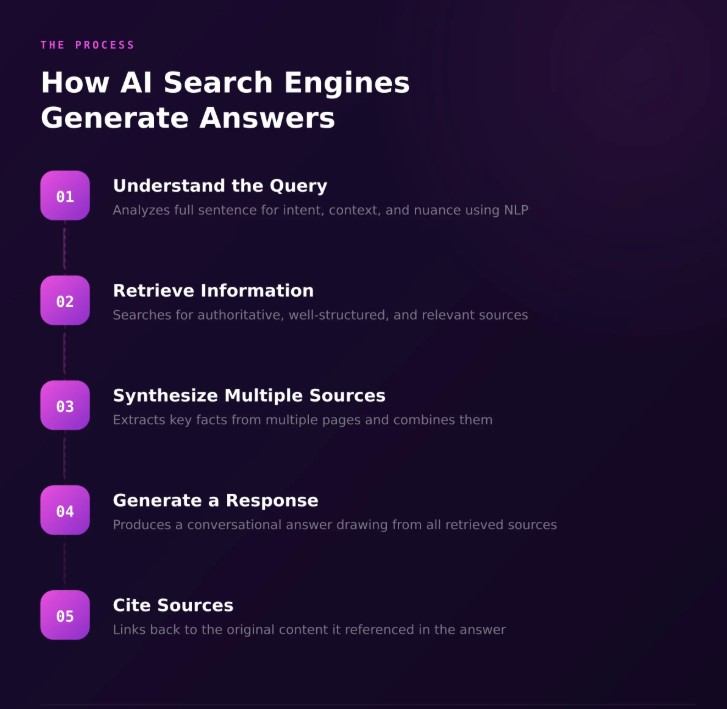
AI search engines follow a multi-step process to produce their responses. Understanding how this works is critical for any business that wants to remain visible in AI-driven search.
Step 1: Understanding the Query
When a user submits a question, the AI doesn't just look at the individual words. It analyzes the full sentence to understand intent, context, and nuance. Natural language processing (NLP) allows the system to distinguish between a question about "Python programming" and "python snakes" based on the surrounding context.
Step 2: Retrieving Information
The AI then searches its index — or in some cases, the live web — for relevant sources. It doesn't just pull the top-ranked pages. It looks for content that is authoritative, well-structured, and directly relevant to the specific question being asked.
Step 3: Synthesizing Multiple Sources
Here's where it gets interesting. The AI reads content from multiple pages, extracts the most relevant facts and explanations, and combines them into a single response. This is fundamentally different from traditional search, which just points you to individual pages and lets you do the synthesis yourself.
Step 4: Generating a Conversational Response
The AI then produces a response written in natural, conversational language. It's not copying and pasting from a single source. It's creating a new piece of text that draws on multiple sources to provide a complete answer.
Step 5: Citing Sources
Most AI answer engines — especially Perplexity and Google's AI Overviews — include citations or links to the sources they used. This is where AI citation optimization becomes important. If your content is well-structured, authoritative, and easy for AI systems to parse, you're more likely to be cited as a source in these responses.
The implication is clear: being on the first page of Google is no longer enough. Your content also needs to be the kind of content that AI systems recognize as trustworthy and choose to cite. For a closer look at how platforms like ChatGPT, Perplexity, and Gemini each handle this process differently, this breakdown of how AI search engines work covers the key differences.
How Does Keyword Search Compare to AI Search?
The differences between keyword search and AI search go deeper than just the user interface. Here's a side-by-side comparison of how the two models differ across key dimensions.
DimensionKeyword SearchAI SearchUser ExperienceList of links; user clicks and reads multiple pagesDirect conversational answer; minimal clicking neededRanking SystemPages ranked by keywords, backlinks, and domain authoritySources selected by relevance, authority, and answer qualityIntent InterpretationBased on keyword matching and query patternsBased on natural language understanding and contextContent ExtractionUsers visit pages and extract information themselvesAI extracts and synthesizes information automaticallyCitation BehaviorOrganic rankings determine visibilityAI selects and cites trusted, well-structured sourcesContent FormatOptimized for crawlers: meta tags, keyword density, headersOptimized for extraction: clear answers, structured data, entity claritySearch Query StyleShort keyword phrases ("best CRM software")Full natural language questions ("What CRM should a 10-person startup use?")
The most important takeaway from this comparison: keyword search vs AI search is not about one being better than the other. Both will coexist for some time. But the share of searches handled by AI is growing, and businesses that only optimize for keywords will gradually lose visibility.
Generative engine optimization — the practice of structuring content so AI systems can easily find, understand, and cite it — is quickly becoming just as important as traditional SEO.
What Does This Shift Mean for Businesses?
The move from keywords to AI-generated answers has real consequences for any business that depends on organic search traffic. If your content doesn't show up in AI responses, you're missing a growing share of your potential audience.
SEO Strategies Need to Evolve
Traditional SEO still matters. Google isn't going away. But businesses that treat SEO as their only discovery channel are increasingly vulnerable. AI search visibility requires a different kind of optimization — one focused on being cited rather than just being ranked. Understanding how AEO differs from traditional SEO is a good starting point for teams rethinking their approach.
Content Marketing Must Change
Content written purely to target keywords and rank on Google won't necessarily perform well in AI search. AI answer engines favor content that provides clear, direct answers, demonstrates expertise, and is structured in ways that make extraction easy. Fluffy 2,000-word articles padded with keywords won't cut it.
Website Visibility Is Fragmenting
In the old model, traffic came from search rankings. In the new model, your content might influence an AI response without the user ever visiting your site. This creates both a challenge and an opportunity. The challenge is attribution — it's harder to track. The opportunity is authority — brands that consistently get cited in AI responses build enormous trust.
Digital Discovery Is Becoming Conversational
Users are increasingly finding businesses through conversational search rather than traditional search. They're asking AI assistants for recommendations, comparisons, and advice. If your business isn't part of those conversations, you're invisible to a growing segment of your market.
Companies that want to stay ahead need a clear playbook for getting their brand into AI-generated responses. This guide on how to rank on ChatGPT, Perplexity, and Gemini walks through the practical steps.
The bottom line: adapting isn't optional. Businesses that wait too long will find themselves losing traffic they can't easily recover.
Which Businesses Are Already Adapting to AI Search?
Early movers are already seeing results from investing in AI search visibility. And it's not just tech companies. Businesses across industries — SaaS, e-commerce, professional services, healthcare, finance — are recognizing that their content strategy needs to account for AI answer engines.
Some companies have started restructuring their content around question-based formats, building topical authority through comprehensive content clusters, and actively monitoring whether their brand appears in AI-generated responses.
A growing number of agencies now specialize in generative engine optimization and AI citation strategies. The market for these services is expanding fast as more businesses realize that traditional SEO alone can't guarantee visibility in AI-driven search.
What early adopters have in common is a willingness to invest in content quality over content volume. They're building fewer, better pages — each designed to be a definitive source that AI systems want to reference. They're also investing in monitoring tools that track whether their brand appears in AI-generated responses across platforms like ChatGPT, Perplexity, and Gemini.
Some businesses are taking it a step further by creating dedicated "answer-first" content hubs — sections of their website designed specifically to provide clear, authoritative answers to the questions their target audience is asking. These hubs serve double duty: they rank well in traditional search and they're structured for easy extraction by AI systems.
The pattern is clear: companies that move early on AI search optimization are building advantages that will be hard for competitors to replicate later. First-mover advantage in AI visibility is real, because the content that AI systems learn to trust early tends to maintain its position as a preferred source.
How Can You Optimize Content for AI-Generated Answers?
Getting your content cited in AI-generated answers requires a different approach than traditional SEO. Here are the strategies that matter most.
Structure Content Around Clear Answers
AI systems look for content that directly answers specific questions. Every major section of your content should begin with a clear, concise answer (40-60 words) before expanding into detail. Think of it as writing for someone who wants the answer first and the explanation second.
Build Semantic Depth
AI search engines don't just match keywords — they understand topics. Building semantic SEO means covering a subject comprehensively, using related terms naturally, and demonstrating that your content understands the full context of a topic, not just one narrow keyword.
Optimize for Entities, Not Just Keywords
Entities are the people, places, products, organizations, and concepts that AI systems use to understand content. Make sure your content clearly identifies and defines the entities it discusses. If you're writing about a specific product, name it, describe it, and explain how it relates to other entities in its category.
Build Topical Authority
AI systems prefer to cite sources that demonstrate deep expertise on a subject. Publishing one article on a topic isn't enough. You need clusters of interrelated content that cover a subject from multiple angles and link together logically.
Earn Trusted Citations
The sources that AI systems trust most are those that other authoritative sources also reference. Getting cited in industry publications, earning backlinks from reputable sites, and being mentioned in expert roundups all increase the likelihood that AI systems will recognize your content as authoritative.
Use Structured Data
Schema markup, FAQ sections, and clear heading hierarchies all help AI systems parse your content more effectively. The easier you make it for an AI to understand what your page is about and what questions it answers, the more likely it is to use your content in its responses.
Write for Extraction
This is the key mindset shift. Traditional SEO is about writing for rankings. AI search optimization is about writing for extraction. Your content should be structured so that an AI system can easily pull out key facts, comparisons, definitions, and recommendations.
What Does the Future of Search Look Like?
The future of search is not a single model. It's a hybrid environment where traditional search engines, AI answer engines, and conversational AI assistants all coexist — and businesses need to be visible across all of them.
AI Assistants Will Become Primary Discovery Tools
Voice assistants, embedded AI features in apps, and standalone AI tools like ChatGPT and Perplexity are becoming the first place many people go to find information. This trend will accelerate as AI improves and becomes more integrated into everyday tools and workflows.
Search Will Become More Conversational
The days of typing three-word keyword queries are fading. Conversational search — where users ask full questions and have back-and-forth exchanges with AI systems — will become the dominant mode. This changes everything about how content needs to be written and structured.
SEO and AEO Will Merge
Right now, SEO and AEO are treated as separate disciplines. But over the next few years, they'll converge. The most effective content strategies will optimize simultaneously for Google rankings and AI citations. Businesses that treat these as siloed efforts will fall behind.
Authority Will Matter More Than Ever
In a world where AI systems choose which sources to cite, authority becomes the single most important ranking factor. Businesses that invest in building genuine expertise, earning trusted citations, and publishing high-quality content will have a massive advantage over those that rely on keyword tricks and volume.
Zero-Click Interactions Will Increase
More and more searches will be resolved without the user clicking through to any website. AI answers will satisfy the query directly. This means businesses need to think about brand presence within AI responses, not just website traffic. Being mentioned and cited in an AI answer is the new equivalent of ranking on page one.
Content Quality Will Be the Ultimate Differentiator
In traditional search, you could sometimes rank with mediocre content if your technical SEO and link profile were strong enough. That won't work in AI search. AI systems are trained to identify and prioritize high-quality, expert-level content. Thin, generic content will be ignored entirely. Businesses that invest in genuinely useful, well-researched content will be rewarded disproportionately.
Multi-Platform Visibility Will Replace Single-Channel Thinking
Businesses used to think about "ranking on Google." Now they need to think about appearing in ChatGPT responses, Perplexity citations, Gemini summaries, voice assistant answers, and traditional search results — all at the same time. This requires a more holistic approach to content strategy that considers how different platforms discover, evaluate, and present information.
The businesses that thrive in this new landscape will be the ones that combine strong SEO fundamentals with a deliberate AEO strategy, backed by high-authority content that AI systems want to reference. The shift is happening now, and the window to get ahead is narrowing.
Frequently Asked Questions
What are AI-generated answers?
AI-generated answers are direct responses produced by artificial intelligence systems that pull information from multiple web sources, synthesize it, and deliver a consolidated answer to the user's question. Instead of showing a list of links, AI answer engines provide a single, conversational response.
How do AI search engines differ from Google?
Traditional search engines like Google return ranked lists of web pages based on keywords and backlinks. AI search engines understand the user's intent through natural language processing and generate a direct answer by combining information from multiple sources.
What is generative search?
Generative search is the process by which AI systems create new text-based answers by reading and synthesizing content from across the web. Rather than retrieving a single page, the AI generates an original response that draws on multiple sources.
Why are keywords becoming less important?
Keywords are becoming less important because AI search engines understand natural language and user intent, not just word patterns. Users now ask full questions, and AI systems evaluate content based on relevance, authority, and answer quality rather than keyword density.
What is Answer Engine Optimization (AEO)?
AEO is the practice of optimizing content so it gets cited and referenced by AI answer engines like ChatGPT, Perplexity, and Gemini. It focuses on content structure, authority signals, and clear answer formatting rather than traditional keyword targeting.
How can businesses get cited in AI answers?
Businesses can increase their chances of being cited by structuring content around clear answers, building topical authority, using schema markup, earning backlinks from trusted sources, and writing content that AI systems can easily parse and extract from.
Will SEO become obsolete?
No. SEO will remain important because traditional search engines aren't disappearing. But SEO alone won't be enough. Businesses will need to combine SEO with AEO strategies to maintain visibility across both traditional and AI-powered search environments.
What types of content perform best in AI search?
Content that includes direct answers to specific questions, comprehensive coverage of topics, clear structure with headings and lists, and authoritative citations performs best. AI systems favor content that demonstrates expertise and is easy to extract information from.
How do AI answer engines decide which sources to cite?
AI answer engines evaluate sources based on authority, relevance, content structure, and trust signals. Pages that are frequently cited by other authoritative sources, provide clear and accurate answers, and use structured data are more likely to be selected.
Is it too late to start optimizing for AI search?
No. AI search is still in its early stages, and most businesses haven't adapted yet. Companies that start optimizing now have an opportunity to establish authority and visibility before the market gets crowded. The best time to start was a year ago. The second best time is today.
Will Abraham
Will Abraham spent five years building one of the largest PPC and SEO agencies serving real estate investors. After ChatGPT's launch in 2022, he saw the shift from traditional search to AI-driven answers coming and built Visibella to help brands become the answer AI gives, not the link buried underneath it. He stays close to active AEO researchers and the teams shaping how AI search works.