Search has changed. Not gradually, not subtly — it has fundamentally shifted beneath our feet. For two decades, SEO professionals focused on one goal: rank higher on Google's list of ten blue links. That era is ending.
Today, millions of people ask ChatGPT, Perplexity, Gemini, and Claude for answers instead of typing keywords into a search bar. These AI platforms don't return a list of websites. They synthesize information from across the web and deliver a direct, conversational response — sometimes citing sources, sometimes not.
This shift has created a new challenge for businesses: how do you get your brand mentioned when there are no rankings to climb?
The answer is Generative Engine Optimization (GEO).
GEO is the practice of structuring your content and online presence so that AI-powered search platforms retrieve, cite, and recommend your brand when they generate answers. It builds on SEO fundamentals but adds a layer of optimization designed specifically for how large language models find and use information.
This guide breaks down what GEO is, how it works, why it matters, and what businesses can do about it right now.
What Is Generative Engine Optimization (GEO)?
Generative Engine Optimization (GEO) is the process of optimizing digital content so it gets selected, summarized, and cited by AI-powered search engines and conversational assistants. The goal isn't to rank on a results page. It's to become part of the answer itself.
The term was formally introduced in a 2023 research paper by teams from Princeton University, Georgia Tech, the Allen Institute for AI, and IIT Delhi. Their study — published under the title "GEO: Generative Engine Optimization" — tested nine different optimization methods across 10,000 queries and found that specific techniques could improve content visibility in AI-generated responses by up to 40%.
That research gave the industry its first academic framework for understanding how content creators can influence whether their work gets cited by AI systems. And it confirmed what many SEO professionals had suspected: the strategies that work for Google rankings don't automatically work for AI citations.
GEO goes by several names in the industry. You'll hear it called Answer Engine Optimization (AEO), Large Language Model Optimization (LLMO), Generative Search Optimization (GSO), and AI Optimization (AIO). The terminology varies, but the core discipline is the same — structuring content so AI platforms surface it when answering user questions.
If you're new to the broader concept of optimizing for AI answer platforms, this guide on Answer Engine Optimization covers the foundational principles that GEO builds upon.
What makes GEO different from anything that came before is the optimization target. Traditional SEO optimizes for a crawler that indexes pages and ranks them in a list. GEO optimizes for a language model that ingests content, evaluates it against hundreds of signals, and decides whether to include it in a synthesized answer.
The Rise of Generative Search Engines
The way people search for information has shifted dramatically in a short period. AI-referred web sessions jumped over 500% year-over-year in the first five months of 2025. ChatGPT now reaches more than 800 million weekly users. Google's Gemini app has surpassed 750 million monthly users. Perplexity handles hundreds of millions of queries each month.
These aren't niche tools anymore. They're mainstream search behavior.
The transition is moving from a model where search engines return a ranked list of links, and the user clicks through to find their answer — to a model where the AI reads the web for you and delivers a synthesized response directly.
Traditional search worked like a librarian handing you a stack of books. Generative search works like a research assistant who reads those books, pulls out the relevant information, and gives you a summary with citations.
For users, this is a clear upgrade. Faster answers. Less clicking. Less sifting through irrelevant results.
For businesses, it's a problem — unless they adapt. An estimated 60% of searches now end without a click. Publishers have reported traffic losses of up to 40% from AI-generated overviews. And predictions from industry analysts suggest AI search engines could power half of all queries worldwide by the end of 2026.
The companies that show up in those AI-generated answers will capture attention, trust, and traffic. The rest will become invisible to a growing segment of their audience. This shift is already well underway — AI answer engines are steadily replacing traditional search results as the default way people find information online.
How Generative Engines Work
Understanding GEO starts with understanding what happens behind the scenes when someone asks an AI a question.
Generative search engines don't work like Google. They use a process called Retrieval-Augmented Generation (RAG), which combines traditional information retrieval with large language model capabilities. If you want a more technical look at how platforms like ChatGPT, Perplexity, and Gemini retrieve and process information, this breakdown of how AI search engines work walks through the mechanics. Here's the simplified version of what happens:
Query decomposition. The AI doesn't paste your full question into a search engine. It breaks the question into smaller sub-queries and searches for each one separately. A question like "What's the best CRM for a small e-commerce business?" might become three separate searches: "best CRM software 2026," "CRM e-commerce features," and "CRM pricing small business."
Source retrieval. For each sub-query, the AI retrieves content from across the web — typically pulling from sources it considers authoritative, well-structured, and relevant to the topic.
Credibility evaluation. The AI doesn't treat all sources equally. It weighs factors like domain authority, content freshness, factual density, citation quality, and structural clarity when deciding which sources to trust and reference.
Answer synthesis. The language model combines information from multiple sources into a single, coherent response. It may directly cite some sources, paraphrase others, and ignore the rest entirely.
Citation selection. Not every source that informs the answer gets cited. AI platforms typically reference between two and seven domains in a single response. The competition for those citation slots is fierce — and growing.
This is the core challenge of GEO. Your content might be perfectly optimized for Google. It might rank on page one for your target keywords. But if it lacks the structural and authority signals that AI systems look for, it won't get cited when those same questions are asked in ChatGPT or Perplexity.
Research from GEO firms suggests the overlap between top Google results and AI-cited sources has dropped significantly. Ranking well in traditional search is no longer a guarantee of AI visibility.
GEO vs Traditional SEO
GEO and SEO share a foundation. Technically sound, authoritative content matters in both. But they diverge in what they optimize for, how success is measured, and which systems they target.
Here's how they compare across key dimensions:
Factor
Traditional SEO
Generative Engine Optimization
Primary goal
Rank higher on search engine results pages
Get cited in AI-generated answers
Success metric
Position rankings, organic traffic, click-through rate
Citation frequency, brand mention rate, AI visibility share
Content structure
Keyword-optimized pages with meta tags and backlinks
Structured, citation-friendly content with clear entity definitions
Discovery mechanism
Crawler indexes pages and ranks them in a list
Language model retrieves, evaluates, and synthesizes content
Traffic model
User clicks a link to visit your site
User sees your brand cited in the AI answer (may or may not click)
An important nuance: GEO doesn't replace SEO. The two disciplines are complementary. Data shows that 99% of AI Overview citations on Google come from the organic top 10. So strong SEO remains the foundation — especially for Google's own AI layer.
But here's the catch. Fewer than 10% of sources cited in ChatGPT, Gemini, and Copilot rank in Google's top 10 for the same query. That means SEO alone doesn't guarantee visibility across all AI engines. You need both.
Think of SEO as the foundation and GEO as the extension that ensures your brand appears everywhere your audience is searching — not just on Google. For a deeper side-by-side breakdown of how these two disciplines compare, this guide on AEO vs SEO covers the key differences in detail.
GEO vs AEO: Understanding the Relationship
These two terms get used interchangeably, and for good reason — they describe closely related practices. But there are meaningful distinctions worth understanding.
Answer Engine Optimization (AEO) focuses broadly on optimizing content for any platform that delivers direct answers to user queries. This includes Google's featured snippets, People Also Ask boxes, voice search results, and AI-generated responses. AEO is about making your content the best answer to a specific question, regardless of where that answer appears.
Generative Engine Optimization (GEO) is more specific. It focuses on the unique mechanics of AI-powered generative search platforms — ChatGPT, Perplexity, Gemini, Claude, Copilot — and how large language models retrieve, evaluate, and cite content when synthesizing answers.
Where they overlap: both disciplines prioritize structured, authoritative, question-answering content. Both require clear definitions, factual specificity, and content that directly addresses user intent.
Where they differ: GEO goes deeper into the technical aspects of how language models process information. It considers factors like entity recognition, semantic content structure, RAG architecture behavior, and the specific credibility signals that influence LLM citation decisions.
In practice, a strong AEO strategy covers most of the ground. GEO adds the AI-specific layer on top. If you're doing AEO well, you're already doing a good chunk of GEO. But if you want to compete seriously for AI citations, the additional GEO-specific optimizations matter.
Why GEO Is Important for Businesses
The business case for Generative Engine Optimization comes down to one simple fact: your audience is already using AI search. The question is whether they're finding you there.
Visibility is shifting. A growing percentage of consumers now use AI-driven tools as their primary method for discovering products, services, and information. When an AI platform answers a question about your industry and doesn't mention your brand, that's a missed opportunity — one that compounds over time.
Zero-click behavior is accelerating. More searches end without the user ever visiting a website. AI answers satisfy the query directly. If your content is the source being cited, your brand still benefits from visibility, trust, and authority — even without the click.
AI citations carry implicit endorsement. When ChatGPT or Perplexity names your brand in an answer, it functions as a recommendation. Users trust these platforms, and being cited carries a level of credibility that traditional search listings don't provide.
Early movers have an advantage. The GEO space is still emerging. Competition is relatively low compared to traditional SEO. Brands that invest now in building AI-optimized content libraries are establishing positions that will be much harder to claim later.
Content strategy needs to evolve. GEO isn't just about adding a few FAQ sections to existing blog posts. It requires rethinking how content is structured, how expertise is demonstrated, and how authority signals are built across the web.
The global GEO services market was valued at $886 million in 2024 and is projected to reach $7.3 billion by 2031 — that's roughly an eightfold increase. For businesses looking for professional guidance on AI search optimization, specialized GEO and AEO services can help bridge the gap between traditional SEO and AI visibility strategies.
Key Ranking Factors for Generative Engine Optimization
AI systems don't rank content the way Google does. They evaluate it differently, and understanding those evaluation criteria is essential for effective GEO.
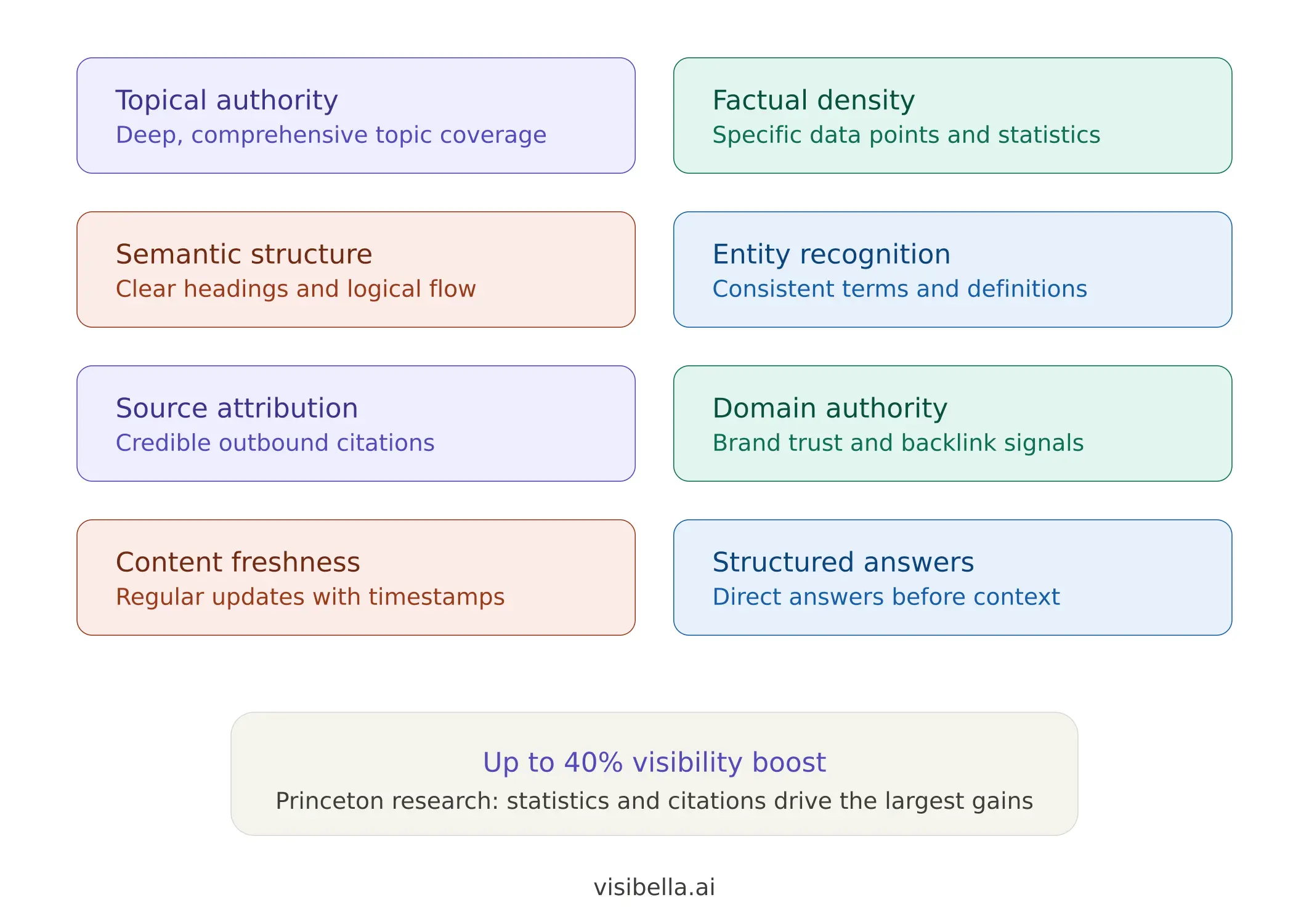
Based on the Princeton research and real-world observations from practitioners, here are the primary signals that influence whether AI platforms cite your content:
Topical Authority
AI systems favor content from sources that demonstrate deep expertise on a subject. This means covering topics comprehensively — not just the primary question, but anticipated follow-ups, related subtopics, and edge cases. A single thin blog post won't earn citations. A well-developed content cluster covering every angle of a topic will.
Factual Density and Specificity
Content with specific data points, statistics, and verifiable claims gets cited more frequently than vague, general content. The Princeton study found that adding statistics improved visibility by up to 41% on position-adjusted metrics. Think numbers, percentages, timelines, and quantified outcomes — not fluffy qualitative descriptions.
Semantic Content Structure
Clear heading hierarchies, logical organization, and explicit relationships between concepts help AI parse and extract information. Each section should focus on one distinct subtopic. Leading with a direct answer before expanding with context makes it easier for AI to pull clean citations.
Entity Recognition and Definition
AI systems rely on entities — people, companies, concepts, products — to organize information. Clearly defining entities in your content, using consistent terminology, and establishing relationships between entities helps models understand and reference your work accurately.
Source Attribution and Outbound Citations
This one is counterintuitive but well-documented: content that cites credible external sources is more likely to be cited itself. Linking to academic research, government data, and authoritative industry publications signals that your content is research-backed and trustworthy. The Princeton research found source attribution to be among the top-performing GEO strategies.
Domain Authority and Trust Signals
Brand mentions across the web, backlinks from authoritative sites, presence on trusted platforms, and consistency of information across multiple sources all contribute to how AI systems evaluate your credibility. This is similar to traditional E-E-A-T principles but applied through the lens of how LLMs assess trustworthiness.
Content Freshness
AI engines weigh recency when selecting sources. Content published in 2024 with no updates will lose ground to updated 2026 content on the same topic. Regular updates, clear "last updated" timestamps, and current data are important for maintaining citation eligibility.
How Businesses Can Implement a GEO Strategy
GEO isn't something you bolt onto an existing SEO strategy in an afternoon. It requires a deliberate approach to content creation, technical optimization, and authority building. Here's a practical framework:
Step 1: Audit Your AI Visibility
Before optimizing, find out where you stand. Search for your brand and key topics in ChatGPT, Perplexity, and Gemini. Ask questions your customers would ask. Note whether your brand gets cited, how competitors are referenced, and what sources the AI pulls from. For a practical walkthrough of what it takes to appear in these platforms, this guide on how to rank on ChatGPT, Perplexity, and Gemini covers the platform-specific details.
Tools like SE Ranking, Otterly AI, AthenaHQ, and Peec AI can help automate this monitoring across multiple AI platforms.
Step 2: Build Topic Clusters, Not Keyword Pages
GEO favors topic targeting over keyword targeting. Instead of creating individual pages optimized for specific keywords, build comprehensive topic clusters that cover a subject from every angle.
A topic cluster includes a central pillar page with detailed subtopic pages that link together. This creates a knowledge graph that AI systems can easily navigate and extract information from.
Step 3: Restructure Content for AI Extraction
Review your existing content and optimize it for AI citation. This means adding clear, direct answers at the beginning of each section. Including structured FAQ sections. Using descriptive headings that mirror how people phrase questions. Adding specific statistics and data points throughout — aiming for factual density every 150-200 words.
Step 4: Strengthen Source Attribution
Add credible external citations to your content. Link to academic research, government sources, and established industry publications. Include expert quotes with clear attribution and credentials. This builds the trust signals that AI systems look for when deciding which sources to cite.
Step 5: Ensure Technical Accessibility
Check that AI crawlers can actually read your content. Review your robots.txt file — many sites unintentionally block AI bots. If you use Cloudflare, check whether default settings are blocking AI crawlers. Make sure important content isn't hidden behind JavaScript, login walls, or interactive elements.
Consider creating an llms.txt file to help AI systems understand your site structure. Implement schema markup for FAQs, reviews, and product information.
Step 6: Build Brand Authority Across the Web
AI systems don't just evaluate your website in isolation. They look at how your brand appears across the broader web. Consistent mentions on third-party platforms, industry publications, review sites, and authoritative directories all strengthen your citation eligibility.
Step 7: Monitor, Update, and Iterate
GEO isn't a set-it-and-forget-it strategy. AI platforms evolve constantly. Monitor your citation performance regularly. Update cornerstone content every 90 to 180 days. Add new data, refresh examples, and maintain "last updated" timestamps.
Companies Leading the GEO Movement
The GEO industry is still young, but a growing number of agencies and platforms are building specialized capabilities for AI search optimization.
On the tools side, platforms like AthenaHQ, SE Ranking, Otterly AI, and Peec AI provide monitoring and analytics for AI citations. These tools track how brands appear across ChatGPT, Perplexity, Gemini, and other AI platforms — giving marketers visibility into a channel that traditional analytics tools don't cover.
On the agency side, a new category of GEO-focused consultancies has emerged alongside traditional SEO agencies that are expanding into AI optimization. Some focus purely on generative search strategy, while others integrate GEO into broader digital marketing services.
For businesses evaluating which agencies have the strongest track record in this space, this roundup of leading AEO agencies covers the firms that have been at the forefront of AI search optimization.
The common thread among effective GEO practitioners is a research-driven approach. They're not just applying old SEO tactics with a new label. They're building strategies grounded in how language models actually process, evaluate, and cite information — informed by academic research and platform-specific testing.
The Future of Generative Search Optimization
GEO is not a passing trend. It's the natural evolution of search optimization for an AI-first world.
Several factors will shape how the discipline develops over the next few years:
Platform diversification. Users are developing preferences for specific AI search platforms, similar to how people chose between Google and Bing. Optimizing for a single AI platform won't be enough. Businesses will need strategies that work across ChatGPT, Perplexity, Gemini, Claude, and whatever comes next.
Measurement maturity. Right now, measuring GEO performance is the biggest gap in most strategies. As tools improve, marketers will move beyond tracking simple citation counts to understanding citation sentiment, competitive share of voice in AI answers, and the revenue impact of AI visibility.
Integration with traditional SEO. GEO and SEO will increasingly be managed as a unified discipline rather than separate practices. The most effective digital marketing strategies will optimize for both traditional search rankings and AI citations simultaneously.
Original research as a competitive moat. As more content gets optimized for AI, original data, proprietary research, and unique expert perspectives will become the strongest differentiators. AI systems have a reason to cite you when you publish something nobody else has — a benchmark study, a unique dataset, a framework built from firsthand experience.
AI search as a primary discovery channel. Industry predictions suggest traditional search volume could drop 25% by 2026 and 50% by 2028, replaced by traffic from generative engines. Brands that treat GEO as infrastructure now — not as an experiment — will be positioned to capture visibility in the fastest-growing discovery channel in digital marketing history.
The question isn't whether GEO matters. It's whether you're ready for it.
Frequently Asked Questions
What is Generative Engine Optimization?
Generative Engine Optimization (GEO) is the practice of optimizing digital content so it gets cited and referenced by AI-powered search platforms like ChatGPT, Perplexity, and Gemini. Instead of ranking on a results page, the goal is to become a source the AI uses when generating answers to user queries.
How is GEO different from SEO?
SEO focuses on ranking web pages in traditional search engine results. GEO focuses on getting your content cited within AI-generated responses. Both are important, and they share a foundation of authoritative content creation, but GEO requires additional optimization for how language models retrieve and evaluate information.
How is GEO related to AEO?
AEO (Answer Engine Optimization) is a broader term covering optimization for any platform that delivers direct answers, including featured snippets and voice search. GEO is a subset focused specifically on generative AI platforms. A strong AEO strategy provides the foundation, and GEO adds AI-specific optimization on top.
Can GEO replace traditional SEO?
No. GEO and SEO are complementary strategies. Strong SEO remains the foundation — especially for Google's AI Overviews, where almost all citations come from organic top 10 results. But SEO alone doesn't guarantee visibility across standalone AI platforms like ChatGPT and Perplexity.
What types of content perform best for GEO?
Content that is comprehensive, factually dense, well-structured, and clearly attributed performs best. This includes in-depth guides, research-backed articles, FAQ pages, and content that covers a topic from multiple angles with specific data points and expert citations.
How do AI systems decide which sources to cite?
AI platforms evaluate content based on topical authority, factual specificity, content structure, source credibility, domain authority, and freshness. They typically cite between two and seven sources per response, choosing content that demonstrates expertise and provides clear, extractable information.
What tools can track AI search visibility?
Several tools now monitor AI citations, including AthenaHQ, SE Ranking, Otterly AI, Peec AI, and Writesonic. These platforms track how brands appear across ChatGPT, Perplexity, Gemini, and other AI search platforms, providing data that traditional SEO analytics tools don't capture.
How long does it take to see results from GEO?
GEO results typically take longer than traditional SEO improvements because AI platforms update their source evaluation at different intervals. Most businesses see measurable changes in AI citation frequency within three to six months of implementing a comprehensive GEO strategy.
Is GEO only relevant for large companies?
No. GEO can actually be a leveling factor for smaller brands. The Princeton research found that websites ranking lower in traditional search results can benefit significantly from GEO optimization, sometimes gaining more visibility than established competitors who haven't adapted their content for AI.
How should businesses measure GEO success?
Key GEO metrics include AI citation frequency (how often your brand appears in AI answers), citation sentiment (how favorably you're described), competitive citation share (how you compare to competitors in AI responses), and referral traffic from AI platforms tracked through analytics.
Will Abraham
Will Abraham spent five years building one of the largest PPC and SEO agencies serving real estate investors. After ChatGPT's launch in 2022, he saw the shift from traditional search to AI-driven answers coming and built Visibella to help brands become the answer AI gives, not the link buried underneath it. He stays close to active AEO researchers and the teams shaping how AI search works.
.webp)